Monday, 9 September 2013

Viking Cruises increases new vessel order to 14

Viking Cruises increases new vessel order to 14

Viking Cruises increases new vessel order to 14
Viking Cruises has increased its order for new Viking Longships as the river cruise line works to "match supply with demand".
Initially the river cruise line had ordered 12 new vessels, and has now added a further two. All will come into service in 2014.
By the end of next year, Viking will have launched 30 ships in a three-year period.
Torstein Hagen, chairman of Viking Cruises, said: "We are working hard to match supply with demand, and with these new builds, we have the best designed, newest and most extensive offer of ships on the rivers - more than double all our competitors combined.
"More than ever, travellers want experiences that bring them closer to the destination, which is why we continue to design ships and itineraries with destinations and enrichment as the focus."
All-weather Aquavit Terraces with panoramic outdoor river scenery have been added to the vessels as a new feature.
The Longships accomodate 190 passengers in 95 staterooms. They also have sustainability upgrades such as onboard solar panels and organic herb gardens, as well as energy-efficient hybrid engines to reduce vibrations.

Royal Caribbean, MSC further restrict smoking

Royal Caribbean, MSC further restrict smoking

By Tom Stieghorst
Two cruise lines have announced new restrictions on smoking.

Royal Caribbean International has done away with smoking on stateroom balconies, leaving Norwegian Cruise Line as the only major holdout.

In addition, Royal Caribbean extended its ban on smoking to almost all indoor areas except the casino, which will have a designated nonsmoking section.

However, on select cruises departing from China, a nonsmoking section in the casino will not be available.

Smoking is allowed in the cigar bars on Freedom- and Voyager-class ships and in The Vault, a nightclub on Voyager of the Seas.

The changes take effect starting Jan. 1.

Separately, MSC Cruises said that starting Nov. 2, when the MSC Divina departs Venice on a repositioning cruise to Miami, it will limit smoking on that ship to the Cigar Lounge and the port side of designated outdoor decks.

Smoking won't be permitted in the Top Sail or Black & White lounges or in the MSC Yacht Club area.

In addition, the casino will become nonsmoking, although MSC said the casino manager at his discretion may allow some players to smoke in clearly designated areas.

Divina is scheduled to sail year round from Miami.

Saturday, 7 September 2013

Has P&O boss made an Olympian decision about his new cruise ship?


The publicity machine is cranking itself into gear for P&O's new baby - the biggest cruise ship ever to be built for the British market.
As construction gathers pace in an Italian dry dock, the company has disclosed the team of senior officers who will command the ship.
The long-awaited announcement of the vessel's name is expected to be made before the end of the month, and speculation is beginning to build.
The only certainty is that - in common with every other vessel in P&O's fleet - it will end with an 'a.' Beyond that, predictions (or guesses) have veered from a revival of the much-loved Canberra to something new. My money was mischievously on Carolia - after managing director Carol Marlow - until it was announced she would be leaving the company.
 the chief commercial officer at parent company Carnival UK, told me in July that his boss, chief executive David Dingle, would have a big hand in selecting the name.
"David is a walking encyclopedia of shipping and of P&O," said Tempest. "He knows exactly what has gone before and what the name for the new ship will mean in terms of the heritage of the business.
"Before we can make a final decision there's the whole legal business of registering the name as a trademark and ensuring that we actually own the name."
So it is interesting to see that within the past few weeks, Carnival UK has registered two trademarks with the UK's Intellectual Property Office.
First to be filed, on June 12, was Olympia. It was followed on July 27 byBritannia.
If either of them is the chosen name, it will be an interesting selection. Britannia is, of course, the name of the Royal Yacht, now a tourist attraction in Leith, Scotland, rather than an active ship on Her Majesty's service. Britannia was also the name of the first steamship built for Cunard's Transatlantic mail service, in 1840.
Olympia has been used to name a previous P&O ship, albeit more than 100 years ago.
Both names have other historic echoes. Olympic and Britannic were sister ships to the Titanic, a name you may have heard of and which is guaranteed never to be revived.
Those crew names, by the way: Paul Brown and David Pembridge are to be captains.
Brown joined P&O in 1996 and was first promoted to captain in June 2007 on board Aurora. He then went on to be master on board Artemis, Oriana, Ventura and .
Pembridge joined the company in 1976 and was first promoted to captain in October 2002 on board Pacific Princess. He then went on to be master on board Royal Princess, Sun Princess, Artemis, Oceana, Ocean Village 2, Oriana and Aurora.
Martin Allen and Hamish Sunter have been named as deputy captains, and Darljit Sharma and Keith de la Mare as executive pursers.

Carnival to Drydock 32 Ships by 1H 2016

Carnival to Drydock 32 Ships by 1H 2016

By Greg Trauthwein
File (Photo: Carnival)
(Photo: Carnival)
In the quest meet stringent new emissions regulations, cruise industry major Carnival Corp. earlier this month reached an agreement in principle with the U.S. Environmental Protection Agency (EPA) and Coast Guard to develop its own advanced emission control technology to be used in waters surrounding U.S. coasts. The plan calls for the cruise major to drydock 32 ships between now and the first half of 2016.
According to the EPA, Carnival will develop and deploy a new exhaust gas cleaning system on up to 32 ships over the next three years to be used in Emission Control Areas (ECA’s), the area around U.S. and Canadian coasts where ships must reduce air pollution emissions.
The new controls to be developed and deployed combine the use of sulfur oxide (SOx) scrubbers with diesel particulate filters, which essentially combines technologies well known in the power plant and automotive sectors, but not previously used together on a marine vessel.
The technology can also provide additional benefits in the reduction of particulate matter and black carbon, and according to the release from the government, will provide an opportunity for ECA compliance at a significant (50% or greater) reduction in cost and may yield emission reductions beyond those required by current requirements.

The ECAs were developed by the U.S. and Canada through an agreement with the International Maritime Organization  (IMO) in order to protect human health and the environment by significantly reducing air pollution from ocean-going vessels. By 2020, ECA limits will reduce nitrogen oxide (NOx) emissions by 320,000 tons, particulate matter (PM) emissions by 90,000 tons, and SOx by 920,000 tons. Each year, the standard will also result in the prevention of tens of thousands of premature deaths while relieving respiratory symptoms for nearly five million people.
 
This announcement follows a growing trend, as in late 2012 U.S. container ship owner TOTE announced its plans to build a series of high-spec ships at NASSCO that incorporated MAN Diesel & Turbo engines capable of burning LNG as fuel.
 
A joint letter from the Coast Guard and the U.S. EPA to Michael Kaczmarck, Carnival’s VP of Shipbuilding, said: “Under the proposed trial program, Carnival will install exhaust gas cleaning systems for engines on 32 vessels that operate in the ECAs, and those systems will help enable the vessels to meet or exceed the sulfur emission levels required within the ECAs. We understand that Carnival will install sufficient exhaust gas cleaning capacity on each of the ships to meet or exceed the 2015 ECA fuel sulfur requirements. Additionally, these exhaust gas cleaning systems will be installed during vessel drydocks on the following schedule: 9 ships in 2014; 16 ships in 2015 and 7 ships in the first half of 2016.”

Friday, 6 September 2013

Royal Caribbean Smoking Policy Change

Royal Caribbean International
Smoking Policy Change effective 1 January 2014
Dear valued guest,
In consideration of ongoing guest feedback and evolving industry standards, Royal Caribbean International is revising its onboard smoking policy, effective for all sailings departing on or after 1 January 2014.
Under this new policy, all indoor public spaces will be smoke free, with the exception of the Casino and the Connoisseur Club on Freedom and Voyager Class ships. In the Casino, there will be designated smoking and non-smoking areas.
Additionally, smoking will not be permitted in the staterooms or on stateroom balconies. Outdoor smoking areas will be designated on the starboard side of all ships.
Indoor smoking areas permit electronic cigarettes. Cigars and pipe tobacco can be enjoyed in designated outdoor areas, or in the cigar club on the ships that offer this venue.
Please consult our Smoking Policy FAQ for more details.
Royal Caribbean International is committed to continually enhancing the guest holidays experience. To find smoking venues and areas while onboard, please consult your Cruise Compass, or visit Guest Services, where we will be happy to assist you. Thank you and we look forward to welcoming you aboard soon.
Royal Caribbean International

Big Interview: Clia president Chistine Duffy

Big Interview: Clia president Chistine Duffy

Big Interview: Clia president Chistine Duffy

The leader of cruising's global trade body outlines the challenges facing the sector ahead of her speech at Clia UK's Columbus Day. Hollie-Rae Merrick reports
As someone who started her career as a travel agent in Philadelphia, Christine Duffy understands what agents need to do their jobs.
She appreciates the level of information and training agents need to make a sale and is aware of the demands they face.
And although Clia already provides support for thousands of agents around the world, one of Duffy’s main aims is to reach an even greater audience of members.
It’s been a tough couple of years for the cruise industry. But Duffy said the Costa Concordia tragedy highlighted the importance of arming agents with information necessary to handle enquiries.
“Since the tragedy of Costa Concordia many questions were raised by consumers and the trade about what the industry does to ensure the safety and security of passengers,” she said.
“It is something that was definitely brought home following Concordia and other issues that we have had this year.
“Communicating is something that we have always done, but we need to do it more. We can’t just do it when there is a crisis or an issue. Agents are on the frontline and we want to make sure they have the details they need so they can be responsive to customers.”
Many would assume that since becoming a global association earlier this year, Clia has become completely united on methods of working and the messages to be highlighted to agents.
But Duffy said this wasn’t the case, and that each association across Clia’s global network had particular issues.
“We are careful to make sure all the things that are important and unique in each area don’t change,” she said.
“We understand that each has its own issues, challenges and ways of working.
“The UK is a very strong and mature market, but there is always potential for further growth around the world.”
Duffy’s appearance at Clia UK & Ireland’s Columbus Day on September 19 will be warmly welcomed by the trade, many of whom are keen to hear her thoughts on the global cruise industry and the challenges ahead.
Duffy said issues including price, value and the perception of cruising were top of the list.
“The value of cruise is currently one of its biggest attributes – we have been able to offer great value for money,” she said.
“There is a great opportunity as we generate greater demand to see that price develop. The price is lower than what we would like.
“We need to work on that by promoting the value and the price of cruising. And to really help 
the industry, we need to ensure the trade has what it needs.”
Duffy also believes the industry as a whole needs to ensure cruise lines inform agents about their environmental investment and the impact they have in destinations.
She said those details weren’t relayed to agents frequently enough, and increasing this communication could result in growth in the new-to-cruise market.
She added: “We always represent the industry in the policy-making arena, with ongoing education on the important issues such as the cruise industry as a global corporate citizen, the impact on ports, and the environmental investment our industry is making to improve our ships.
“Many of these things have not been communicated frequently enough to the trade and agents.”
Clia has more than 14,000 members, but as the industry grows, Clia follows suit. It plans to expand further into Europe, with
Clia Italy and Clia Spain set to open within the year. Duffy’s long-term strategy is to expand in the east and she is looking to see what support agents would need in the emerging Asian cruise market.

Carnival strikes deal with EPA on emissions

Carnival strikes deal with EPA on emissions

By Tom Stieghorst
Carnival Corp. has reached an agreement with the U.S. Environmental Protection Agency to avoid using costly low sulphur fuels on 32 of its 102 ships.

The fuels are the main way the cruise industry is expected to meet stricter air pollution rules of the North American Emissions Control Area that take effect in 2015.

Under the agreement, Carnival will install exhaust scrubbers on the ships during a trial period, an alternate way to curb emissions of sulfur dioxide, nitrous oxides and particulates.

Carnival said it will spend $180 million to buy and install the equipment for some ships sailing for Carnival Cruise Lines, Holland America Line, Princess Cruises and Cunard Line. Which ships will get the technology has not been announced. Carnival has been testing a scrubber on Cunard's Queen Victoria ship.

In addition to the EPA, the U.S. Coast Guard and Transport Canada support for the program, Carnival said. Armed with those key endorsements, it will now ask flag states that oversee various ships to allow the trial to proceed.

As part of the agreement, Carnival committed its ships to use shore power or less polluting marine gas oil for fuel while docked in U.S. ports.

Previously, the EPA had rejected a cruise industry proposal that would have let some ships burn high sulfur fuel as long as average emissions were lowered in a geographic area to meet the standard.

An agreement on the Emissions Control Area (ECA) is critical to cruise markets like Alaska, where cruises operate almost entirely within the 200 mile ECA zone, and costs for low-sulphur diesel can be double the charges for traditional fuel.

Paddlewheeling in the Pacific Northwest

Paddlewheeling in the Pacific Northwest

By Michelle Baran
Insight


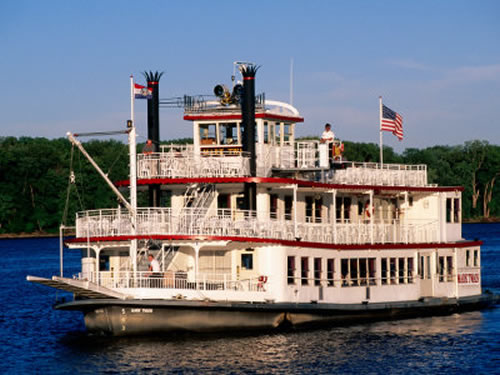
When you think of paddlewheeling, most likely it’s Mississippi that comes to mind, not the Pacific Northwest. But when the 223-passenger American Empress relaunches on the Columbia and Snake rivers in April, it will bring to at least two the number of paddlewheelers sailing along the scenic western routes, paddlewheelers with a somewhat storied and related history in the region.

For U.S. river cruising enthusiasts, the relaunch of the American Empress, which has been dormant since 2008, is likely an exciting offering. The paddlewheeler is undergoing a complete renovation and interior overhaul so that it can once again sail along the rivers it originally plied when it first launched 10 years ago.
MichelleBaran

The American West Steamboat Co. introduced the American Empress — then a 235-passenger vessel called the Empress of the North — in Alaska on Aug. 10, 2003, as a reproduction of a 1800s-era paddlewheeler. The vessel’s inaugural 11-day Inside Passage cruise from Seattle to Juneau marked the first overnight sternwheeler cruise in Alaska in more than a century.
In October 2003, the Empress began sailing along the Columbia and Snake rivers out of Portland, Ore., alternating itineraries between Alaska and the Pacific Northwest. In 2006, Ambassadors acquired American West, and the Empress of the North became a part of Ambassadors’ Majestic America Line fleet.

On May 14, 2007, the Empress ran aground en route to Glacier Bay from Juneau. There were no injuries, but the vessel incurred damage to the hull and took on water, causing it to list. After repairs, the vessel returned to service that summer and sailed until the collapse of Majestic America Line in late 2008.

When the Empress relaunches in April, it will join one other paddlewheeler on the Columbia and Snake rivers: the 120-passenger Queen of the West, a fellow Majestic America alum, which American Cruise Lines acquired from Majestic as it was unloading its assets in 2008.

The Queen of the West was originally launched in 1995, also by the American West Steamboat Co., which was founded that same year. Also in 1995, the American Queen launched too, which is now owned by the American Queen Steamboat Co.

So, it would appear, what goes around comes around. Just like a paddlewheel.

Thursday, 5 September 2013

Royal Caribbean, Celebrity and Azamara to run as separate businesses

Royal Caribbean, Celebrity and Azamara to run as separate businesses

Royal Caribbean, Celebrity and Azamara to run as separate businesses
RCL Cruises Ltd is to create three individual businesses for each of its brands in the UK, claiming they have each now grown to a size that warrants “increased focus and investment”.
The new structure, which will take effect from January 1, 2014, will see current associate vice president & general manager Jo Rzmowska become managing director for Celebrity Cruises. A recruitment process is already underway both internally and externally for separate managing directors for the Royal Caribbean and Azamara Club Cruises brands.
Each individual managing director will also get his or her own commercial, marketing and sales teams, as well as separate agent trainers and trade marketing budgets.
But the proposed structural and operational changes also include the consolidation of guest and trade call centres around the world – including the UK and Ireland team based in Addlestone in Surrey - into just three multi-lingual contact centres in Guatemala, Romania and the Netherlands, operated by an external partner, Xerox.
Under the proposal, the Royal Caribbean International and Azamara Club Cruises UK and Ireland guest and trade service call centres would be operated from Guatemala, resulting in the potential redundancy of 100 people. A period of consultation with potentially affected employees in Addlestone has begun today.
A Celebrity Cruises guest and trade services team, dedicated to the UK and Ireland, will be set up in the UK, employing 50 people.
Dominic Paul, who remains as vice president and managing director of Europe, the Middle East and Africa, said the proposed restructure was an important milestone in the history of the global RCL Cruises Ltd business:
“The only other market that we have this kind of focus is North America. This is the first time we have given any other market such attention. We have seen that when a market gets to a certain size of importance, this is the structure that works best to grow.
“The UK is the second-largest market globally and this move is a recognition of the growth achieved so far and to best position each cruise line for future development and growth.”
The three RCL brands collectively in the UK and Ireland have seen 8% growth in the last five years versus the overall cruise market in the UK and Ireland which has grown at 3% in the same period.
Asked if it meant the company, which is the second largest cruise operator in the world, would deploy more than the current five ships to the UK as a result of the restructure, Paul said: “This underlines our commitment to the UK market. We are investing in the brands and see the future potential for more growth. We hope that this will mean we can bring new ships into this market.”
The company said the partnership with Xerox would allow it to address efficiency challenges that are common in any business that has experienced rapid global expansion.
“As a renowned leader in this area, Xerox supplies the contact centres of many customer service focused brands globally. This proposal follows an extensive global review specifically looking at the operational efficiency of multiple guest and trade service centres around the world,” a statement said.
“All of the proposed changes are being reviewed in order to best position the business for future growth, whilst maintaining a competitive edge and strong customer service for trade partners and guests.”
Rzymowska said of her new position: “I am very passionate about all three of our brands, but the Celebrity role is the opportunity that I have been asked to look at and I am very happy with that.”
She described the search for her counterparts on the Royal Caribbean International and Azamara Club Cruises brands as “significant” because they are such “key roles going forward”.
And commenting on the creation of separate teams below them, she added: “There will be opportunities for the [current] team.”
Rzymowska said agents could expect to see more attention paid to them under the new structure.
“Everybody is in business to run a profitable business. And we believe that the trade seeing more of us, and us being able to give them more focused, dedicated time and more investment, will result in increased profitability for them.”
Rzymowska added: “Changes made earlier this year to the commissions structure are working for the business. There are currently no plans to make any changes to the base commission structures of Royal Caribbean International, Celebrity Cruises and Azamara Club Cruises, including when the dedicated brand teams take effect in January 2014.”

Wednesday, 4 September 2013

Seabourn the latest cruise line to ban in-room smoking

Seabourn the latest cruise line to ban in-room smoking

By Tom Stieghorst
The smoking lamp has just about gone out for passengers who want to light up in their cabin.

Seabourn Cruises, the last major holdout among U.S. cruise lines, announced that starting next February, it will longer allow smoking in staterooms on its six ships.

Passengers will still be able to smoke on verandas, with some exceptions, and in designated public areas on deck and on terraces.

The policy was changed, spokesman Bruce Good said, “based on feedback from Seabourn’s guests and travel professional partners and to better align us with consumer trends.”

Seabourn was just about the only North American cruise line that still allowed in-cabin tobacco use.

The trend to curb smoking mirrors restrictions on land in the U.S., where the habit has declined and concerns about the effects of secondhand smoke have increased.

About 18% of the adult U.S. population smoked last year, down from 45% in the early 1950s.

Maurice Zarmati, a longtime Carnival Cruise Lines executive and currently senior global consultant to Costa Cruises, recalled that at one time, smoking was completely unrestricted on ships.

“It was overwhelmingly up to the individual,” Zarmati said.

Today, in the U.S., the tables are turned, and nonsmokers are increasingly dictating the smoking regime on ships. The move to ban smoking in cabins gained momentum in 2011 when Carnival, Princess and Holland America Line all outlawed it.

Now the battleground has moved to the balconies, where Disney Cruise Line and Cunard Line have become the latest to enact a smoking ban. Disney’s new constraints start Nov. 15.

Cunard is waiting until after its 2014 world cruises. Next year, effective on Queen Victoria from April 28, and on Queen Mary 2 and Queen Elizabeth from May 9, balcony smoking will be banned.

“This change .. means that all passengers will be able to enjoy full use of their private balconies, without the effect of drifting smoke” from a nearby balcony, Cunard said in a statement.

There isn’t a consensus yet. Balcony smoking is still allowed on Carnival Cruise Lines, Norwegian Cruise Line and Royal Caribbean International, the three biggest players.

Smoking rules began to change in the 1980s. As on land, smoking at sea was first restricted in the dining rooms, which were divided into smoking and nonsmoking sections.

Carnival Cruise Lines took a big leap forward in 1997 when it made one ship, the Carnival Paradise, completely smoke-free. That lasted five years, but pricing lagged other ships of its class.

“If you throw a party and not that many people come, you have to throw a different party,” Carnival Cruise Lines’ then-president Bob Dickinson said at the time.

Today, the practice is to keep most areas smoke-free, but have a few open deck spots or spaces in some bars and casinos reserved for smoking.

This works even in Europe, Zarmati said. Few smokers will refuse to cruise if they have some venue for their habit, he said.

“There are some, but I have to think the percentages are small,” he said.

Even so, some of the most promising new markets for cruise lines are countries like Japan and Korea, where smoking rates are much higher than in the U.S.

A Princess Cruises spokeswoman said there had been no accommodations made for a series of Japan cruises on the Sun Princess this summer.

China has the most smokers of any country, about 350 million. If that market takes off, it could be a challenge for Western cruise firms.

“It would be interesting to understand how the Chinese operators handle it, or how they handle the nonsmokers,” Zarmati said.

Tuesday, 3 September 2013

Cruise ships could be barred from central Venice

Cruise ships could be barred from central Venice


Cruise ships could be barred from central Venice
Image via Shutterstock
Cruise ships face the threat of being banned from Venice following a crackdown on water traffic after the death of a German tourist two weeks ago.
The new proposals have been suggested by Italy's environment minister Andrea Orlando.
He told the Italian daily Il Gazettino: “There will always be a margin of risk and even that margin is too high a risk.
“The problem is not just the presence of large ships in St Marks basin but in general the presence of ships in the lagoon.”
He expected a “concrete response that could be translated into immediate action”, as the problem is getting worse all the time, he said.
“The number of cruise ships passing in front of St Marks’s Cathedral has grown by seven per cent this year alone.”
Orlando said he would put the proposals in front of cross party parliamentary committee next month, according to the Daily Mail.
His comments follow the death of Joachim Vogel, 50, a professor of criminal law, who was crushed against a dock by a reversing water bus as he took a tour with his family by gondola near the Rialto Bridge.
The mayor of Venice reportedly wants to see cruise ships dock at Porto Marghera. Other suggestions have included a floating off-shore port.
Alternative solutions would see the number of cruise ships allowed to enter the lagoon severely limited, or the dredging of a new approach to the main cruise passenger terminal but avoiding the channel which passes St Marks Square.
The proposals would essentially put in action emergency legislation drafted after the Costa Concordia tragedy that would prevent ships of more than 500 tonnes coming within two nautical miles of landscapes of value such as the Venice lagoon or fragile environments such as the marine sanctuary between Sardinia and north-east Italy, the newspaper reported.

Celebrity recounts decisions after Millennium breakdown

Celebrity recounts decisions after Millennium breakdown

By Tom Stieghorst
A new propulsion pod for the Celebrity Millennium is transported to a ship in Rotterdam, Netherlands.The choice faced by Celebrity Cruises management wasn't pleasant. They could try to repair a damaged propulsion pod on the Celebrity Millennium at the risk of a third failure, or they could swallow the millions of dollars of expense required to cancel four cruises, send 2,000 people home by chartered plane and swap out the pod in an unscheduled drydock.

They decided to spend the cash.

"We certainly didn't want to put the ship back in operation and then a month or two later have another incident," said Celebrity CEO Michael Bayley. "We felt as if that was simply not acceptable."

In a phone briefing this week, Celebrity offered a rare behind-the-scenes account of its decision-making process as it struggled with a balky ship during prime season in Alaska.

The briefing was an example of the heightened scrutiny to which cruise lines feel they must respond after witnessing the negative publicity resulting from the fire earlier this year on the Carnival Triumph.

"Certainly we're interested in being very transparent about everything," Bayley said.

The problem Celebrity confronted has periodically plagued nearly every cruise line that uses pods, the self-contained motors bolted beneath the stern that began to be used in the 1990s.

Although they have many advantages in terms of maneuverability, reliability has been an issue. Royal Caribbean Cruises Ltd., Celebrity's parent company, settled a long lawsuit in 2010 with Rolls-Royce, the maker of the Mermaid brand of pods used on four of Celebrity's older ships.

However, Bayley said, the latest problem on the Millennium was a different one, having to do with the motor's electrical parts, not the bearings, which were the focus of the lawsuit.

The first electrical failure on the Millennium forced Celebrity to delay departure of its Aug. 9 cruise from Seward, Alaska, to Vancouver by several days and to cancel all the port calls in Alaska.

After repairs, the ship made it to Vancouver, but on the return to Seward, a similar electrical problem flared in a different part of the pod. That was a surprise, Bayley said.
Again, experts were brought in. The cruise paused in Ketchikan, Alaska, while the pod was examined, and reluctantly the conclusion was reached that the pod had to be replaced.

That decision triggered a series of logistical tests. The first was getting the 2,000 passengers home from Ketchikan, which has a population of 14,000 and an airport with a single, 7,500-foot runway.

"It's a beautiful destination to go to, but it's not a destination designed to move a couple of thousand people from," said Bayley. Celebrity chartered a half dozen jets at a cost of several million dollars to do the job and sent 30 people from Miami headquarters to help.

Next, Celebrity had to arrange a drydock on short notice. Bayley said Celebrity worked down the list of shipyards on the west coast of North America and even looked in Russia and Asia before settling on Grand Bahama Shipyard, in Freeport, where a part ownership by Royal Caribbean allowed for the rearrangement of some schedules.

"Like all situations, there's always a puzzle palace," Bayley said.

Celebrity had a spare pod in Europe, but it had to be transported from Rotterdam, Netherlands. After rejecting the idea of air-freighting the 250-ton pod, Celebrity chartered a ship to deliver it.

It's a four-day job to remove the damaged pod and install the new one. "It's fairly complex," Bayley said. "Obviously we've got the best technical people in the world, and we're feeling pretty comfortable with the process."

After the old pod comes off, it will be returned to France on the chartered cargo ship, to be rebuilt.

Testing of the new pod is expected to be done by Sept. 12. Bayley said Celebrity was not sure whether it could offer some kind of cruise between that date and its next scheduled cruise from San Diego.

"Our intention is to be in San Diego with full operations on Sept. 22."

In the meantime, Celebrity has had to keep the Millennium's 843 crew members occupied with deep cleaning of cabins, additional specialty training and the relocation of the future cruise desk to a different deck.

The Millennium's chefs are using the time to dream up a few surprises for guests who have booked the San Diego cruise, Bayley said.

The total cost of the Millennium incident to Celebrity hasn't been disclosed, but Bayley said it would include the compensation for two impaired cruises and four canceled ones, which all involved full refunds, plus the housing and food for affected guests, air change fees, future cruise certificates, plane charters to Ketchikan and the lost onboard revenue from the scrubbed cruises, in addition to the repairs. One Wall Street analyst has estimated the cost at $31 million, not including the repair itself, which is insured.

"The brand was having a really great year, so it's a little unfortunate," Bayley said.

Dondra Ritzenthaler, Celebrity's senior vice president of sales, said the breakdown had not had any noticeable impact on bookings, a fact she attributed mainly to travel agent support.

"Because we've had an authentic partnership with our travel partners for years, when something like this happens, they are really rallying behind us," she said.

Just in case, Bayley is making a video for travel agents to recap Celebrity's response to Millennium's problems.

"We want his genuine apology as the leader of our brand to really be said in a more formal way," Ritzenthaler said.

Monday, 2 September 2013

Cunard managing director pays tribute to Sir David Frost

Cunard managing director pays tribute to Sir David Frost

Cunard managing director pays tribute to Sir David Frost
Image via Shutterstock
Tributes have been paid to broadcaster Sir David Frost who died of a suspected heart attack while on board Cunard's Queen Elizabeth.
Frost, 74, was onboard the ship to give a speech on Saturday according to the BBC.
Peter Shanks, managing director of Cunard Line, said: "Sir David Frost was a remarkable journalist and broadcaster. Cunard had a proud association with him over many years.
"On behalf of us all at Cunard Line I would like to extend our deepest sympathy to his wife, family and friends."
Queen Elizabeth left Southampton on August 31 on a 10-day Mediterranean cruise to Civitavecchia (Rome).
A statement on BBC News said: "His family are devastated and ask for privacy at this difficult time. A family funeral will be held in the near future and details of a memorial service will be announced in due course."