Showing posts with label Costa Concordia. Show all posts

Wednesday, 14 July 2021

Coast Guard Seeks Public’s Help Developing Mass Casualty at Sea Lifesaving Device

Coast Guard Seeks Public’s Help Developing Mass Casualty at Sea Lifesaving Device

Costa Concordia after the initial disaster

Here’s a scenario for you… a cruise ship is sinking at sea and hundreds, if not thousands of people are in need of immediate rescue. Due to conditions, lifeboats are inoperable or infeasible. What’s the best option for rescue? That’s a question the Department of Homeland Security needs your help figuring out.

In collaboration with the U.S. Coast Guard, the Department of Homeland Security Science and Technology Directorate has released the “Mass Rescue Operations Lifesaving Device Broad Agency Announcement” solicitation seeking the public’s help in coming up with innovative technology to respond to mass-casualty events at sea.

The solicitation asks innovators, industry, academia, and laboratories to submit solutions for a large capacity-floating device to keep survivors out of the water during mass rescue operations.

The U.S. Coast Guard Research and Development Center (RDC) will provide technical support to DHS S&T throughout the effort to help with the development of the device.

“We’re looking forward to working with the public to help develop their innovative ideas into a practical and useable design,” said RDC Commanding Officer, Capt. Dan Keane. “If successful, the mass life-saving device will give first responders additional capability and capacity to respond quickly to a mass rescue situation.”

Specifically, the solicitation seeks an effective solution for providing short-term lifesaving and rescue assistance in disasters that render existing systems, such as onboard lifeboats, inoperable or infeasible. The Coast Guard wants to develop a non-standard, one-time use, large capacity, an ultra-lightweight floating device that will be deployed from air or vessel during a mass rescue operation to mitigate the loss of life.

For example, if a large ferryboat or cruise ship is unexpectedly stranded or sinking, the ship’s staff may not be able to deploy the lifeboats. Coast Guard aircraft or vessels could respond and deploy mass rescue devices at the scene to better maintain passengers until all can be rescued.

“The purpose of a large-capacity floating device is to solely keep survivors out of the water during a mass rescue operation,” said S&T Program Manager Angela Blair. “The commercial marketplace already has large, flotation devices, but these are too heavy to be deployed from a U.S. Coast Guard helicopter or easily lifted over a vessel’s bulwark for deployment.”

White papers are due by 2 p.m. EDT on August 5, 2021.

“The Coast Guard is excited to work with industry to develop this cutting edge, mission-critical, lifesaving capability,” said Tom Gorgol of the Coast Guard office of search and rescue.

For more information, visit the mass rescue solicitation on SAM.gov.


Saturday, 11 July 2020

Carnival Corp. CEO: Demand should be 'more than adequate' at the restart

Carnival Corp. CEO: Demand should be 'more than adequate' at the restart

Carnival Corp. CEO Arnold Donald at a Cruise3Sixty event in 2018.

Carnival Corp. expects demand to be "more than adequate to fill ships in a staggered restart," said CEO Arnold Donald during a business update call with analysts.
Donald said he was not concerned about achieving this without substantial bookings from the new-to-cruise market, because two-thirds of its global guests, 8 million each year, are repeat cruisers. He said Carnival Corp. has an active database of nearly 40 million past guests, and the average frequency of cruisers to repeat is every two to three years. 
"Clearly cruise will not come back all at once," Donald said. "We intend to resume with a small percentage of the fleet, which inherently makes us less reliant on new-to-cruise in the early days."
As opposed to other down cycles, the limited capacity will help achieve stronger pricing when cruising initially resumes.  
"Historically we had only two levers to pull in a down cycle: occupancy and rate," Donald said. "In this environment, we'll have a third: capacity."
Donald said Carnival is very encouraged by the booking patterns it is seeing. He said that this week, when it announced that Aida Cruises would resume service in Germany in August, it had over 1,000 bookings in one day, "taking up a significant portion of the first sailings and on a very short notice period."
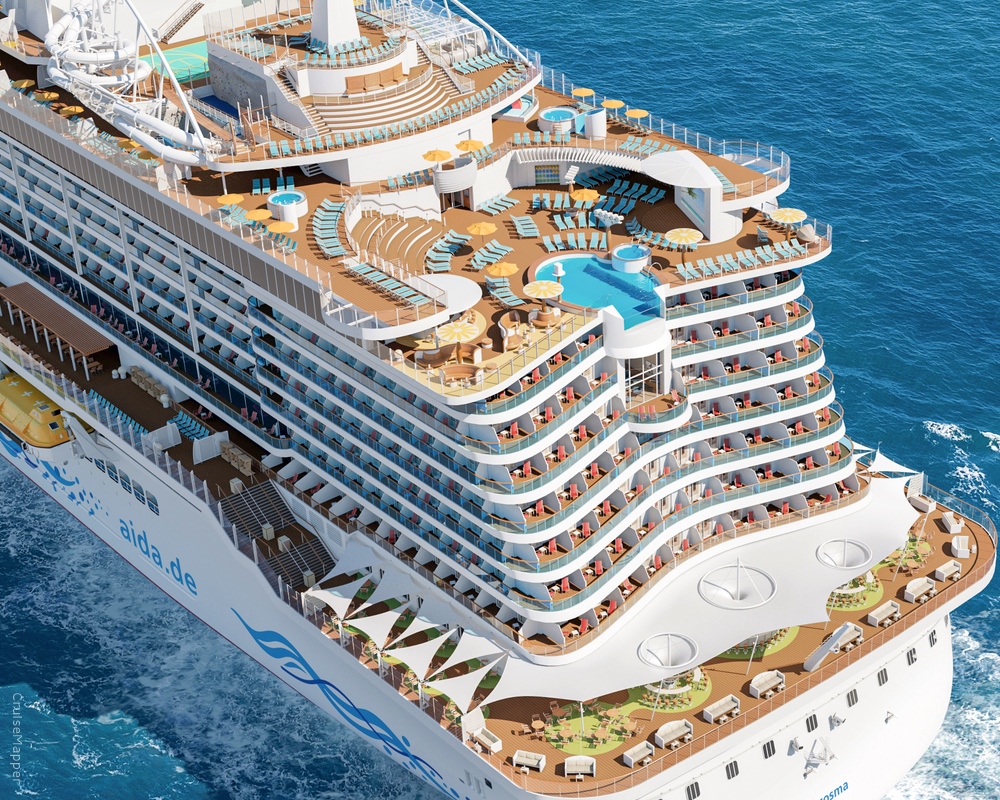
AIDA Cruises - Ships and Itineraries 2020, 2021, 2022 | CruiseMapper
He said forward bookings include not only a number of future cruise credits (FCCs) but "substantial new bookings and even new-to-cruise bookings, which given the current state of the environment in the world is really a good testament to how strong a vacation experience and value cruising really is."
When asked if brands that were more badly tarnished by the media attention on cruise ship outbreaks in the early days of the pandemic, such as Princess, were being disproportionately affected in terms of consumers' preference, Donald said the line is "trending with all the other brands in the industry."
In fact, he said that none of the brands in the industry had reached what he called "the trough" of 2012 or 2013 when a number of negative, high-profile incidents. such as the engine room fire on the Carnival Triumph and the sinking of the Costa Concordia, rocked the cruise industry and Carnival Corp. specifically.
"None of the brands in the industry, ours or others, have gone to the low levels that we experienced at that time," he said. "The trough in this period has been higher than the trough in that period.
"So there is a lot of pent-up demand, a lot of latent demand," he continued. "That doesn't mean we don't have work to do once we start cruising with much larger volumes of capacity to attract new to cruise. Of course, we will have work to do, but right now the brands are strong, the bookings are encouraging, and with the staggered start we're going to have in the resumption of cruising, there should be plenty of pent-up, latent demand with previous cruisegoers to fill the ships."
Donald also said that having national brands in its portfolio is "clearly an asset" in this situation because as nations reintroduce social gathering and cruising, they are "most likely initially to restrict reactivation to their own residents exclusively." 
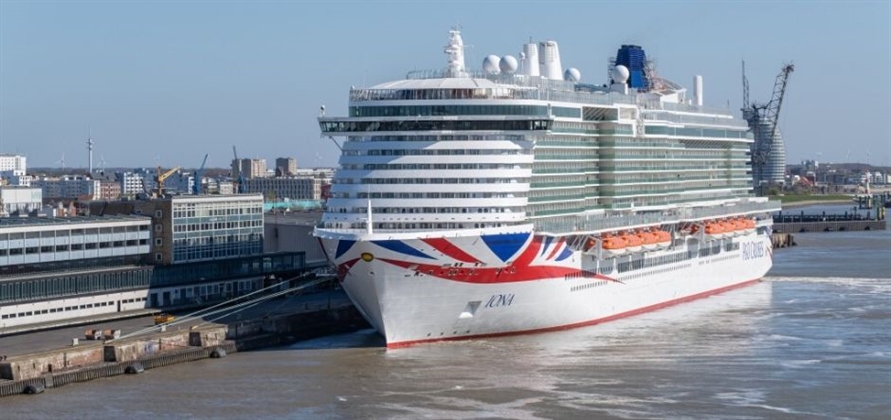
 P&O Cruises' Iona arrives in Rotterdam
P&O Iona waiting for delivery.
Carnival's German brand sources 95% from Germany; P&O UK is 98% British-sourced; Costa Europe is 80% continental Europe-sourced; P&O Australia is more than 99% sourced from Australia and New Zealand, and Carnival Cruise Line is 92% U.S.-sourced, Donald said.
"We are very well positioned," Donald said. "Additionally, the fact that these brands are characterized by ready access, with the drive-to market and prevalence of shorter duration cruises, strengthens the possibility for success in today's environment."
Donald said that in general, longer cruises such as world cruises are not booking as well as shorter ones, which he said makes sense given the uncertainty of whether ports are open or closed in different regions.
For the second quarter, which ended May 31, Carnival reported a loss of $2.4 billion on revenue of $740 million,  compared with $451 million in net income on $4.8 billion in revenue during the same period in 2019.
Carnival Panorama wins the “Best New Cruise Ship of 2019” Award ...
2021 bookings  
As of June 21, Carnival reported that approximately half of the guests on cancelled cruises requested cash refunds. The company also said that despite substantially reduced marketing and selling spend, it continues to see new 2021 bookings.
During the first three weeks in June, almost 60% of 2021 bookings were new bookings, Carnival said, with the remaining booking volumes from guests applying FCCs to specific future cruises.
Advanced 2021 bookings are currently within historical ranges at prices that are down in the low- to the mid-single-digits range, which included the negative yield impact of FCCs and onboard credits applied.
Carnival said the majority of its customer deposits of $2.6 billion are in FCCs, and $121 million in third-quarter sailings and $353 million in fourth-quarter sailings.

Tuesday, 30 June 2020

Costa Victoria sold for scrap

Costa Victoria sold for scrap

Costa Victoria sold for scrap

Costa Cruises confirmed that the Costa Victoria has left its fleet, with ownership transferred to a subsidiary of the San Giorgio del Porto shipyard. The ship awaits demolition.
Earlier this month, Costa parent company Carnival Corp. said plans were in place to remove six ships within 90 days, with more to come. Carnival Corp. accelerated plans already in place because of the Covid-19 pandemic. 
Last week, the 23-year-old Costa Victoria arrived in Piombino, Italy, where San Giorgio has a subsidiary yard, according to the city’s mayor. In a Facebook post, the mayor said that the 1,928-passenger ship was being prepared for demolition. 
Carnival Corp. had said in an earlier release that San Giorgio is the only Italian company listed in the Register of Environmental Ship Reclamation & Recycling Facilities and able to carry out green ship recycling projects. 
San Giorgio is the shipyard that carried out the recycling and demolition of the Costa Concordia after the ship ran aground and partly sank in January 2012.

Thursday, 10 October 2019

Arison on Carnival Corp.'s post-Concordia changes

Arison on Carnival Corp.'s post-Concordia changes

Image result for costa concordia


There was some interesting back-and-forth last week in federal court between Carnival Corp. chairman Micky Arison and U.S. District Court Judge Patricia Seitz that started out predictably but veered into unexpected territory.

Arison had been summoned to a status conference in the ongoing probation proceedings that Carnival is involved in as a result of Princess Cruises pleading guilty to environmental crimes in 2016.

Seitz was there to hold Carnival's feet to the fire, in a bid to stop continuing violations of environmental laws that have put her in a position of having to harangue Carnival about the problems.

Then she took a less confrontational tack.

"What do you love about being in your business, Mr Arison?"

Arison, one of the few people in a room full of lawyers and consultants who have actually worked on a cruise ship, recounted his 50-year career at Carnival, which included 32 years as its CEO.

"I'm very proud of what we've accomplished," Arison said. "Obviously we wouldn't be here if we were perfect."

Seitz then expressed her admiration for how Carnival reformed some of its processes after the sinking of the Costa Concordia on Jan. 13, 2012.

"That was the worst day of my life," Arison admitted in a hoarse voice.

Arison told Seitz that the Concordia illustrates some of the unique dilemmas in the cruise business that is not always understood by those outside the industry. As an example, he said, Carnival Corp. trains its bridge officers to work as a team. But the Italian Coast Guard, which trains Carnival's Italian officer corps, had a different approach.

That meant that creating a uniform safety culture across Carnival's 10 brands was hard to achieve.

"The Italian rules at that time were archaic," Arison said. "The captain was the master. Other team members [on the bridge] could not question the captain." Arison said Carnival lobbied hard with the Italian government to change the rules, but only after the Concordia accident were the changes made.

Seitz also had praise for the Arison Maritime Center, which Carnival opened in 2016 in Almere, the Netherlands. There, the company trains 6,500 bridge and engineering officers annually, in state-of-the-art simulators. That also gives the company a roadmap for change, she said.

Arison said that his family -- and himself personally -- was proud of having created the training centre. "We never put our name on a building in Miami," he added, despite plenty of offers. "That was one building we were proud to put our name on."

Tuesday, 16 May 2017

Costa Concordia captain loses final appeal against prison sentence

Costa Concordia captain loses final appeal against prison sentence

Image result for costa concordia

The captain of the Costa Concordia has lost his final appeal bid.

Francesco Schettino was sentenced to 16 years in prison in 2015 after a court found him guilty of manslaughter, causing a maritime accident and abandoning ship.

On Friday the sentence was upheld by Italy’s highest criminal tribunal, the Court of Cassation.

The ship capsized after hitting rocks off the Tuscan island of Giglio in 2012 killing 32 people.

Schettino had handed himself in to the Rebibbia prison in Rome after the verdict, according to the BBC.

More than 4,000 passengers and crew were aboard the Costa Concordia during a Mediterranean cruise.

Tuesday, 17 January 2017

Costa Concordia Taken Apart For Scrap Five Years After Tragedy Struck

Costa Concordia Taken Apart For Scrap Five Years After Tragedy Struck

Image result for scrapping of costa concordia
Costa Concordia Lounge

The Costa Concordia has finally been dismantled for scrap five years after it tragically sank, killing 32 people.
The ship hit an underwater rock in January 2012 and capsized in Isola del Giglio, near Tuscany.
The vessel had been carrying 4,252 people and 32 of these tragically drowned when the ship sank. The captain of the ship Francesco Schettino was then sentenced to 16 tears in jail for manslaughter. He had caused outrage as he fled the ship before all of the passengers had escaped safely.
His sentence was increased due to the fact he had given false information to the port authorities. The ship had hit the rocks because he was steering the ship too close to shore in order to impress a friend.
The disaster was the worst maritime incident for Italy since the Second World War.
Captain Schettino later appealed his sentence and claimed that Costa was itself to blame, but this was rejected in court.
The wreck of the ship was removed from the sea last year and has now finally been turned into scrap metal in the port of Genoa.
It’s been said that roughly 70 per cent of the 144,500 tonne wreckage will be recycled during these efforts. It will cost up to £1.2 billion to salvage and scrap the ship meaning that it is one of the most expensive maritime wrecks in history.
Since the disaster, cruise lines have worked to make safety procedures clearer and 73% of guests now think cruising is safer

Monday, 11 January 2016

Costa Concordia - Four Years After The Tragedy

Costa Concordia - Four Years After The Tragedy


Story by; http://www.cruisediscuss.com/

January 13 marks the fourth year of the tragedy that took the life of 32 innocent cruise passengers after the Costa Concordia sunk off the coast of Italy.

The gigantic wreck of the that had been lying on a rock off the island of Giglio is gone now. For the past seven months, the remains of the ship have been gradually dismantled and sent for recycling in a shipyard and a few days ago the huge support to keep the ship afloat were removed.

But the image of Concordia will remain for a long time in the history of the Tuscan island and the Italian Navy.  The disaster that tore thirty-two lives, injured 157 will possibly stay forever in the mind of the survivors and the families that lost their loved ones.

As for the ship's captain - Francesco Schettino, also known as Captain Coward - he was sentenced on 11 February 2015 to 16 years in prison, however, the sentence is not yet in effect and the 'brave' captain is giving interviews and cashing income from world-famous magazines such as GQ.

Even today many cruise ship passengers that survived the tragedy await for compensation for property left on board and lost when the ship sunk. Money in no way can reduce the grief but it was something that the cruise line owed to the people.

"Four years later Costa Crociere has yet to compensate the huge damage " shared Mara Parmegiani, a journalist, writer and fashion expert that was on board the Concordia during the disaster. "The legal department had assured me that by the end of 2015 I would be notified how the refund will be processed but then no one contacted me further on. Besides my case, there are other outstanding of important value, like that of a jeweler. " 


The fashion expert was on board with his precious collection of vintage clothes, as part of an Ambassodor of Fashion Made in Italy display. Glamorous dresses made ​​by the founders of high fashion - the sisters Fontana Valentino, by Antonelli to Ferré, to Gattinoni, Egon Furstenberg and Gay Mattiolo were showcased. 

A huge loss,but just from an economic standpoint, which in no case comparable to the psychological and emotional hardships that still disrupt the daily life with frequent panic attacks of the survivors. Among the most moving memories was the one of the small Daiani, the five-year old child whose little body was fished out a few days later by the rescuers.

"The memory comes back constantly before my eyes, I met her just before she died, she was in the arms of her dad on the deck packed with people; she looked at me, recognized me and gave me a pat. I was initially surprised, then I pulled out a little key ring with a teddy bear filled with rhinestones and I gave it to the girl who smiled at me and kissed me. I think Iit was her last smile ", one of the survivors shared. 

Thursday, 2 April 2015

Cruise ship cocaine smuggling racket uncovered

Cruise ship cocaine smuggling racket uncovered
A sophisticated system of smuggling cocaine from Latin America and the Caribbean to Europe via cruise ships is reported to have been uncovered by Italian investigators.
Costa Concordia, which capsized killing 32 passengers, was said to have been used by the mafia to smuggle large amounts of the drug, the Times reported.
Police stumbled on the smuggling operation during an investigation into the ’Ndrangheta mafia that led to 20 arrests.
In one overheard conversation, two mafia members discussed “the ship that made us look ridiculous all around the world”.
Prosecutors said there was no doubt that the men “were referring to the Costa Concordia and the shipwreck of January 13, 2012”, court documents cited by La Repubblica stated.
Police monitoring internet chat recorded them discussing a large quantity of cocaine they believe was destined for Costa Concordia.
The organisation has relied on Spanish ports to bring cocaine into Europe, as well as the Italian port of Gioia Tauro in the mafia branch’s home region of Calabria.
It is believed that cruise ships have become a useful conduit, with drugs either smuggled on board with supplies or taken by couriers posing as passengers.
The smugglers also allegedly used cruise ships operated by MSC and Norwegian Cruise Line, investigators discovered.
It was not clear whether cocaine was being transported on Costa Concordia on the night it hit rocks off the island of Giglio, nor have authorities reported finding drugs as they searched the ship for bodies. The ship is being broken up after being towed last year to the port of Genoa.
A spokesman for Costa Cruises declined to comment.
Five staff with Norwegian Cruise Line were arrested in Florida this month after allegedly smuggling 5kg of cocaine from Honduras in their spandex underwear aboard the Norwegian Sun, the newspaper reported.
Customs officials in Argentina seized cocaine worth more than $1 million from two crew members who allegedly attempted to board Royal Caribbean International’s Splendour of the Seas with the drug taped to their bodies.

Thursday, 12 February 2015

Captain of Costa Concordia Sentenced to  16 Years for Manslaughter

Captain of Costa Concordia Sentenced to 

16 Years for Manslaughter 


Captain Francesco Schettino, the man who was at the helm of the Costa Concordia when the cruise ship hit a reef off of the coast of Italy in 2012, was found guilty of manslaughter and sentenced to a little over 16 years in prison. 


The trial lasted 19 months and Schettino was found guilty of multiple counts of manslaughter after 32 passengers and crew members that were on the Costa Concordia died as a result of his actions. 

He was also convicted of abandoning ship and causing a shipwreck.  He left the ship before many of the over 4,000 passengers and crew members were still onboard.  

Prosecutors asked for a sentence of 26 years and 3 months and called him a “reckless idiot”. Schettino was not present in the court when Judge Giovanni Puliatti read the verdict in the Grosseto Theater.  He previously told the court that he was being “offered for sacrifice” for the sake of the economic interests of his employer.

- See more at: http://cruisefever.net/0211-captain-of-costa-concordia-sentenced-16-years-for-manslaughter/#sthash.MkVk8BBG.dpuf

Thursday, 24 July 2014

Costa Concordia embarks on its last voyage

Costa Concordia embarks on its last voyage: Italian cruise liner finally heads home to Genoa where it will be broken up for scrap


  • Four tugboats and several escort ships were lined up to tow the 114,000-tonne vessel
  • It is being taken to a port near Genoa in northern Italy where it is due to arrive on Sunday
  • The once-gleaming white luxury liner sank off the holiday island of Giglio in January 2012
  • 32 people died in the disaster after the ship struck rocks and capsized 
  • What followed was the most daunting - and expensive - salvage operation ever attempted
  • Environmental groups have grave concerns warning the operation could be a 'maritime Chernobyl'
  • Indian waiter Russel Rebello is still missing, but authorities are hopeful that his body may be found


A huge convoy moving at a speed of two knots is taking the Costa Concordia on its final voyage to the scrapheap today two-and-a-half years after it struck rocks and capsized, killing 32 people.
Fourteen boats, including three UK flagged boats, the Garibaldi, the Afon and the Earl Vow, are accompanying the liner, as well as a helicopter and a military plane that has circled continuously overhead.
As well as two powerful tugs in front, there are two spare tugboats behind, in case the boat needs to reverse in the face of an obstacle.
Fast outriding speed boats are warning sea traffic ahead to move aside, giving the Concordia at least 1.5 miles of space around it.
One vessel is tasked with checking for any marine mammals in the region, while others check the water quality for comparison before and after the passage. 
Scroll down for video
Final voyage: The wreck of the Costa Concordia is towed by two tugboats as it leaves behind the tiny Tuscan island of Isola del Giglio,  Italy
Final voyage: The wreck of the Costa Concordia is towed by two tugboats as it leaves behind the tiny Tuscan island of Isola del Giglio, Italy
The Costa Concordia cruise liner has begun its final voyage away from the tiny Italian island where it capsized on January 13, 2012
Environmental campaigners have warned of the risk of a 'maritime Chernobyl' as the ship is towed away
Setting off: The cruise ship Costa Concordia is towed by tugs from Giglio after being refloated.  The ship is bound for it's home port of Genoa

Setting off: The cruise ship Costa Concordia is towed by tugs from Giglio after being refloated. The ship is bound for it's home port of Genoa
Another boat accommodates the technicians when they are not working. A group of 12 are on a control room on the boat but switch with another workgroup every 12 hours.
As it was tugged along like a floating multi-storey carpark, the far side of the wrecked ship could be seen for the first time since it was hoisted out of the water last week.
Entire decks newly emerged from the brine are covered in rust while others have collapsed in the decay. The nearside is blighted by a huge hole where the ship hit rocks two years ago.
Maneouvres began early this morning to remove the cruise liner's rusty hulk from the Italian island of Giglio where the disaster happened. 
 
The vessels, led by the tug boat Blizzard, then started to tow the Concordia to a port near Genoa in northern Italy where it is due to arrive on Sunday, before being broken up for scrap.
On Giglio there was a carnival-like atmosphere as half the island turned out to pay homage to the ship. The church bells rang out and villagers and tourists cheered in unison as salvage workers came off shift for the last time.
A gang of six divers and welders from Titan, the US-led salvage company, sprayed champagne and lit cigars while posing for selfies in their hard hats and onesies.
'Make sure you get the Costa Concordia in the background cause we f***ing did it!', one yelled. 
But on Corsica environmental campaigners have warned of the risk of a 'maritime Chernobyl'. 

The heavy tug boat Blizzard (left) moves into position to maneuver the re-floated wreck of the Costa Concordia cruise liner from its position off the coast of Giglio. The operation to get it moving again began today
Homeward bound: After more than two years since it slammed into a reef along the coastline of Isola del Giglio the wreck has begun its last journey, to the Italian port of Genoa, where it will be scrapped
People watch as the wrecked cruise ship Costa Concordia is towed by tugs from Giglio after being refloated.  The ship is bound for it's home port of Genoa
People watch as the wrecked cruise ship Costa Concordia is towed by tugs from Giglio after being refloated. The ship is bound for it's home port of Genoa
The ship will take a route out of the port towards the east, before heading north at a rate of two knots, or nautical miles per hour, to Genoa
There was a carnival-like atmosphere as half the island turned out to pay homage to the ship
They have grave concerns that the ship could split as it leaves port or during the four day voyage north, spilling a toxic brew of hydro carbons, chemicals and waste into the sea.
Its final passage will take it through a marine sanctuary home to rare whales and dolphins nursing their young. 
Franklin Fitzgerald, from Houston, said: 'We've been here for two years. There's been lots of long long days. It's been blood sweat and tears. But it was the best job ever, it won't repeat itself.'
'The island was the best bit of the job, one claimed, while another shouted, 'the women and the beer. 
The once-gleaming white luxury liner sank off the holiday island of Giglio in January 2012 after sailing too close to shore. Its wreck has remained there ever since as engineers embarked on one of the largest maritime salvage operations in history.
Over the past week, salvagers have slowly lifted the 114,500-tonne ship from underwater platforms by pumping air into 30 large metal boxes, or sponsons, attached to the hull.
This morning salvage workers lowered the 'Blue Peter' flag, which they had raised yesterday to announce that the ship was ready to depart.
Salvage master Nick Sloane who is overseeing the entire operation said: 'Traditionally the flag tells the sailors its time to get out of the bar.'
As he arrived for his most important day in the job so far, he said: 'Everything is going to plan and it’s a big day for Giglio but we can only relax once we get to Genoa.'