Showing posts with label green energy. Show all posts

Friday, 10 October 2025

Polar Latitudes and Albatros Expeditions to Merge Polar Latitudes and Albatros Expeditions are set to merge their operations ahead of the 2026 season in the Arctic. The two expedition brands joined forces earlier this year, coming together under the same ownership group. While the merger was confirmed in a social media update, additional details of the joint operation will be announced in mid-October. “We are very excited about our future in the expedition cruise industry, which we intend to lead through innovation, collaboration, and leading responsible tourism initiatives,” Polar Latitudes stated. The brand added in a social media update that the merged operations will be highlighted by operating “the most fuel-efficient fleet” in polar areas. In an interview with Luxury Australian Travel Trade News (Latte), Albatros Expeditions’ CEO Patrick Shaw said that the new company will be named Polar Latitudes Expeditions. Shaw will reportedly serve as CEO of the newly created entity, having previously served as CEO and President of Quark Expeditions. “Given this exposure and experience, I have been in a unique position to appreciate the possibilities that this merger affords, and I am honoured and delighted to be a part of this transformation,” he told Latte. He noted that the new brand will operate “more durable, efficient and expertly led” ships, highlighting the company’s field staff training and integration with communities. Polar Latitudes currently operates the Seaventure for seasons in Antarctica, while Albatros Expeditions sails the Ocean Victory and the Ocean Albatros. The Ocean Albatros operates for the brand on a year-round basis, offering expeditions in Antarctica and the Arctic. Chartered from SunStone Ships, the Ocean Victory sails for the brand seasonally, offering itineraries in Antarctica and South America. Polar Latitudes Expeditions’ new website is expected to launch in mid-October, when the company is also set to organise a series of online events for trade members and customers.

Polar Latitudes and Albatros Expeditions to Merge


Polar Latitudes and Albatros Expeditions are set to merge their operations ahead of the 2026 season in the Arctic.

The two expedition brands joined forces earlier this year, coming together under the same ownership group.

While the merger was confirmed in a social media update, additional details of the joint operation will be announced in mid-October.

“We are very excited about our future in the expedition cruise industry, which we intend to lead through innovation, collaboration, and leading responsible tourism initiatives,” Polar Latitudes stated.

The brand added in a social media update that the merged operations will be highlighted by operating “the most fuel-efficient fleet” in polar areas.

In an interview with Luxury Australian Travel Trade News (Latte), Albatros Expeditions’ CEO Patrick Shaw said that the new company will be named Polar Latitudes Expeditions.

Shaw will reportedly serve as CEO of the newly created entity, having previously served as CEO and President of Quark Expeditions.

“Given this exposure and experience, I have been in a unique position to appreciate the possibilities that this merger affords, and I am honoured and delighted to be a part of this transformation,” he told Latte.

He noted that the new brand will operate “more durable, efficient and expertly led” ships, highlighting the company’s field staff training and integration with communities.

Polar Latitudes currently operates the Seaventure for seasons in Antarctica, while Albatros Expeditions sails the Ocean Victory and the Ocean Albatros.

The Ocean Albatros operates for the brand on a year-round basis, offering expeditions in Antarctica and the Arctic.

Chartered from SunStone Ships, the Ocean Victory sails for the brand seasonally, offering itineraries in Antarctica and South America.

Polar Latitudes Expeditions’ new website is expected to launch in mid-October, when the company is also set to organise a series of online events for trade members and customers.


Friday, 29 September 2023

Holland America: Full Fleet Shore Power Ready

Holland America: Full Fleet Shore Power Ready


Following the shore power installation on the Volendam, Holland America Line’s entire fleet is now equipped for shore power connectivity.

The Volendam recently completed its installation in Vancouver, British Columbia, and was connected to the port’s shoreside electricity for a full day on September 27.

“At Holland America Line, our legacy of exceptional onboard care extends to caring for the planet, and having our entire fleet capable of shore power connection is a tremendous milestone in our sustainability efforts,” said Gus Antorcha, president of Holland America Line. “We have committed to reducing our carbon emission intensity by 20 per cent by 2030 from our 2019 baseline, and we’re on our way to reaching that goal through a variety of initiatives that include shore power. We look forward to more global ports embracing shore power capability in the future and are ready to work with them to connect.”

Ports that the cruise line’s ships visit with shore power include Juneau, Alaska; New York; San Francisco and San Diego, California; Seattle, Washington; Halifax, Montreal and Vancouver, Canada; Bergen, Ã…lesund and Kristiansand, Norway; Kiel, Germany; and Shanghai and Xiamen, China.

Holland America Line began converting ships for shore power connectivity in 2006 with its four Vista Class ships.

The cruise line’s Pinnacle Class ships (the Koningsdam, Nieuw Statendam and the Rotterdam) all were built with shore power systems installed, while the Eurodam and Nieuw Amsterdam were launched with a partial installation that has since been completed.

In addition to shore power, the company has also adopted a variety of environmental practices such as banning single-use plastics onboard and using biodegradable or paper-based alternatives.

“We’ve made our packaging changes in a thoughtful manner to ensure that we can both reduce our footprint and also maintain our outstanding guest experience,” added Antorcha.


Monday, 21 August 2023

Portsmouth Port Makes the Switch to Solar Power

Portsmouth Port Makes the Switch to Solar Power


The installation of the cutting-edge solar and battery system at Portsmouth’s port has passed a final milestone and is now fully operational, according to a statement.

Managed by the in-house energy services and building services teams of Portsmouth City Council installed by Custom Solar and assisted by engineers at the port, the project began with installing roof-mounted solar panels across several buildings, large battery storage, and the first solar canopies at a UK port.

The last piece of the project was finalized in July 2023, where an upgraded connection to the national grid allowed the full potential of the 1.2-megawatt peak system to be realized.

This system, comprised of 2,660 solar panels, provides an impressive 35% of the site’s electricity. With this, the council-owned Portsmouth International Port is one step closer to becoming one of the UK’s first net carbon-neutral ports.

The solar system is complemented by an onsite battery with a capacity of 1.3 megawatt hours, which can power a typical home for four months. It captures renewable energy, which would otherwise be exported to the local electricity network, and redirects it to the port’s buildings when required.

The battery and new solar system work in conjunction with each other, providing balancing services to the national grid and storing power during periods of lower pricing.

Elly Howe, environmental and sustainability coordinator at Portsmouth International Port said: “This huge solar installation and battery storage facility will help the port reach our ambitious sustainability goals. Energy consumption at the port is already down 33% from last year so I’m excited to see what we can achieve in the future.

“Along with our project partners, I’d like also like to thank Brittany Ferries, the port’s biggest customer, for helping to accommodate the work throughout some of the busiest times of the year.”


Saturday, 22 April 2023

AIDA Reaches Milestone in Decarbonization Efforts

AIDA Reaches Milestone in Decarbonization Efforts


AIDA Cruises has expanded the use of shore power in its fleet, reaching a significant milestone in its decarbonization efforts, according to a press release.

The AIDAsol was recently connected to shore power in nearly all ports during its recent voyage from April 16 to 21, 2023.

The ship was supplied with green energy from shore in Rostock-Warnemünde, Aarhus (Denmark), Kristiansand (Norway), and Hamburg.

The growing shore power infrastructure in Northern Europe has made it possible for AIDA Cruises to achieve this milestone.

AIDA President Felix Eichhorn stated that the company’s goal is to use shore power in all ports where port infrastructure is available. He added that the company’s investments in clean technology are actively supporting the goals of the EU’s “Fit for 55” program to build a corresponding infrastructure in all major EU ports by 2030.

During its recent voyage, AIDAsol made history by being the first cruise ship to conduct shore-side and shipboard integration tests on a newly built facility in Aarhus, Denmark. The official opening of Denmark’s first shore power plant for cruise ships is scheduled for later this year.

The AIDAsol was also supplied with energy from shore during its stop in Kristiansand, Norway, which it already did in 2022.

AIDA Cruises has been investing in sustainable cruising for many years, with a goal to achieve carbon-neutral ship operation for its fleet by 2050.

The company has been considering the use of environmentally friendly technology since 2004, and more than ten years have passed since it was able to start the usage of shore power in regular operation with an AIDA ship in Hamburg Altona in 2017. The company signed a memorandum of understanding in April 2022 with Cruise Baltic, a network of 31 ports and destinations, to use shore power in the ports of the Baltic Sea region.

AIDAsol’s arrival in Hamburg, its home port for this year’s summer season, marked another significant moment in AIDA Cruises’ decarbonization efforts. The ship was connected to Europe’s first shore power plant for cruise ships and switched off its main engines shortly after docking at the Cruise Center Altona.

The expansion of the use of shore power is part of AIDA Cruises’ efforts to use low-emission liquefied natural gas (LNG) and other alternative energy sources such as batteries and fuel cells. The company is working with various partners to find solutions for the use of regenerative and synthetic fuels.

“AIDA Cruises shows what can already be possible today,” said Eichhorn. “We can only achieve the energy transition together.”

Saturday, 11 February 2023

Norwegian Cruise Line Holdings Completes Biofuel Trial

Norwegian Cruise Line Holdings Completes Biofuel Trial


PRIO, a producer of biofuels in Portugal, and Norwegian Cruise Line Holdings in collaboration with World Fuel Services (WFS) have successfully completed the first trials with sustainable biofuels produced in Portugal, according to a press release.

Following the launch of ECO Bunkers B15 and taking the first step towards the decarbonization of maritime transport in the Iberian Peninsula, PRIO has announced a blend of Biofuels with 30 per cent renewable base material.

This milestone was achieved in collaboration with Norwegian Cruise Line Holdings and the Florida-based energy and services company World Fuel Services.

The new fuel, ECO Bunkers B30, contains a blend of 30 per cent of advanced biofuel from waste raw materials and it is produced at PRIO’s biodiesel plant in Aveiro. This enables the company to scale up production as demand increases and to adjust the percentage of Biodiesel blends (up to a 100 per cent renewable product).

Luis Nunes, a member of PRIO’s Executive Board said: “Advanced biofuels, produced from residual raw materials, i.e., the result of circular economy, are the solution of the present and that allows us to immediately meet the growing needs of our clients. They are “drop-in” solutions, meaning that they did not require any modifications to the engine or tank of Norwegian Cruise Line Holdings’ cruise ships and, in this way, allowed an immediate impact without any need for additional investment in these ships.

“We are at a crucial moment in the world’s response to climate and biodiversity emergencies, so PRIO believes we can already accelerate the energy transition if we increase the contribution of advanced biofuels in the maritime sector,” he added.

PRIO has established itself as the ideal partner for maritime companies on the road toward decarbonization of the sector.

With the help of World Fuel Services, two Norwegian Cruise Line Holdings ships were fueled with a total of 400 tons of B30 supplied by PRIO last year.

The Norwegian Star received 200 tons of ECO Bunkers B30 in Lisbon in November.

The following week, the Norwegian Epic, received another 200 tons of ECO Bunkers B30. This has enabled the cruise company to avoid approximately 440 tons of CO2 emissions.


Monday, 26 July 2021

MSC, Fincantieri and Snam Partner for ‘World’s First Oceangoing Hydrogen-Powered Cruise Ship’

MSC, Fincantieri and Snam Partner for ‘World’s First Oceangoing Hydrogen-Powered Cruise Ship’


MSC Cruises, Fincantieri and Snam have announced the signing of a Memorandum of Understanding to jointly determine the conditions for the design and construction of what would become the world’s first oceangoing hydrogen-powered cruise ship.

According to a press release, MSC Group, Fincantieri and Snam have joined forces to initially carry out a study that will assess the feasibility of designing and building “the world’s first ocean-going cruise ship powered by hydrogen.” MSC Group said that the ship would allow zero-emissions operations in certain areas and the development of the related hydrogen bunkering infrastructure.

Green hydrogen can be produced without fossil fuels, using renewable energy to split water in a process called electrolysis and can therefore be emissions-free on a full lifecycle basis, MSC said. It can be used to generate electrical power through a fuel cell, emitting only water vapour and heat. This type of ‘green’ hydrogen holds great potential to contribute to the decarbonization of the shipping industry, including cruising, whether in its pure form or as a hydrogen-derived fuel.

“As a company that has long made environmental sustainability its focus, we want to put ourselves at the forefront of the energy revolution for our sector and hydrogen can greatly contribute to this. However, today production levels remain low and hydrogen fuel is still far from being available at scale. With this project, we’re taking the lead to bring this promising technology to our fleet and the industry while sending the strongest possible signal to the market about how seriously we take our environmental commitments. As we advance with the development of the maritime technology required, we will also see that energy providers take note and ramp up production to unlock this and that governments and the public sector step in to provide the necessary support for a project that is critical to the decarbonization of cruising and shipping,” said MSC Group’s Executive Chairman of the Cruise Division, Pierfrancesco Vago.

The CEO of shipbuilding group Fincantieri, Giuseppe Bono, said that “every opportunity for new solutions and technologies is a source of growth for us.”

“This one allows us to offer our customers the best of innovation to help minimize the environmental impact,” he noted.

The CEO of international energy infrastructure operator Snam, Marco Alverà, said that the company was “strongly committed” to concrete initiatives for sustainable heavy transport – on the road, rail and by the sea – promoting the use of renewable gases such hydrogen and bio LNG.

“This agreement for us is part of a wider strategy to leverage on our experience, competencies and technologies in green gases and energy efficiency in order to contribute to the full decarbonization of the shipping value chain, including ports and logistics, which will be increasingly crucial in our economies,” Alverà explained.

“Hydrogen could be a key enabler in achieving the target of net-zero emissions in shipping, accounting for approximately 3 per cent of global CO2 emissions, as well as in all the hard to abate sectors,” he added.

As per the terms of the Memorandum of Understanding, during the next 12 months, the three companies will study key factors related to the development of oceangoing hydrogen-powered cruise ships.

These include arranging ship spaces to accommodate H2 technologies and fuel cells, technical parameters of onboard systems, calculating the potential greenhouse gas emissions savings, and technical and economic analysis of hydrogen supply and infrastructure.

MSC Cruises said that it was committed to achieving net carbon neutral operations by 2050.

“To accomplish this objective, the company is working in partnership with a wide range of shipyards, suppliers, manufacturers and other organizations as well as investing in different upcoming technologies and solutions for its fleet,” MSC Group wrote. “The implementation of the cooperation above described will possibly be an object of future binding agreements to be discussed by the parties in relation thereto.”

Sunday, 27 December 2020

Budweiser and CleanEarth announce Magor Brewery to be Powered by Massive Wind Turbine

Budweiser and CleanEarth announce Magor Brewery to be Powered by Massive Wind Turbine

Budweiser Brewing Group UK&I, a proud part of AB InBev, and renewable energy company, CleanEarth, reached a milestone in the brewer's sustainability efforts. A new wind turbine has been installed at Budweiser Brewing Group's brewery in Magor, South Wales to help power the site with renewable electricity. 

One billion pints

The newly installed turbine will supply nearly a quarter of the energy consumed at Budweiser’s Magor Brewery. As the site produces more than 1 billion pints of beer each year (including Budweiser, Stella Artois, Corona and Bud Light) its power demand is considerable.

Located just under a mile from the brewery, the turbine serves the plant via a direct wire, with Budweiser Brewing Group purchasing the power from CleanEarth through a power purchase agreement (PPA).

The turbine is the latest step in Budweiser Brewing Group’s commitment to brewing its beers with 100% renewable electricity by next year and its continued investment in renewables.

Lloyd Manship, Brewery Manager at Magor Brewery, said, “Having worked at the brewery for more than 20 years, it’s amazing to see how far we’ve come in our sustainability initiatives. The installation of this wind turbine is going to make a huge difference in helping us to operate more sustainably long into the future.”

Unprecedented scale

The Vensys V136 turbine presented significant logistical challenges, especially in the transportation of the blades. The conventional route by road was dropped in favour of shipping them over 800 miles by sea and into Bristol’s Avonmouth Dock, leaving just the last 20 miles to be negotiated by road.

The combination of sheer size with the latest design and engineering technology makes the Magor turbine highly efficient in harnessing the available wind, providing an output of up to 3.5 megawatts.

This will generate 9 million kilowatt-hours of electricity each year – the equivalent of powering 2,300 Welsh homes – while saving more than 2,600 tonnes of CO2 emissions. That’s well over 65,000 tons of carbon savings during its operational lifetime.

Commitment to decarbonization

The partnership between Budweiser and CleanEarth is another important step in the decarbonization of UK businesses. As Paula Lindenberg, President, Budweiser Brewing Group UK&I, said, “We’re committed to brewing Britain’s most sustainable beers. Partnerships like this one with CleanEarth help drive positive change – making it easier for people to make sustainable choices at the pub or on their weekly shop.”

This was echoed by Dean Robson, Managing Director of CleanEarth, who said, “Too often corporate goals are not coupled with strong and effective action – but Budweiser Brewing Group has been supportive at all levels, and have acted throughout with a clarity that’s consistent with their ambitious environmental targets.

“We are proud of the work we’ve done with Budweiser Brewing Group on this project. As a result of this collaboration, CleanEarth will generate low-carbon, low-cost energy into the Magor brewery for years to come.”

Sunday, 25 October 2020

AVANGRID and PNM Resources Announce Merger Plans

AVANGRID and PNM Resources Announce Merger Plans


AVANGRID, a leading sustainable energy company, and PNM Resources announced today that their respective boards have approved the merger of PNM Resources into AVANGRID. Ignacio Galán, chairman of AVANGRID and chairman of IBERDROLA Group, said, "This transaction is a consequence of the IBERDROLA Group’s disciplined strategy followed over more than 20 years. This is a friendly transaction, focused on regulated businesses and renewables in highly rated states with legal and regulatory stability and predictability offering future growth opportunities."

Dennis V. Arriola, AVANGRID’s CEO who will continue as CEO of the combined company, said, “This merger between AVANGRID and PNM Resources is a strategic fit and helps us further our growth in both clean energy distribution and transmission, as well as helping to expand our growing leadership position in renewables.  Our two companies also share the same values as we both are passionate about our customers, employees and the communities we serve. In addition, both AVANGRID and PNM Resources are leaders in environmental, social and governance issues that impact our stakeholders.”

Pat Vincent-Collawn, chairman, president and CEO of PNM Resources, stated, “We are excited to be part of this transaction that provides so many benefits to our customers, communities, employees and shareholders.  Our combined companies provide greater opportunities to invest in the infrastructure and new technologies that will help us navigate our transition to clean energy while maintaining our commitments to our local teams and communities.”

AVANGRID will add two independent board members from PNM Resources to its board of directors and one independent board member from PNM Resources will join the AVANGRID Networks board.

Key Highlights

  • The transaction is expected to be EPS accretive in the first full year after closing.  
  • As a result of PNM’s earnings from regulated distribution and transmission assets, it is expected that AVANGRID’s regulated earnings contribution post-transaction will exceed 80%.  This proportion of regulated earnings will support AVANGRID’s fast-growing renewables business over the next decade.
  • The purchase price represents a premium of 10% over the PNM`s share price as of Tuesday 20th October and 19.3% over the average PNM share price during the 30 days prior to 21st  October. 
  • AVANGRID’s majority shareholder, Iberdrola, has provided the company with a funding commitment letter for the entire equity proceeds for the transaction. 
  • As a result of this transaction, PNM’s shareholders will receive approximately $4.318 billion in cash. 

The agreement between AVANGRID and PNM Resources is subject to approval by PNM Resources shareholders. In addition, the transaction will require approval from a number of state and federal regulators including the New Mexico Public Regulation Commission, Public Utility Commission of Texas, Federal Energy Regulatory Commission, Hart Scott Rodino Clearance, Committee on Foreign Investment in the United States, Federal Communications Commission and the Nuclear Regulatory Commission.  Regulatory approvals are expected to be completed in approximately 12 months.

AVANGRID currently owns 1,900 MW of renewable energy and a pipeline of 1,400 MW of renewables assets in New Mexico and Texas.  In addition, Iberdrola operates a retail business in Texas. For more than 15 years, Iberdrola has also funded the King Felipe VI Chair in the Department of Electrical and Computer Engineering at the University of New Mexico.

Thursday, 3 September 2020

Total Enters Giant Korean Floating Wind Projects in Green Push

Total Enters Giant Korean Floating Wind Projects in Green Push

offshore wind

By Francois de Beaupuy (Bloomberg) — Total SE will team up with Macquarie Group’s green bank to develop more than 2 gigawatts of floating wind farms off South Korea, the latest push by the French oil and gas giant to diversify into clean energy.

Total and European peers such as Royal Dutch Shell Plc and BP Plc have vowed to reduce their exposure to fossil fuels and trim emissions as governments, consumers and investors demand increased efforts to tackle global warming. Floating wind parks at the scale planned by Total — dwarfing current sites — will be key to bringing down the cost of the emerging technology.

The French major and Macquarie’s Green Investment Group will develop five floating wind farms off the eastern and southern coasts of South Korea, Total said in a statement on Tuesday. They plan to start building the first 500-megawatt project by the end of 2023. That compares with the 30 megawatts of capacity at Equinor ASA’s Hywind site off Scotland, the biggest operating floating wind project so far.

The plan is “in line with Total’s strategy to profitably develop renewable energy worldwide and contribute to our net-zero ambition,” Chief Executive Officer Patrick Pouyanne said in the statement. “Thanks to its extensive experience in offshore projects, in cooperation with many Korean shipyards, Total is particularly well-positioned to contribute to the successful development of this new technology.”

Developers have recently started to test large floating wind turbines, aiming to install them in areas that lack shallow waters, where traditional offshore turbines can be anchored to the seabed. Total itself took a majority stake in a floating wind project off Wales this year, reflecting its commitment to invest in the technology while tapping its experience developing oil and gas offshore.

The total has also stepped up spending on renewable energy more broadly, with investments this year in large solar developments in India and Qatar, a giant wind farm in the North Sea, and growth in clean power in Spain and France. The company aims to have stakes in at least 25 gigawatts of renewable generation capacity in 2025, up from more than 5 gigawatts currently.

Total didn’t discuss funding of the Korean wind farms in its statement.

Sunday, 26 July 2020

Saipem Wins More Offshore Wind Work for Saipem 7000

Saipem Wins More Offshore Wind Work for Saipem 7000

The Saipem 7000 installs a wind turbine at the Hywind offshore wind project located approximately 30 km off the coast of Aberdeenshire, Scotland. Photo courtesy Saipem

Italian oil services giant Saipem has announced multiple new contract awards related to offshore wind projects currently under development off the coasts of England, Scotland and France.
First, the Dogger Bank Offshore Wind Farms, the joint venture between Equinor and SSE Renewables, has awarded Saipem with a contract for the transportation and installation of two offshore High Voltage Direct Current platforms for the first two phases of the Dogger Bank project: Dogger Bank A and Dogger Bank B. Both platforms will have a capacity of 1.2 GW and will consist of a 2,900-ton jacket and a. 8,500-ton topside.
Once completed, Dogger Bank will be the world’s biggest offshore wind farm, located some 130km off the North East coast of England. The project is the first to use HVDC technology in the UK’s offshore wind market.
Next, Saipem has also been awarded an installation contract by Seaway 7 related to the Seagreen Offshore Wind Farm, a 1,075 MW joint venture project between SSE Renewables (49%) and Total (51%) off the East coast of Scotland. The scope of work entails the installation of 114 foundations for an equivalent number of wind turbines.
Finally, Saipem has been awarded a contract for the transportation and installation of the jacket and topside of the offshore substation at St-Brieuc offshore wind farm, located in Brittany, France, which is being developed by Ailes Marines, part of the Iberdrola group. All project management and engineering activities shall be executed by Saipem SA, Saipem’s French subsidiary established in Paris.
All three offshore installation projects will be carried out by the crane vessel Saipem 7000. Previously the Saipem 7000 was hired to mount five floating offshore wind turbines for the Highwind project in the UK North Sea.
Saipem values the contracts in the north of 90 million euros combined. The company says the contracts help to further establish the company within the renewables sector, for which a dedicated business line has been recently established within the E&C Offshore division.
“These new contracts confirm Saipem’s participation in the most relevant offshore wind farm developments and are the tangible results of a strategy which has led us to become a global reference player in the energy transition,” said Francesco Racheli, Chief Operating Officer of Saipem’s E&C Offshore Divisio. “This significant achievement has been attained by leveraging on our capabilities, our technological flexibility and our distinctive assets.”

Thursday, 11 June 2020

Demands grow for 'green industrial revolution'

Demands grow for 'green industrial revolution'

Offshore wind farm
The document plans for a massive expansion in offshore wind

Greenpeace has joined a growing list of organisations demanding that the UK government puts protecting the environment at the heart of any post-COVID-19 economic stimulus package.
The campaign group has produced a detailed "manifesto" with measures to boost clean transport and smart power.
The document follows a comparable call from some of Britain's most powerful business leaders earlier this week.
Last week, the prime minister also expressed a similar ambition.
Boris Johnson said he wanted to see a "fairer, greener and more resilient global economy" after Covid-19 and that "we owe it to future generations to build back better".
The manifesto also contains measures to support the protection of nature, green buildings and the creation of an economy in which virtually everything is reused.
Greenpeace says the crisis has given Britain a "once in a lifetime" opportunity to transform life, travel and work.
It added that the plan would create hundreds of thousands of secure jobs.

Green business

On Monday, more than 200 chief executives of some of the UK's top firms - including HSBC, National Grid, and Heathrow airport - signed a letter to the prime minister asking him to use the Covid-19 lockdown as a springboard to "deliver a clean, just recovery".
Many people may be surprised how similar the recommendations of these two very different interest groups are.
  • Both Greenpeace and the chief executives are asking the government to prioritise investments in low carbon technologies and calling for the decarbonisation of the British economy to be speeded up
  • Both say they want to see a focus on sectors that best support the environment
  • Both are demanding that financial support for ailing businesses must come with a requirement for them to commit to taking action to reduce their impact on the environment.
Greenpeace's manifesto is, however, considerably more detailed.
It is a 62-page document with a specific policy, spending and tax measures covering most of the British economy.
It calls on the government to deliver its 2050 net-zero emissions goal before 2045.

Controversial policies

BikeImage copyrightGETTY IMAGES
Image captionThe manifesto contains measures to encourage clean transport
However, lots of the policies Greenpeace proposes would prove very controversial.
For example, motorists say they are ready to change their behaviour to improve air quality, according to a recent AA survey.
But many drivers may balk at Greenpeace's proposals to radically redesign the road network to favour walking and cycling, at the suggestion that petrol and diesel cars are banned by 2030 or that fuel duty is steadily increased.
Many homeowners might be reluctant to spend money to upgrade their properties to meet tough energy efficiency standards.
At the same time, many local communities are likely to resist the plan for a big increase in onshore wind and solar power to complement a proposed massive expansion of offshore wind farms - few things unite local communities like a proposal to put in an array of wind turbines.
Plastic bottles at recycling plantImage copyrightGETTY IMAGES
Image captionThe manifesto proposes the creation of an economy in which virtually everything is reused
But, says Greenpeace, tough policies like these are essential if the government is going to take meaningful action to tackle climate change.
"The choices our government makes now will define… whether or not we succeed in the fight against the climate emergency", says John Sauven, executive director of Greenpeace.
"If we fail to get this right, we may never get another chance. Now is the time for a green recovery, and for that, we need action, not words."
It says there would be huge dividends in terms of job creation, should its programme be adopted.
Greenpeace calculates that its plans would create hundreds of thousands of new high-skilled jobs as well as helping to level up inequalities between communities in the UK.

Unique opportunity

The UK government has already indicated that protecting the environment will feature heavily in any stimulus package.
Back in April, Boris Johnson said a post-COVID-19 recovery plan should include efforts to "turn the tide on climate change".
Meanwhile, the European Union has unveiled what it called the biggest "green" stimulus in history.
Last week, it said it planned to commit a whopping €750bn (£667bn; $841bn) to its recovery package.
Add in spending from future budgets and the total financial firepower the European Commission says it will be wielding is almost €2tn (£1.8tn; $2.2tn).
Fighting climate change is at the heart of the bloc's recovery from the pandemic.
There will be tens of billions of euros to make homes more energy-efficient, to de-carbonise electricity and phase out petrol and diesel vehicles.
The idea is to turbo-charge the European effort to reduce carbon emissions to net-zero by 2050.
"If we do not do it, we will be taking much more risk," Teresa Ribera, deputy prime minister of Spain, told the BBC.
"The recovery should be green or it will not be a recovery, it will just be a shortcut into the kind of problems we are facing right now."

Sunday, 7 June 2020

Wind Turbine Inventor Sees Unlimited Potential in Floating Wind Farms

Wind Turbine Inventor Sees Unlimited Potential in Floating Wind Farms

Offshore Wind Turbines At Sea
File Photo: Shutterstock/Teun van den Dries

By Will Mathis (Bloomberg) — The turbine inventor Henrik Stiesdal is small in the shadows of gigantic curves of steel, watching workers weld towers that will be rooted in the seabed. This factory in the Danish countryside has churned out thousands of masts for wind turbines whose blades can stretch more than 500 feet. It’s an important contribution to a global wind revolution that’s supplying electricity to millions of homes worldwide.
Soon the factory will set about a new task, manufacturing components for a different kind of turbine, designed by Stiesdal, that bobs on the open sea. These structures promise to put the strong, consistent gusts that blow over deep waters within reach for the first time. The turbines now found around Denmark, England, and the other coastlines of the North Sea are made for shallow water and require large underwater structures to fasten them in place. “Normal places don’t have shallow water near population centres—they have deep water,” says Stiesdal, a legendary turbine inventor and a former executive at some of Europe’s biggest wind companies. This situation renders many coastal places unsuitable for wind power. “We could power California many times over with their offshore resource,” he says, “but it all has to be floating.”
If the next generation of wind farms can float, and if costs can be kept low, it could usher in an era of almost unlimited, emission-free energy. The International Energy Agency (IEA) estimates that floating wind turbines could help provide enough electricity to satisfy the world’s electricity needs 11 times over, based on expected power demand in 2040. At 63, Stiesdal has taken every step in the modern evolution of wind power. As a young man, he designed the first turbine and later took part in the introduction of the first offshore wind farm, creating what’s now one of the fastest-growing forms of renewable energy. He’s seen global wind capacity grow from virtually nothing in 1978 to more than 600 gigawatts today, according to BloombergNEF data.

Floating Offshore Wind Power
Trio to develop floating offshore wind turbine inspection method ...

As 2019 ended, about three-quarters of global offshore capacity lay in Europe, mostly clustered around the U.K. and Germany. This regional dominance owes partly to the North Sea’s relative shallowness. Although similar waters off China, Vietnam, and the eastern U.S. seaboard could someday add more wind farms using established technology, there’s greater potential farther offshore. Many more places, including California, Japan, and South Korea, have heavy power needs, big ambitions to lower emissions and deep seas. Not to mention that people tend to complain—loudly—about turbines within eyesight of the shore. The open sea isn’t in anyone’s backyard.
Now Stiesdal is among those bringing about the floating-energy future. With offshore wind power increasingly competitive with the price of fossil fuels, expansion into deeper waters could help rid electric grids of carbon emissions for good. “I had some bad moments thinking about the climate,” he says. “The politicians will not solve it. We need to solve it ourselves.”
After he finished high school in rural Denmark in the late 1970s, Stiesdal heard about a nearby teachers’ college that was running an experiment to generate electricity from wind. He decided to try making a model turbine in his family’s home. He built the first blades from steel and high-grade nylon, working on the living room floor as his mother knitted on the sofa.
The first turbine he made was small enough that he could lift it with one hand. “Once you got it spinning, it got to be alive, and you could feel all the small things in the wind,” Stiesdal recalls. “I was hooked.” It worked well enough that he got a local machinist to help him build a bigger version that could provide power to his family’s farm.
A few years later, with more tinkering, he’d scaled up to a point that it took two people to carry a blade. Executives from a local manufacturer of hydraulic cranes came over to check out his turbines and drink coffee. Replacing expensive, polluting fossil fuels with wind made sense, even before climate change became a pressing concern.
Stiesdal struck a licensing agreement with the executives, which eventually led to mass production and later a full rebranding as Vestas Wind Systems A/S. The company is the world’s largest wind turbine manufacturer, with more than $13 billion in revenue last year. In its official corporate history, Vestas acknowledges that its earliest efforts—designed to look like an egg whisk—failed to produce enough electricity to be viable. But Stiesdal’s prototypes, the company writes, are “essentially the same three-blade model used today.” And not only by Vestas: The same configuration is used all over the world, by scores of manufacturers.
Earn your Referral Bonus – North America, Onshore Wind Technicians ...
The inventor worked with Vestas until the mid-1980s, then went on to a job at Bonus Energy, a Danish turbine company that was later bought by German industrial giant Siemens AG. That’s where he orchestrated the introduction in 1991 of the first offshore turbines able to withstand harsh conditions at sea. “He’s like the godfather of wind,” says Tom Harries, who analyzes the sector for BNEF.
Offshore turbines are now scattered around the world by the thousands, the product of billions of dollars of investment. The latest and largest, an 860-foot-high machine from Siemens Gamesa that will be tested next year in northern Denmark, is almost as tall as New York’s Chrysler Building. As turbines have multiplied and spread, costs have fallen sharply—down more than 60% in the last decade.
In the next two decades, the IEA expects the offshore industry to attract $840 billion—almost as much investment as natural gas. Most of the biggest developers right now are European power companies such as Denmark’s Orsted, Germany’s RWE, and Spain’s Iberdrola, which have increasingly shifted away from fossil fuels. In China, the second-biggest offshore market after Europe, companies such as China Ming Yang Wind Power Group Ltd. and Xinjiang Goldwind Science & Technology Ltd. have sold hundreds of turbines domestically.
“The cork is coming off the bottle,” Stiesdal says. “With the cost reductions we’re seeing, we’re outcompeting with all kinds of fuels. You can’t build gas-fired plants and coal plants and nuclear plants that can match the wind.”
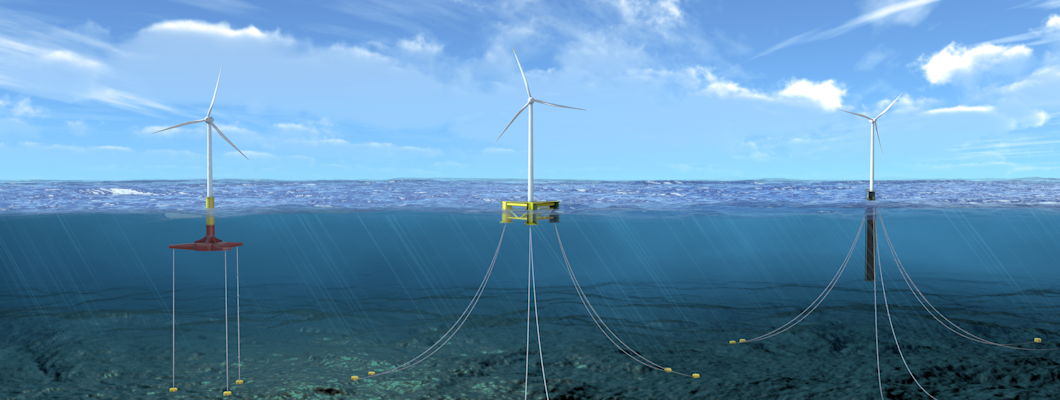
A successful floating platform would push open new wind markets and potentially generate billions of dollars of turbine contracts. The earliest glimpses of this future, ironically, come from pilot projects started by fossil fuel companies, which have long expertise in extracting resources from the seabed using platforms. Designs for wind versions vary, but the most prevalent use steel or concrete to support a single turbine. Some models have a tube shape, with a turbine on one corner. Others look more like a buoy, with a turbine bobbing on top. The main engineering challenge is keeping the machine in the right position; a slight rotation can move the blades out of the wind. The designs rely on cables and anchors to keep the platforms in the right spot. Buoyant turbines fitted with anchors can be put out at sea in water as deep as 1,000 meters (3,281 feet).

Opening Deeper Shorelines to Wind Turbines

On the economic side, “the key bottleneck is the floating foundation,” says Jason Cheng, managing partner at private equity firm Kerogen Capital. “We think that’s where a great amount of the value will be captured.” Kerogen mostly invests in fossil fuels, but it’s taken a stake in Ideol, a French platform developer. Cheng says he liked that floating wind draws on proven technologies. “Because it’s already been developed in oil and gas, we know what those solutions could look like.”
If floating platforms are to help wind power achieve anything like the almost unlimited capacity anticipated by the IEA, companies will have to bring down costs. Floating introduces a whole new expense in the manufacture and installation of platforms, in part because mooring cables get more expensive as water gets deeper. Transportation costs could be lower because floating platforms can be towed from port rather than erected at sea, but that’s not enough to offset the cost of a technology that isn’t designed for mass production. “It’s not copy-paste from oil and gas,” says Manahil Lakhmiri, head of offshore wind at Engie, which is working with California-based Principle Power Inc. on a floating pilot project off Portugal. “What we see today is there’s one floater made every three months,” she adds. “We need one floater per week.”
That’s a problem Stiesdal has solved before. The turbines he helped pioneer proved quite scalable—they became as prevalent as they did because their components could be produced quickly and cheaply. His new floating platform, dubbed TetraSpar and backed by oil giant Royal Dutch Shell Plc and German utility Innogy SE, aims to industrialize the industry. He’s also working with Welcon A/S, one of the largest turbine tower manufacturers. That’s allowed Stiesdal, an independent inventor, to create a prototype at factory speeds.
His platform is predominantly made with the same materials as a turbine tower, with much of the labour at the Danish factory done by robots. Machines roll out the steel and do most of the welding, while workers fit pieces together and perform finishing touches. “It would be quite easy to mass-manufacture them,” says Rune Holm, a project manager at Welcon. “If you want the industrialization, you should use some of the knowledge you already have.”
Norway's Equinor acquires 9.7% stake in Scatec Solar for USD 82.4M ...
Stiesdal’s competitors include Norway’s Equinor ASA, the first developer to get a floating wind farm out on the water, a pilot project of five turbines off the coast of Scotland in the North Sea. The company plans to scale up with a larger venture in Norway that’s expected to cost about $500 million. Another major competitor is Principle Power, which is backed by Spanish oil company Repsol SA and EDP Energias de Portugal SA. Principle has already tested its design in the Atlantic with some of the largest turbines on the market.
Even with a mere handful of floating pilot projects out on the sea, energy analysts predict exponential growth to follow fast after the technology is established. If the floating wind reaches 3.5 gigawatts by 2030, as BNEF forecasts, that pace would track the one followed by traditional offshore wind. Much will depend on governments; offshore wind took off only with the help of subsidies, and it’s unclear whether and in what form help will continue.
Later this year, or possibly early in 2021, depending on the impact of the coronavirus pandemic, a truck will haul Stiesdal’s floating device to the Danish coast. A boat will tow it to Norway. The next step would be to build up to test a much larger turbine. If all goes well, the man who helped start the wind industry could jump to the front of the race for the next clean-energy breakthrough. The stakes, measured in increments of global temperatures, are rising fast. “The trajectory today is not even two degrees—it’s much higher,” Stiesdal says. “The mantra I’ve had myself was we need to change the question from, ‘How can we afford it?’ to ‘How can we afford not to?’??”
© 2019 Bloomberg L.P