Showing posts with label carbon footprint. Show all posts

Thursday, 12 February 2026

Meyer Turku Unveils Net Zero Cruise Ship Concept

Meyer Turku Unveils Net Zero Cruise Ship Concept


Meyer Turku has completed a net zero cruise ship concept developed under its AVATAR project, achieving more than 90 percent reduction in lifecycle carbon footprint compared to the baseline defined by the International Maritime Organization.

The concept was developed as part of NEcOLEAP, Meyer Turku’s four-year research and development program co-funded by Business Finland, according to the company.

“AVATAR has provided a solid foundation for our development work,” said Anu Ahola, chief strategy and transformation officer at Meyer Turku.

“We now have a substantial portfolio of new ideas, tools and next-generation ship technologies.”

The concept vessel incorporates technologies and solutions expected to be technologically viable and available by 2030.

More experimental or early-stage technologies were deliberately excluded.

“No single solution is enough, for example, simply switching fuels will not achieve the desired impact,” said Liina Vahala, head of product development at Meyer Turku. “A net zero vessel concept is the sum of many complementary measures.”

The design emphasizes a more streamlined and lightweight structure, as well as improved energy efficiency of onboard spaces.

More energy efficient air-handling units reduce heating and cooling power demand on cabin decks by approximately 50 percent.

The chosen fuel is bio-methanol.

The concept vessel also utilizes wind-assisted propulsion technology and solar panels.

Sustainable materials and optimized use of space further contribute to reducing the vessel’s total lifecycle emissions.

A dynamic energy simulation model, a digital twin, was used to evaluate the impact of different design choices across the entire energy system.


Thursday, 24 August 2023

Cunard connects the entire fleet to shore power

Cunard connects the entire fleet to shore power

Cunard's new vessel Queen Anne will be able to connect to shore power (source: Cunard)

British cruise operator Cunard has taken a ‘significant step’ in reducing its emissions by providing the capability for its trio of current vessels and new vessel Queen Anne to connect to shore power when docking, where available

Queen Mary 2
, Queen Victoria and Queen Elizabeth now have shore power capabilities while Queen Anne, set to launch in May 2024, will have the technology already installed.

Cunard president Katie McAlister said, “By adopting shore power technology, we are taking a significant step in our ongoing commitment to reducing emissions, minimising our carbon footprint, and fostering healthier port environments. The introduction of shore power technology aligns seamlessly with Cunard’s corporate vision and values, and we are proud to be able to take such a positive step.”

MSC Virtuosa connected to shore power Photo Credit Spacejunkie2 (Flickr)

Shore power technology enables docked ships to connect directly to a specially fitted land-based source, allowing cruise ships to switch off their engines and operate on electricity sourced entirely from the local electrical grid, reducing emissions and noise while at port. The ability for the ships to plug into local grids already exists at many key ports, including Queen Mary 2’s homeport at the Brooklyn Cruise Terminal and Queen Anne’s homeport in Southampton, England.


Monday, 6 March 2023

Norwegian Optimizes Sky Cruise Itinerary to Reduce Carbon Footprint

Norwegian Optimizes Sky Cruise Itinerary to Reduce Carbon Footprint


Norwegian Cruise Line is optimizing Apr. 17, 2023, sailing onboard the Norwegian Sky.

According to a statement sent to booked guests, the itinerary of the cruise was adjusted as part of the company’s commitment to driving a positive impact on society and the environment.

“We are continually seeking opportunities to reduce our overall carbon footprint, and recently committed to pursuing net zero greenhouse gas emissions across our operations and value chain by 2050,” Norwegian Cruise Line said.

“To support this mission, we have optimized our arrival and departure times for Norwegian Sky’s sailing on April 17, 2023,” the company added.

As part of the changes, the cruise saw part of its itinerary reversed and a reduction of the time docked in most of the ports of call.

Sailing to the Eastern Caribbean, the nine-night cruise includes visits to the Bahamas, Puerto Rico, St. Maarten, the U. S. Virgin Islands, Antigua, and the Dominican Republic.

Instead of visiting Great Stirrup Cay on Apr. 18, the Norwegian Sky is now spending the first day of the cruise sailing in the Caribbean.

On Apr. 19, the vessel replaces a sea day with an eight-hour visit to Puerto Plata. The length of stay at the Dominican port was increased by one hour.

The three subsequent ports of call – San Juan on Apr. 20, Philipsburg on Apr. 21 and St. John’s on Apr. 22 – remained unchanged but had their arrival and departure times adjusted, resulting in a total reduction of eight and a half hours in port.

On Apr. 23, instead of visiting Puerto Plata as originally planned, the Norwegian Sky is spending the day at sea to anchor at Great Stirrup Cay on Apr. 24.

The visit to Norwegian’s private island in the Bahamas replaces a sea day on the original cruise schedule.

“We appreciate your understanding and support on this important sustainability initiative,” Norwegian Cruise Line added.

Saturday, 11 February 2023

Norwegian Cruise Line Holdings Completes Biofuel Trial

Norwegian Cruise Line Holdings Completes Biofuel Trial


PRIO, a producer of biofuels in Portugal, and Norwegian Cruise Line Holdings in collaboration with World Fuel Services (WFS) have successfully completed the first trials with sustainable biofuels produced in Portugal, according to a press release.

Following the launch of ECO Bunkers B15 and taking the first step towards the decarbonization of maritime transport in the Iberian Peninsula, PRIO has announced a blend of Biofuels with 30 per cent renewable base material.

This milestone was achieved in collaboration with Norwegian Cruise Line Holdings and the Florida-based energy and services company World Fuel Services.

The new fuel, ECO Bunkers B30, contains a blend of 30 per cent of advanced biofuel from waste raw materials and it is produced at PRIO’s biodiesel plant in Aveiro. This enables the company to scale up production as demand increases and to adjust the percentage of Biodiesel blends (up to a 100 per cent renewable product).

Luis Nunes, a member of PRIO’s Executive Board said: “Advanced biofuels, produced from residual raw materials, i.e., the result of circular economy, are the solution of the present and that allows us to immediately meet the growing needs of our clients. They are “drop-in” solutions, meaning that they did not require any modifications to the engine or tank of Norwegian Cruise Line Holdings’ cruise ships and, in this way, allowed an immediate impact without any need for additional investment in these ships.

“We are at a crucial moment in the world’s response to climate and biodiversity emergencies, so PRIO believes we can already accelerate the energy transition if we increase the contribution of advanced biofuels in the maritime sector,” he added.

PRIO has established itself as the ideal partner for maritime companies on the road toward decarbonization of the sector.

With the help of World Fuel Services, two Norwegian Cruise Line Holdings ships were fueled with a total of 400 tons of B30 supplied by PRIO last year.

The Norwegian Star received 200 tons of ECO Bunkers B30 in Lisbon in November.

The following week, the Norwegian Epic, received another 200 tons of ECO Bunkers B30. This has enabled the cruise company to avoid approximately 440 tons of CO2 emissions.


Monday, 12 December 2022

Chantiers de l’Atlanique: Exploring Windpower

Chantiers de l’Atlanique: Exploring Windpower


Chantiers de l’Atlantique has announced it has manufactured its first carbon-fibre mast in collaboration with Lorima, Mulitplast, Avel Robotics, CDK Technologies and SMM.

Sixty-six meters tall and 2 meters wide, the mast weighs approximately 20 tons and can carry a SolidSail of 1,500 square meters.

SolidSail is a foldable sail made of 100 per cent composite materials and has been created by Chantiers de l’Atlantique.

SolidSail is designed to propel Silenseas, which is currently being developed by the French shipbuilding company, and will be the largest wind-powered cruise ship in the world. The concept can also be applied to cargo ships.

The Aeoldrive rig, which comprises the SolidSail mast and sail, is described as being fully automated, able to rotate 360 degrees, and the masts can rotate or tilt 70 degrees to go under bridges.

Chantiers de l’Atlantique said it is spearheading the design and manufacturing of tomorrow’s ships. Partly wind-powered, these ships may see their CO2 emissions reduced by up to 40 per cent, according to a prepared statement. Further work on energy efficiencies will reduce CO2 emissions by 25 to 40 per cent.

Friday, 4 November 2022

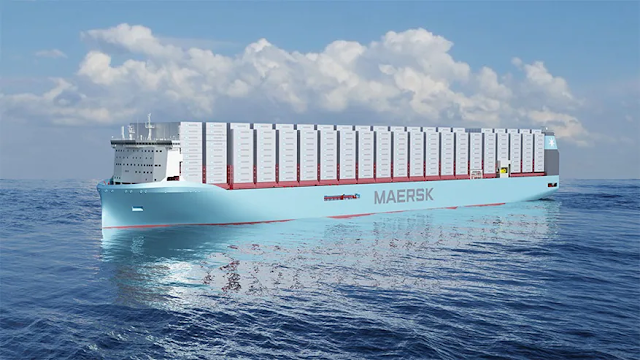
Maersk to Explore Large-Scale Green Methanol Fuel Production with Spain

Maersk to Explore Large-Scale Green Methanol Fuel Production with Spain


MADRID, Nov 3 (Reuters) – Maersk plans to produce up to two million tonnes of e-methanol a year in Spain by 2030 to supply its fleet of cargo ships and reduce its carbon footprint, the shipping giant and the Spanish government said on Thursday.

The project will require an investment of about 10 billion euros ($9.75 billion), according to Spanish government calculations, and Spain may enter as a strategic investor.

An agreement on the project, which will be partly financed by EU recovery funds, was signed on Thursday in Madrid by Maersk CEO Søren Skou and Prime Minister Pedro Sanchez.

It forms part of an objective by Maersk, the world’s second-largest container shipping firm, to achieve net zero emissions in its business by 2040.

Maersk plans to put 19 vessels capable of running on e-methanol between 2023 and 2025, which will require around 750,000 tonnes of the fuel, Maersk said. 

The company will need roughly 6 million tonnes of e-methanol per year to reach its 2030 emissions target, it said.

With global shipping accounting for nearly 3% of the world’s CO2 emissions, the sector is under growing pressure to reduce its carbon footprint.

As the company looks to switch from diesel, finding a reliable supply of greener fuels remains one of its key challenges and has pushed the company to opt for producing its own fuel in strategic locations. 

Sanchez said the project was “perfectly aligned” with Spain’s reindustrialisation and energy transition strategies, adding it would help meet the EU’s commitment to decarbonisation.

The project will begin in the second half of 2024 and is currently securing financing from banks and investors.

“If we enter the shareholding, it would be to give a signal to other companies and investors,” said a senior government source.

The added demand will mean Spain will need to speed up the procurement of renewable plants, but the Spanish government pointed out that Maersk can also opt to buy farms that are already in operation to speed up the process. 

Last year, Maersk announced the launch of the world’s first carbon-neutral liner vessel, which will begin operating in 2023. It has said all future ships will be built with dual fuel technology installed, allowing them to run on either e-methanol or low-sulphur fuel oil. 

($1 = 1.0252 euros)

(Reporting by Belén Carreño, Charlie Devereux and Jacob Gronholt-Pedersen; editing by David Latona and Jason Neely)

Saturday, 23 May 2020

Sticking to lockdown washing routines could cut Britain’s long-term carbon footprint

Sticking to lockdown washing routines could cut Britain’s long-term carbon footprint


  • Changes to our daily routines as a result of lockdown could shrink the nation’s carbon footprint by reducing pressure on energy demand at peak times
  • EDF estimates that if a third of households continue to use their dishwasher and washing machines at non-peak times, annual CO2 emissions could reduce by half a million tonnes - equivalent to more than 750,000 cars switching to electric vehicles
  • 8 in 10 Brits keen to see lifestyle changes that have had a positive impact on the planet continue post-lockdown
Changes to our daily household routines could have a long-term positive impact on our carbon footprint – as data from EDF reveals households continuing to take care of chores throughout the day could reduce the need for fossil-fuelled generation at peak times once industries power up again. 
Historically, households created additional demand for energy at peak times, typically between 4 and 7pm, as people returned home from work and started to tackle these day-to-day chores at the same time. However, since lockdown began, demand for energy throughout the day has smoothed.
The data, released as part of work by the low carbon electricity supplier to assess the impact of lockdown routines on energy efficiency, estimates that if just over a third of households continue to use their dishwasher and washing machines at non-peak times in the future, as they have been doing during the lockdown, annual CO2 emissions could reduce by half a million tonnes – the equivalent to more than 750,000 cars switching to electric vehicles (EVs)*.   
The announcement comes as consumer research** undertaken by EDF reveals 8 in 10 of us are keen to see environmentally-friendly lifestyle changes continue after restrictions are lifted. 
The study of 2,000 UK residents found that lockdown restrictions have caused the nation to reassess the impact of their daily habits on the environment, with 40% planning to take steps to reduce their carbon footprint post-lockdown, rising to 51% of those under the age of 34. The most popular steps were:
  • Walking more (67%)
  • Recycling more (52%)
  • Purchasing more locally produced products (47%)
  • Using the car less (46%)
  • Unplugging electronic devices when not in use (37%)
The reduced pollution levels resulting from dramatically fewer vehicles on the road have also sparked an increased interest in EVs, with 1 in 5 (19%) more likely to consider switching to a low emission EV in the future. 
78% of people believe we can all do more to reduce our carbon footprint once restrictions are lifted. However, despite the potential impact on CO2 emissions, less than a third (31%) are aware that the time of day they do household chores, such as washing dishes and laundry, impacts their carbon footprint.
There is a strong demand for more advice on living greener, with nearly two thirds (62%) wanting information about how to reduce their carbon footprint.

Wednesday, 7 June 2017

The Cruise Industry Remains Committed to the Environment

The Cruise Industry Remains Committed to the Environment

The Cruise Industry Remains Committed to the Environment
PHOTO: Holland America Line's Westerdam in Alaska. (photo by Jason Leppert)

President Donald Trump may have announced that he will be pulling the US out of the Paris climate accord, but the worldwide cruise industry remains committed to environmental protection.
Cruise Lines International Association (CLIA) recently outlined the many ways conservation is promoted within.
“The cruise industry recognizes the importance of taking active measures to preserve our environment and we are constantly striving to develop more eco-friendly practices that enable travelers to stay green’ while traveling,” said Cindy D’Aoust, president and CEO, CLIA, in a press release. “Cruise lines have continued to offer new incentives for earth-friendly travel and know that this attention to our own environmental impact is not only beneficial, it is vital.”
The following are among the many eco-friendly programs and incentives:
Green Policies
Lots of cruise ships partake in recycling and waste treatment at sea as well as on land. Seabourn, for example, specifically utilizes advanced wastewater treatment systems and environmentally-friendly cleaning supplies. It also recycles and donates reusable items.
It continues to increase fuel efficiency every year with new ships including low-flow passenger toilets, sinks and showers.
Dedicated Officers
Many CLIA Members employ dedicated officers charged with daily environmental program oversight. Each Disney Cruise Line ship stations Environmental Officers to check water quality and supply. It trains these officers and crew on waste minimization and environmental safety while supervising initiatives such as recycling.
Sustainable Practices
Cruise lines frequently collaborate with eco-friendly vendors and destinations that seek to reduce their carbon footprint. For one, Uniworld Boutique River Cruise Collection works with environmentally-conscious businesses like organic wineries.
Smart Ships
Smart technologies allow modern ships to conserve energy, water and fuel. Examples include Carnival Cruise Line’s partnership with the South Coast Air Quality Management District, the City of Long Beach, California, and Southern California Edison on shore power.
Similarly, Royal Caribbean International’s Quantum-class and Harmony of the Seas smart HVAC have dropped cooling energy consumption by a quarter.
Waste Minimization & Creative Composting
Up front, cruise lines work to reduce supply packaging and then compost food waste. In fact, MSC Cruises uses incinerators, food pulpers, grinders and compactors for garbage processing while Costa Cruises was the first travel company to sign the Milan Protocol.
Solar Sailing
For ships that can, energy waste is reduced by utilizing renewable battery power and solar energy for some systems. AmaWaterways’ Zambezi Queen employs low-emission generators by day and batteries by night, using solar heating for its hot water supply.
Cruise for the Earth
Green voluntourism is available to guests who want to travel and better the world. Azamara Club Cruises has partnered with World Wildlife Fund, and WWF guest speakers are featured on some sailings.
Corporate cousin Celebrity Cruises also encourages Celebrity Xpedition guests to plant trees in Galapagos National Park in support of the Scalescia reforestation effort.
Wildlife Conservation
The environment’s inhabitants are just as important to cruise lines, and Holland America Line has an "Avoiding Whale Strikes" training program in cooperation with National Oceanic and Atmospheric Administration's (NOAA) and the National Parks Service.
All the company’s deck officers have gone through the course, which is also being shared broadly with the cruise and maritime community.
Proper Disposal
Another crucial element of environmental protection is for crew members and guests to remove garbage responsibly. Crystal Cruises, for instance, promotes its “Crystal Clean” initiatives to communicate environmental education. Of course, it’s important to properly recycle and reuse not only paper and plastic but also glass, aluminum, scrap metal, cooking oil, petroleum oil, toner cartridges, electronics and certain chemicals.
Smarter Sewage
Lastly, technology can also assist in lessening the impact of sewage and water waste, as Avalon Waterways has found with its multi-step procedure and specialized onboard sewage treatment system.


Saturday, 28 June 2014

Fleet-wide renovations planned for Norwegian ships

Fleet-wide renovations planned for Norwegian ships

Norwegian Cruise Line has revealed it plans to invest $250 million (£147 million) in fleet-wide renovations that will take place during the course of 2015.
The NEXT makeover programme will focus on bringing "new enhancements, experiences and transformations" across the fleet and will include improvements to food and drink facilities, as well as entertainment amenities.
According to the firm, the renovations will bring older ships inline with the more modern Norwegian Breakaway and Norwegian Getaway liners.
Kevin Sheehan, chief executive officer of Norwegian Cruise Line, said: "The youngest fleet at sea continues to get even better with our robust enhancement taking place over the next two years, and we want to continue to provide fresh and relevant experiences to our guests every time they sail with us.”
The firm will continue its partnership with children’s television network Nickelodeon and plans to create further entertainment options for its youngest passengers.
According to Norwegian, the iConcierge app will be rolled out to all ships and Wi-Fi facilities will be upgraded. In addition, touch screens and digital signage will be fitted across the whole fleet.
Further technological improvements are planned, focusing specifically on improving efficiency and reducing the carbon footprint of the fleet.