Showing posts with label wind power. Show all posts

Sunday, 27 December 2020

Budweiser and CleanEarth announce Magor Brewery to be Powered by Massive Wind Turbine

Budweiser and CleanEarth announce Magor Brewery to be Powered by Massive Wind Turbine

Budweiser Brewing Group UK&I, a proud part of AB InBev, and renewable energy company, CleanEarth, reached a milestone in the brewer's sustainability efforts. A new wind turbine has been installed at Budweiser Brewing Group's brewery in Magor, South Wales to help power the site with renewable electricity. 

One billion pints

The newly installed turbine will supply nearly a quarter of the energy consumed at Budweiser’s Magor Brewery. As the site produces more than 1 billion pints of beer each year (including Budweiser, Stella Artois, Corona and Bud Light) its power demand is considerable.

Located just under a mile from the brewery, the turbine serves the plant via a direct wire, with Budweiser Brewing Group purchasing the power from CleanEarth through a power purchase agreement (PPA).

The turbine is the latest step in Budweiser Brewing Group’s commitment to brewing its beers with 100% renewable electricity by next year and its continued investment in renewables.

Lloyd Manship, Brewery Manager at Magor Brewery, said, “Having worked at the brewery for more than 20 years, it’s amazing to see how far we’ve come in our sustainability initiatives. The installation of this wind turbine is going to make a huge difference in helping us to operate more sustainably long into the future.”

Unprecedented scale

The Vensys V136 turbine presented significant logistical challenges, especially in the transportation of the blades. The conventional route by road was dropped in favour of shipping them over 800 miles by sea and into Bristol’s Avonmouth Dock, leaving just the last 20 miles to be negotiated by road.

The combination of sheer size with the latest design and engineering technology makes the Magor turbine highly efficient in harnessing the available wind, providing an output of up to 3.5 megawatts.

This will generate 9 million kilowatt-hours of electricity each year – the equivalent of powering 2,300 Welsh homes – while saving more than 2,600 tonnes of CO2 emissions. That’s well over 65,000 tons of carbon savings during its operational lifetime.

Commitment to decarbonization

The partnership between Budweiser and CleanEarth is another important step in the decarbonization of UK businesses. As Paula Lindenberg, President, Budweiser Brewing Group UK&I, said, “We’re committed to brewing Britain’s most sustainable beers. Partnerships like this one with CleanEarth help drive positive change – making it easier for people to make sustainable choices at the pub or on their weekly shop.”

This was echoed by Dean Robson, Managing Director of CleanEarth, who said, “Too often corporate goals are not coupled with strong and effective action – but Budweiser Brewing Group has been supportive at all levels, and have acted throughout with a clarity that’s consistent with their ambitious environmental targets.

“We are proud of the work we’ve done with Budweiser Brewing Group on this project. As a result of this collaboration, CleanEarth will generate low-carbon, low-cost energy into the Magor brewery for years to come.”

Sunday, 25 October 2020

AVANGRID and PNM Resources Announce Merger Plans

AVANGRID and PNM Resources Announce Merger Plans


AVANGRID, a leading sustainable energy company, and PNM Resources announced today that their respective boards have approved the merger of PNM Resources into AVANGRID. Ignacio Galán, chairman of AVANGRID and chairman of IBERDROLA Group, said, "This transaction is a consequence of the IBERDROLA Group’s disciplined strategy followed over more than 20 years. This is a friendly transaction, focused on regulated businesses and renewables in highly rated states with legal and regulatory stability and predictability offering future growth opportunities."

Dennis V. Arriola, AVANGRID’s CEO who will continue as CEO of the combined company, said, “This merger between AVANGRID and PNM Resources is a strategic fit and helps us further our growth in both clean energy distribution and transmission, as well as helping to expand our growing leadership position in renewables.  Our two companies also share the same values as we both are passionate about our customers, employees and the communities we serve. In addition, both AVANGRID and PNM Resources are leaders in environmental, social and governance issues that impact our stakeholders.”

Pat Vincent-Collawn, chairman, president and CEO of PNM Resources, stated, “We are excited to be part of this transaction that provides so many benefits to our customers, communities, employees and shareholders.  Our combined companies provide greater opportunities to invest in the infrastructure and new technologies that will help us navigate our transition to clean energy while maintaining our commitments to our local teams and communities.”

AVANGRID will add two independent board members from PNM Resources to its board of directors and one independent board member from PNM Resources will join the AVANGRID Networks board.

Key Highlights

  • The transaction is expected to be EPS accretive in the first full year after closing.  
  • As a result of PNM’s earnings from regulated distribution and transmission assets, it is expected that AVANGRID’s regulated earnings contribution post-transaction will exceed 80%.  This proportion of regulated earnings will support AVANGRID’s fast-growing renewables business over the next decade.
  • The purchase price represents a premium of 10% over the PNM`s share price as of Tuesday 20th October and 19.3% over the average PNM share price during the 30 days prior to 21st  October. 
  • AVANGRID’s majority shareholder, Iberdrola, has provided the company with a funding commitment letter for the entire equity proceeds for the transaction. 
  • As a result of this transaction, PNM’s shareholders will receive approximately $4.318 billion in cash. 

The agreement between AVANGRID and PNM Resources is subject to approval by PNM Resources shareholders. In addition, the transaction will require approval from a number of state and federal regulators including the New Mexico Public Regulation Commission, Public Utility Commission of Texas, Federal Energy Regulatory Commission, Hart Scott Rodino Clearance, Committee on Foreign Investment in the United States, Federal Communications Commission and the Nuclear Regulatory Commission.  Regulatory approvals are expected to be completed in approximately 12 months.

AVANGRID currently owns 1,900 MW of renewable energy and a pipeline of 1,400 MW of renewables assets in New Mexico and Texas.  In addition, Iberdrola operates a retail business in Texas. For more than 15 years, Iberdrola has also funded the King Felipe VI Chair in the Department of Electrical and Computer Engineering at the University of New Mexico.

Thursday, 17 September 2020

Oil Billionaire Says It’s Time to Move Focus to Renewables

Oil Billionaire Says It’s Time to Move Focus to Renewables


By Mikael Holter (Bloomberg) — Norwegian billionaire Kjell Inge Rokke, who built most of his fortune on oil and gas, says the time has come to start investing more heavily in renewable energy.

The 61-year-old suggested that a tipping point had now been reached in the energy industry while underscoring his conviction that the world will continue to need fossil fuels for years to come.

“A good hunter is a patient hunter,” Rokke said during a webcast panel discussion. He also said that investors who started “too early” has “burned through cash.”

Rokke’s investment company Aker ASA took steps earlier this year to spin off clean-energy units, joining a whirlwind of change that’s sweeping the global oil industry. The new companies have since surged in line with other renewable stocks as investors flock around sustainable assets.

In a rare public appearance at Pareto Securities AS’s Energy Conference on Wednesday, Rokke said he had discussed the timing with Aker Chief Executive Oyvind Eriksen for years.

“The key thing for us is to listen, when you are wrong, admit it, and change direction,” Rokke said. “That’s something that has served us well in this extraordinary shift in the energy sector.”

Aker’s 40% stake in oil producer Aker BP ASA, where BP Plc owns 30%, still makes up more than half of the holding company’s value. Rokke dismissed “doomsday sayers” and said Norway shouldn’t stop producing oil and gas. But he also predicted that other businesses will rapidly rise to make up most of his empire.

In as little as five years, Aker’s exposure to digital solutions and IT, primarily through its majority stake in Cognite AS, could make up between half and two-thirds of the company’s value, Rokke predicted. “Quote me on that five years from now,” he said.

“What we’re doing in the green space is also exciting,” he said. “Less than 10% of offshore wind has been installed so far. We are in the infancy.”

Aker is also working on establishing a separate unit dedicated to hydrogen, Eriksen said in a presentation before Rokke spoke.


Monday, 15 June 2020

Norway Opens Expansive Offshore Areas to Wind Development

Norway Opens Expansive Offshore Areas to Wind Development

offshore wind farm

The Norwegian government has announced the opening of more than 860,000 acres of the Norwegian Continental Shelf to offshore wind development.
The areas, known as “Utsira Nord” and “Sørlige Nordsjø II”, are located in Norwegian waters in the northern North Sea. Combined, the two areas allow for the development of 4,500 MW of wind power.
“Offshore wind power offers great opportunities for Norwegian businesses,” said Tina Bru, Minister for Petroleum and Energy. “In the immediate future the market will be in other countries, but if the costs for offshore wind power continues to fall it could also become competitive in Norway. It is now time to prepare for future development by allocating space for offshore renewables.”
.
A proposal to open areas and a draft regulation were open for public comment in 2019.
The Utsira Nord is located to the west of Haugesund and is ideally suited for floating wind power. The area is also large, encompassing 1,010 square kilometres close to shore.
The Sørlige Nordsjø II borders the Danish sector in the North Sea and could be best suited for “direct export” of electricity. The area spans 2,591 square kilometres in mostly shallow water that would allow traditional wind turbines.
The Norwegian government has set an opening date of 1 January 2021.

Thursday, 11 June 2020

Demands grow for 'green industrial revolution'

Demands grow for 'green industrial revolution'

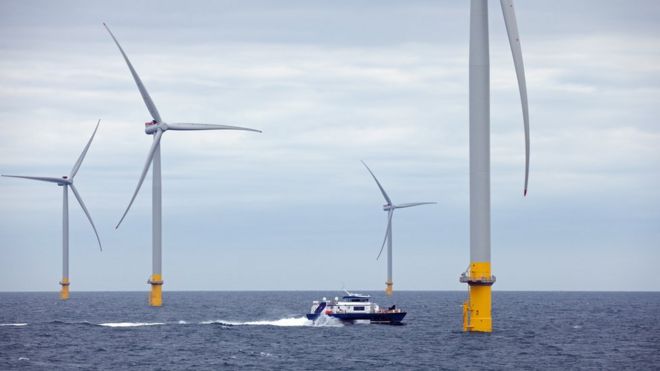
Offshore wind farm
The document plans for a massive expansion in offshore wind

Greenpeace has joined a growing list of organisations demanding that the UK government puts protecting the environment at the heart of any post-COVID-19 economic stimulus package.
The campaign group has produced a detailed "manifesto" with measures to boost clean transport and smart power.
The document follows a comparable call from some of Britain's most powerful business leaders earlier this week.
Last week, the prime minister also expressed a similar ambition.
Boris Johnson said he wanted to see a "fairer, greener and more resilient global economy" after Covid-19 and that "we owe it to future generations to build back better".
The manifesto also contains measures to support the protection of nature, green buildings and the creation of an economy in which virtually everything is reused.
Greenpeace says the crisis has given Britain a "once in a lifetime" opportunity to transform life, travel and work.
It added that the plan would create hundreds of thousands of secure jobs.

Green business

On Monday, more than 200 chief executives of some of the UK's top firms - including HSBC, National Grid, and Heathrow airport - signed a letter to the prime minister asking him to use the Covid-19 lockdown as a springboard to "deliver a clean, just recovery".
Many people may be surprised how similar the recommendations of these two very different interest groups are.
  • Both Greenpeace and the chief executives are asking the government to prioritise investments in low carbon technologies and calling for the decarbonisation of the British economy to be speeded up
  • Both say they want to see a focus on sectors that best support the environment
  • Both are demanding that financial support for ailing businesses must come with a requirement for them to commit to taking action to reduce their impact on the environment.
Greenpeace's manifesto is, however, considerably more detailed.
It is a 62-page document with a specific policy, spending and tax measures covering most of the British economy.
It calls on the government to deliver its 2050 net-zero emissions goal before 2045.

Controversial policies

BikeImage copyrightGETTY IMAGES
Image captionThe manifesto contains measures to encourage clean transport
However, lots of the policies Greenpeace proposes would prove very controversial.
For example, motorists say they are ready to change their behaviour to improve air quality, according to a recent AA survey.
But many drivers may balk at Greenpeace's proposals to radically redesign the road network to favour walking and cycling, at the suggestion that petrol and diesel cars are banned by 2030 or that fuel duty is steadily increased.
Many homeowners might be reluctant to spend money to upgrade their properties to meet tough energy efficiency standards.
At the same time, many local communities are likely to resist the plan for a big increase in onshore wind and solar power to complement a proposed massive expansion of offshore wind farms - few things unite local communities like a proposal to put in an array of wind turbines.
Plastic bottles at recycling plantImage copyrightGETTY IMAGES
Image captionThe manifesto proposes the creation of an economy in which virtually everything is reused
But, says Greenpeace, tough policies like these are essential if the government is going to take meaningful action to tackle climate change.
"The choices our government makes now will define… whether or not we succeed in the fight against the climate emergency", says John Sauven, executive director of Greenpeace.
"If we fail to get this right, we may never get another chance. Now is the time for a green recovery, and for that, we need action, not words."
It says there would be huge dividends in terms of job creation, should its programme be adopted.
Greenpeace calculates that its plans would create hundreds of thousands of new high-skilled jobs as well as helping to level up inequalities between communities in the UK.

Unique opportunity

The UK government has already indicated that protecting the environment will feature heavily in any stimulus package.
Back in April, Boris Johnson said a post-COVID-19 recovery plan should include efforts to "turn the tide on climate change".
Meanwhile, the European Union has unveiled what it called the biggest "green" stimulus in history.
Last week, it said it planned to commit a whopping €750bn (£667bn; $841bn) to its recovery package.
Add in spending from future budgets and the total financial firepower the European Commission says it will be wielding is almost €2tn (£1.8tn; $2.2tn).
Fighting climate change is at the heart of the bloc's recovery from the pandemic.
There will be tens of billions of euros to make homes more energy-efficient, to de-carbonise electricity and phase out petrol and diesel vehicles.
The idea is to turbo-charge the European effort to reduce carbon emissions to net-zero by 2050.
"If we do not do it, we will be taking much more risk," Teresa Ribera, deputy prime minister of Spain, told the BBC.
"The recovery should be green or it will not be a recovery, it will just be a shortcut into the kind of problems we are facing right now."

Wednesday, 22 January 2020

MSC Cruises expanding World-class, and more

MSC Cruises expanding World-class, and more

 MSC's first World class ship is due in 2022.
MSC's first World-class ship is due in 2022. MSC Europa

 MSC Cruises ordered two more cruise ships in its World-class and agreed to develop two additional ship classes. One will have at least four vessels and the other could use wind power.

The two firm ships orders and memorandum of understanding to build the two new prototypes represent a combined value of about $7 billion.

An agreement for the ships and prototypes was made with French shipyard Chantiers de l’Atlantique.

MSC placed orders for its third and fourth World-class ships, powered by liquefied natural gas (LNG), to be delivered in 2025 and 2027.

The new four-ship class will also be LNG-powered, MSC said, while another prototype will incorporate emerging technologies such as wind power.

MSC executive chairman Pierfrancesco Vago said that the investments “confirm this industry’s commitment to environmental sustainability.”

The four new vessels will represent a capital investment exceeding $4.4 billion, MSC said, adding to the $2.2 billion for the two additional World Class ships.

The Chantiers shipyard in Saint-Nazaire, France, is currently building the first two ships in the line’s World-class. The first of those 5,264-passenger, 205,000-gross-ton vessels, due to enter service in 2022, will be the largest ship operated by a European cruise line.