Showing posts with label CO2 emissions. Show all posts

Thursday, 2 November 2023

EU Shore Power Regulations Fall Short of Potential

EU Shore Power Regulations Fall Short of Potential

MSC Virtuosa connected to the Shoreside Power System  photo credit Spacejunkie2 (flickr)

The European Union (EU) is in a race to decarbonize the commercial shipping industry, and part of the strategy includes a requirement for ships to plug into shore power across the bloc’s ports. In line with the FuelEU Maritime Regulation and the Alternative Fuels Infrastructure Regulation, container and cruise ships over 5,000 GT must connect to shore power in the largest EU ports come January 2030.

The regulations have been hailed as critical measures in decarbonizing maritime transport, which accounts for three to four percent of total CO2 emissions in the EU. However, achieving shore power ambitions will be a herculean task. According to the International Council on Clean Transportation (ICCT), the bloc will only achieve a 24 percent reduction of at-berth CO2 emissions under the current setup.

The NGO contends that to achieve a 100 percent at-berth reduction in CO2 emissions, the forthcoming revision of both regulations should include a requirement for all ships greater than or equal to 400 GT to connect to shore power in EU ports. To achieve this, the EU will require nearly 1,929 MW of additional shore power installation to meet average at-berth annual energy demands, and 3,342MW for peak energy demand.

It also argues that boilers should also be retrofitted, electrified, or connected to shore power facilities, just like auxiliary engines, because they are responsible for 44 percent of all at-berth CO2 emissions. Boilers would require 36 percent of all needed shore power for ships berthing in EU ports.

The paper highlights that increasing the level of ambitions by including at-berth electricity demand for all ship types greater than or equal to 400 GT could reduce CO2 emissions by 42 percent. Adding more ports would help to avoid 58 percent of the total at-berth CO2 emissions.

Currently 51 ports in 15 EU member states are equipped with 340 shore power connectors, and Sweden, the Netherlands and Germany lead the pack. The current shore power network supplies around 309 MW, mostly for container, passenger and cruise ships.

Though cargo ships are the most common docking in EU ports, accounting for 43 to 46 percent, their energy demands are relatively low at 14 percent of the total. In contrast, despite their small absolute number in the fleet, the energy demand of cruise ships stands at 21-28 percent of the total. 

The largest additional shore power installations will be needed in Italy, Spain and France where energy demand cumulatively stands at 3,004 GWh, mainly due to high cruise ship traffic. Cruise ships alone in the three countries would account for 59 to 63 percent of shore power needed. 

Sunday, 25 June 2023

MSC Cruises and Gasum Partner for LNG Solutions

MSC Cruises and Gasum Partner for LNG Solutions


The Cruise Division of MSC Group and Gasum have signed a long-term agreement for the supply of liquefied natural gas (LNG) to the new flagship of its MSC Cruises brand, MSC Euribia, as well as a Letter of Intent (LOI) to cooperate on the supply of synthetic e-LNG made with renewable energy, according to a joint company statement.

This is part of the cruise company’s strategy to achieve net zero greenhouse gas emissions from its marine operations by 2050.

The LOI between MSC Cruises and Nordic energy company Gasum is a landmark cooperation that aims at securing MSC access to liquefied synthetic gas, or e-LNG, which is produced using hydrogen, created by hydrolysis with renewable energy and captured CO2, the companies said.

Gasum and MSC Cruises are together creating an actionable roadmap for cutting emissions in MSC’s cruise operations with sizeable volumes of several thousand tons of e-LNG starting in 2026.

The companies also signed a long-term agreement on the delivery of LNG for MSC Euribia.

With this agreement, Gasum supports MSC Cruises in cutting emissions with the immediate use of LNG.

Linden Coppell, Vice President of Sustainability & ESG, MSC Cruises, said: “We are delighted to be partnering with Gasum on our journey to net zero greenhouse gas emissions. Securing a reliable supply of LNG and e-LNG is of critical importance to our decarbonisation efforts, and the LOI and long-term agreement that we have announced today are significant steps on that journey. Partnering with Gasum will enable us to access new and cleaner fuels needed to make net zero cruising a reality. We need more suppliers like Gasum to step up and support our industry with its environmental targets. We are ready and waiting to buy more of these new fuels.”

Mika Wiljanen, CEO, Gasum added: “As an alternative fuel supplier dedicated to the energy transition, Gasum is proud to offer support to MSC Cruises, a major maritime player, in their quest to improve the environmental footprint of their operations. At the same time, MSC Cruises is supporting the development of the most promising alternative fuel by proving demand for it. This LOI on e-LNG is a landmark agreement for the shipping industry as it demonstrates that e-LNG will be available to the maritime transport sector within a short timeframe. We are also very happy about the long-term LNG supply agreement which we believe is the start of long-lasting cooperation.”

Saturday, 11 February 2023

Norwegian Cruise Line Holdings Completes Biofuel Trial

Norwegian Cruise Line Holdings Completes Biofuel Trial


PRIO, a producer of biofuels in Portugal, and Norwegian Cruise Line Holdings in collaboration with World Fuel Services (WFS) have successfully completed the first trials with sustainable biofuels produced in Portugal, according to a press release.

Following the launch of ECO Bunkers B15 and taking the first step towards the decarbonization of maritime transport in the Iberian Peninsula, PRIO has announced a blend of Biofuels with 30 per cent renewable base material.

This milestone was achieved in collaboration with Norwegian Cruise Line Holdings and the Florida-based energy and services company World Fuel Services.

The new fuel, ECO Bunkers B30, contains a blend of 30 per cent of advanced biofuel from waste raw materials and it is produced at PRIO’s biodiesel plant in Aveiro. This enables the company to scale up production as demand increases and to adjust the percentage of Biodiesel blends (up to a 100 per cent renewable product).

Luis Nunes, a member of PRIO’s Executive Board said: “Advanced biofuels, produced from residual raw materials, i.e., the result of circular economy, are the solution of the present and that allows us to immediately meet the growing needs of our clients. They are “drop-in” solutions, meaning that they did not require any modifications to the engine or tank of Norwegian Cruise Line Holdings’ cruise ships and, in this way, allowed an immediate impact without any need for additional investment in these ships.

“We are at a crucial moment in the world’s response to climate and biodiversity emergencies, so PRIO believes we can already accelerate the energy transition if we increase the contribution of advanced biofuels in the maritime sector,” he added.

PRIO has established itself as the ideal partner for maritime companies on the road toward decarbonization of the sector.

With the help of World Fuel Services, two Norwegian Cruise Line Holdings ships were fueled with a total of 400 tons of B30 supplied by PRIO last year.

The Norwegian Star received 200 tons of ECO Bunkers B30 in Lisbon in November.

The following week, the Norwegian Epic, received another 200 tons of ECO Bunkers B30. This has enabled the cruise company to avoid approximately 440 tons of CO2 emissions.


Monday, 12 December 2022

Chantiers de l’Atlanique: Exploring Windpower

Chantiers de l’Atlanique: Exploring Windpower


Chantiers de l’Atlantique has announced it has manufactured its first carbon-fibre mast in collaboration with Lorima, Mulitplast, Avel Robotics, CDK Technologies and SMM.

Sixty-six meters tall and 2 meters wide, the mast weighs approximately 20 tons and can carry a SolidSail of 1,500 square meters.

SolidSail is a foldable sail made of 100 per cent composite materials and has been created by Chantiers de l’Atlantique.

SolidSail is designed to propel Silenseas, which is currently being developed by the French shipbuilding company, and will be the largest wind-powered cruise ship in the world. The concept can also be applied to cargo ships.

The Aeoldrive rig, which comprises the SolidSail mast and sail, is described as being fully automated, able to rotate 360 degrees, and the masts can rotate or tilt 70 degrees to go under bridges.

Chantiers de l’Atlantique said it is spearheading the design and manufacturing of tomorrow’s ships. Partly wind-powered, these ships may see their CO2 emissions reduced by up to 40 per cent, according to a prepared statement. Further work on energy efficiencies will reduce CO2 emissions by 25 to 40 per cent.

Friday, 4 November 2022

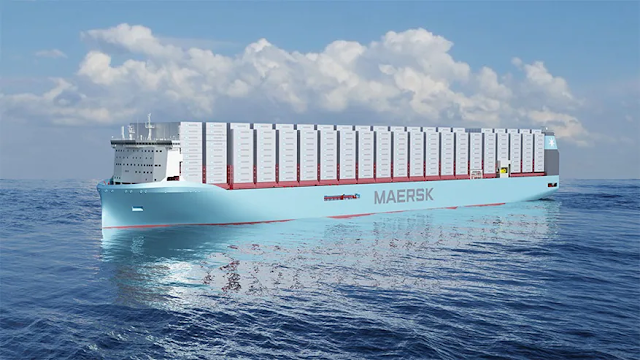
Maersk to Explore Large-Scale Green Methanol Fuel Production with Spain

Maersk to Explore Large-Scale Green Methanol Fuel Production with Spain


MADRID, Nov 3 (Reuters) – Maersk plans to produce up to two million tonnes of e-methanol a year in Spain by 2030 to supply its fleet of cargo ships and reduce its carbon footprint, the shipping giant and the Spanish government said on Thursday.

The project will require an investment of about 10 billion euros ($9.75 billion), according to Spanish government calculations, and Spain may enter as a strategic investor.

An agreement on the project, which will be partly financed by EU recovery funds, was signed on Thursday in Madrid by Maersk CEO Søren Skou and Prime Minister Pedro Sanchez.

It forms part of an objective by Maersk, the world’s second-largest container shipping firm, to achieve net zero emissions in its business by 2040.

Maersk plans to put 19 vessels capable of running on e-methanol between 2023 and 2025, which will require around 750,000 tonnes of the fuel, Maersk said. 

The company will need roughly 6 million tonnes of e-methanol per year to reach its 2030 emissions target, it said.

With global shipping accounting for nearly 3% of the world’s CO2 emissions, the sector is under growing pressure to reduce its carbon footprint.

As the company looks to switch from diesel, finding a reliable supply of greener fuels remains one of its key challenges and has pushed the company to opt for producing its own fuel in strategic locations. 

Sanchez said the project was “perfectly aligned” with Spain’s reindustrialisation and energy transition strategies, adding it would help meet the EU’s commitment to decarbonisation.

The project will begin in the second half of 2024 and is currently securing financing from banks and investors.

“If we enter the shareholding, it would be to give a signal to other companies and investors,” said a senior government source.

The added demand will mean Spain will need to speed up the procurement of renewable plants, but the Spanish government pointed out that Maersk can also opt to buy farms that are already in operation to speed up the process. 

Last year, Maersk announced the launch of the world’s first carbon-neutral liner vessel, which will begin operating in 2023. It has said all future ships will be built with dual fuel technology installed, allowing them to run on either e-methanol or low-sulphur fuel oil. 

($1 = 1.0252 euros)

(Reporting by Belén Carreño, Charlie Devereux and Jacob Gronholt-Pedersen; editing by David Latona and Jason Neely)

Thursday, 4 August 2022

Carnival Corporation is upgrading its ships’ engines and technical systems to improve energy efficiency

Carnival Corporation is upgrading its ships’ engines and technical systems to improve energy efficiency


The "service power packages" upgrades will include ongoing installations throughout 2023 on ships belonging to the company’s nine brands – Carnival Cruise Line, Princess Cruises, Holland America Line, Seabourn, P&O Australia, Costa Cruises, Aida Cruises, P&O Cruises and Cunard.


Developed over the last six years and tailored to each vessel, upgrades to save energy include investments in variable speed drives and on-demand automation and controls, cooling enhancements, energy-saving LED lighting and more efficient heating and ventilation systems.


Carnival estimates the programme will deliver an average of 5-10% fuel savings per ship and is expected to reduce fleet-wide greenhouse gas emissions by more than 500,000 metric tons each year.


The upgrades will also result in around $150 million in fuel cost savings per year.


Carnival’s chief maritime officer Bill Burke said: “Based on our improved fleet composition, including adding six industry-leading LNG-powered ships, and our previous investments to increase efficiency and reduce emissions, our absolute carbon emissions peaked in 2011 despite significant capacity growth over the past decade.”


“These tailored service power packages further build on those efforts as part of our comprehensive approach to sustainability.”


The fleet-wide enhancements are part of Carnival’s energy efficiency investment programme. The company has committed to reducing carbon emission intensity by 20% from its 2019 baseline by 2030, supporting its efforts to achieve net carbon-neutral ship operations by 2050.


Tuesday, 12 July 2022

MSC Cruises Adds Electric Buses for Shore Excursions in Barcelona

MSC Cruises Adds Electric Buses for Shore Excursions in Barcelona


MSC Cruises has chosen Barcelona as its main port this summer for shore excursions to be operated by electric buses as part of the line’s ongoing sustainability drive, the company said, adding that it is committed to achieving net-zero carbon emission operations by 2050.

Daily excursions for guests from the Spanish port number between 20 and 25 journeys and the use of electric buses will make an annual saving of nearly 10,500 kilograms of CO2 emissions compared to petrol-driven vehicles., according to a statement.

The electric buses are also significantly quieter and reduce potential noise impact on local communities. 

MSC Cruises estimates that the new electric buses will transport up to 2,000 passengers every week during the summer from Barcelona and it is working with local tour operators to increase the figure to 4,000 customers with the introduction of more eco-friendly buses to join its sustainable ground transport fleet.

The busses will be available this summer for cruise passengers calling at Barcelona onboard the MSC Armonia, MSC Bellissima, MSC Divina, MSC Fantasia, MSC Grandiosa, MSC Lirica, MSC Magnifica, MSC Meraviglia, MSC Opera, MSC Orchestra, MSC Poesia, MSC Seaview and MSC Virtuosa.

MSC Cruises’ new 11,670 square meter cruise terminal at Barcelona is due to open in 2024 and sustainability credentials will be incorporated into the building.  The new cruise terminal is on track to be ‘Gold Rated’ under the Leadership in Energy and Environmental Design - LEED - standard, a widely used global green building rating system.


Monday, 26 July 2021

MSC, Fincantieri and Snam Partner for ‘World’s First Oceangoing Hydrogen-Powered Cruise Ship’

MSC, Fincantieri and Snam Partner for ‘World’s First Oceangoing Hydrogen-Powered Cruise Ship’


MSC Cruises, Fincantieri and Snam have announced the signing of a Memorandum of Understanding to jointly determine the conditions for the design and construction of what would become the world’s first oceangoing hydrogen-powered cruise ship.

According to a press release, MSC Group, Fincantieri and Snam have joined forces to initially carry out a study that will assess the feasibility of designing and building “the world’s first ocean-going cruise ship powered by hydrogen.” MSC Group said that the ship would allow zero-emissions operations in certain areas and the development of the related hydrogen bunkering infrastructure.

Green hydrogen can be produced without fossil fuels, using renewable energy to split water in a process called electrolysis and can therefore be emissions-free on a full lifecycle basis, MSC said. It can be used to generate electrical power through a fuel cell, emitting only water vapour and heat. This type of ‘green’ hydrogen holds great potential to contribute to the decarbonization of the shipping industry, including cruising, whether in its pure form or as a hydrogen-derived fuel.

“As a company that has long made environmental sustainability its focus, we want to put ourselves at the forefront of the energy revolution for our sector and hydrogen can greatly contribute to this. However, today production levels remain low and hydrogen fuel is still far from being available at scale. With this project, we’re taking the lead to bring this promising technology to our fleet and the industry while sending the strongest possible signal to the market about how seriously we take our environmental commitments. As we advance with the development of the maritime technology required, we will also see that energy providers take note and ramp up production to unlock this and that governments and the public sector step in to provide the necessary support for a project that is critical to the decarbonization of cruising and shipping,” said MSC Group’s Executive Chairman of the Cruise Division, Pierfrancesco Vago.

The CEO of shipbuilding group Fincantieri, Giuseppe Bono, said that “every opportunity for new solutions and technologies is a source of growth for us.”

“This one allows us to offer our customers the best of innovation to help minimize the environmental impact,” he noted.

The CEO of international energy infrastructure operator Snam, Marco Alverà, said that the company was “strongly committed” to concrete initiatives for sustainable heavy transport – on the road, rail and by the sea – promoting the use of renewable gases such hydrogen and bio LNG.

“This agreement for us is part of a wider strategy to leverage on our experience, competencies and technologies in green gases and energy efficiency in order to contribute to the full decarbonization of the shipping value chain, including ports and logistics, which will be increasingly crucial in our economies,” Alverà explained.

“Hydrogen could be a key enabler in achieving the target of net-zero emissions in shipping, accounting for approximately 3 per cent of global CO2 emissions, as well as in all the hard to abate sectors,” he added.

As per the terms of the Memorandum of Understanding, during the next 12 months, the three companies will study key factors related to the development of oceangoing hydrogen-powered cruise ships.

These include arranging ship spaces to accommodate H2 technologies and fuel cells, technical parameters of onboard systems, calculating the potential greenhouse gas emissions savings, and technical and economic analysis of hydrogen supply and infrastructure.

MSC Cruises said that it was committed to achieving net carbon neutral operations by 2050.

“To accomplish this objective, the company is working in partnership with a wide range of shipyards, suppliers, manufacturers and other organizations as well as investing in different upcoming technologies and solutions for its fleet,” MSC Group wrote. “The implementation of the cooperation above described will possibly be an object of future binding agreements to be discussed by the parties in relation thereto.”

Sunday, 27 December 2020

Budweiser and CleanEarth announce Magor Brewery to be Powered by Massive Wind Turbine

Budweiser and CleanEarth announce Magor Brewery to be Powered by Massive Wind Turbine

Budweiser Brewing Group UK&I, a proud part of AB InBev, and renewable energy company, CleanEarth, reached a milestone in the brewer's sustainability efforts. A new wind turbine has been installed at Budweiser Brewing Group's brewery in Magor, South Wales to help power the site with renewable electricity. 

One billion pints

The newly installed turbine will supply nearly a quarter of the energy consumed at Budweiser’s Magor Brewery. As the site produces more than 1 billion pints of beer each year (including Budweiser, Stella Artois, Corona and Bud Light) its power demand is considerable.

Located just under a mile from the brewery, the turbine serves the plant via a direct wire, with Budweiser Brewing Group purchasing the power from CleanEarth through a power purchase agreement (PPA).

The turbine is the latest step in Budweiser Brewing Group’s commitment to brewing its beers with 100% renewable electricity by next year and its continued investment in renewables.

Lloyd Manship, Brewery Manager at Magor Brewery, said, “Having worked at the brewery for more than 20 years, it’s amazing to see how far we’ve come in our sustainability initiatives. The installation of this wind turbine is going to make a huge difference in helping us to operate more sustainably long into the future.”

Unprecedented scale

The Vensys V136 turbine presented significant logistical challenges, especially in the transportation of the blades. The conventional route by road was dropped in favour of shipping them over 800 miles by sea and into Bristol’s Avonmouth Dock, leaving just the last 20 miles to be negotiated by road.

The combination of sheer size with the latest design and engineering technology makes the Magor turbine highly efficient in harnessing the available wind, providing an output of up to 3.5 megawatts.

This will generate 9 million kilowatt-hours of electricity each year – the equivalent of powering 2,300 Welsh homes – while saving more than 2,600 tonnes of CO2 emissions. That’s well over 65,000 tons of carbon savings during its operational lifetime.

Commitment to decarbonization

The partnership between Budweiser and CleanEarth is another important step in the decarbonization of UK businesses. As Paula Lindenberg, President, Budweiser Brewing Group UK&I, said, “We’re committed to brewing Britain’s most sustainable beers. Partnerships like this one with CleanEarth help drive positive change – making it easier for people to make sustainable choices at the pub or on their weekly shop.”

This was echoed by Dean Robson, Managing Director of CleanEarth, who said, “Too often corporate goals are not coupled with strong and effective action – but Budweiser Brewing Group has been supportive at all levels, and have acted throughout with a clarity that’s consistent with their ambitious environmental targets.

“We are proud of the work we’ve done with Budweiser Brewing Group on this project. As a result of this collaboration, CleanEarth will generate low-carbon, low-cost energy into the Magor brewery for years to come.”