Saturday, 20 September 2014

Why Google's designs on travel aren't good news for the big OTAs

Why Google's designs on travel aren't good news for the big OTAs

by David Stevenson
by David Stevenson

by David Stevenson, FT columnist and Travel Weekly's City Insider
Is the travel industry going the way of publishing - unwillingly turned into a digital product which is under the effective control of a single dominant player, such as Amazon or Google?
Until fairly recently I'd have laughed out loud at this kind of techno babble suggestion.
Travel is quite clearly completely different from publishing and being honest I'd be a wealthy man worth many millions of pounds if I'd have pocketed a £1 from each and every person who said Google is coming after travel.
Well, truth be told Google hasn't actually done very much in travel to date and to compare its baby steps with Amazon's omnipotent control of the publishing sector has until now been frankly risible.
Yet over the last few weeks I've slowly started to change my mind. 
Big changes are afoot in the world of digital travel and we may eventually end up in a market place where Google has indeed built a dangerously powerful position.
My damascene conversion to the threat from Google has been prompted by a number of varying encounters and observations over the long summer months.
The first epiphany came via a friend in publishing who is trying at a very senior level to fight off Amazon's predatory pricing regime.
He observed - with a deep sigh - that all business battles are in essence a fight between brands and channels, all mediated by the customer's experience of both researching and then consuming a product.
In the good old days before the internet we physically shopped for product of course, and welcomed the choice and variety on the high street. In the new digital age the reality is very different.
We welcome lots and lots of brands producing varying products but in reality we actually only want a few channels to market and distribution.
No-one really takes pleasure in shopping in the digital 'mall' unlike the real world ones where there are nice coffee shops and fun places to visit and spend your money.
So the internet has the net effect of drastically reducing the avenues of distribution.
Book publishers thought the internet would be revolutionary and promising whereas what they've actually discovered is that everyone bar Amazon has failed to make a profit (and even they struggle) distributing the elusive 'content'.
So in simple language the internet eventually consumes its channels and produces one or two omnipotent distributors.
Amazon is quite clearly that channel in books, but what makes us think that Google could eventually offer up that role in travel?
Cue my next conversation with a major West Coast VC who is also a good friend and sadly for my first acquaintance a very happy investor in Amazon.
This  venture capitalists view is simple - Google wants to rip apart the existing model of digital travel (populated by all manner of OTAs) and create a new architecture with it and TripAdvisor at the top of the ecosystem.
And once it realises that its vision is slowly becoming reality it'll simply buy TripAdvisor - "I give it three years before it decides to spend a tonne of money on buying Trip".
But why on earth would Google want to own the world's dominant review site - one simple word should suffice, search. 
This elusive term - which means so many different things to different people - is being revolutionised by mobile which is turn opening up a land grab.
Google is determined to own lock, stock and barrel this mobile opportunity as  part of its strategy to own multiple channels to personalised data.
It's intuition is based on something I've been aware of for many years - travel is disjointed and profoundly annoying as a consumer.
Every day I look at my inbox and see multiple emails from the likes of Tripit asking me to organise my trips,
Hotels.com telling me about yet another private members only sale, Groupon shouting about some amazing local offer and TripAdvisor educating me about some of my favourite places.
In sum its confusing and disjointed and for the most part these emails end up in the deleted folder. But rather like the journalists who  use Google Alerts to keep them posted of all news about a favourite subject, what if Google could control all those flows of offers, and then personalise them to my own interests ? At minimum I'd let the message  into my inbox and may even be tempted to buy off its list.
This aggregation of research and search requires three essential components from a supplier :
a) I want it to inform me of the latest offers relevant to me
b) Tell me about products I trust, in places I like, supplied by people who I've used before or are recommended by friends 
c) Last but by no means least, some of us may also be interested in a constant social conversation about the product to help shape my friends views (though quite why anyone would actually want to do that is beyond me). This step may involve not only views but also content and video.
It's against this backdrop that a bunch of papers by US advisory firm Evercore stand out. Penned by Ken Seda and his colleagues these start to map out precisely what Google may be up to in the world of digital travel and search - and why the OTAs in particular have a great deal to fear.
The most recent report is from September and is entitled Google's Travel Plans in a Post-Atomic Era, but you should also make a point of reading the earlier Google’s Summer Online Travel Plans report from March.
Seda and colleagues think that Google has essentially decided to cross the rubicon and take on its big customers like Priceline and Expedia. These huge OTAs have been very reliable customers for the search giant but history teaches us that eventually Google decides it can do the job better .
Starting with a number of small scale initiatives  Google is pushing into the OTA territory, with products such as Limited Offers linked to Google's Hotel finder service.
Next up will come a yet to be branded 'captive demand platform' which will allow Google's hotelier customers the ability to upload their secret lists of loyal, valuable customers into the Google engine and then churn out very special rates to customers.
Finally all this will be connected back to Google Wallet, allowing the search giant to control the whole process of research and booking.
This activity opens up a number of possibilities  not least the rise of opaque pricing based on personalised information - a huge departure from the existing rate parity agreements signed with the OTAs, with the potential to push prices below the advertised price on Priceline and Expedia.
Key to this push by Google is the bait for hoteliers - they keep the customer lists and transactions and don't have to rely on the existing 'atomic' model managed by OTA merchants where between 15% and 25% of all revenues is taken as commission.
Data is now owned by the brand marketing channel, allowing them to aggressively market to their own private lists of customers.
According to Ken Seda at Evercore, the OTAs are going to lie down in this battle, with Priceline in particular fighting back by buying up specialist outfits such as Buteeq, HotelNinjas and Open Table - the game plan here is to effectively build another leg to the business allowing the OTAs to turn into white label customer intelligence and servicing propositions for hoteliers.
As these changes start to ripple through the industry I'd wager that we'll see some profound changes, not least for the rabble of OTAs scrapping around for business.
The key challenge is that the direct travel model is a classic 'middle man' squeeze waiting to happen. Technology teaches us that eventually the market finds a way to squeeze out the expensive middle man, even if they provide a valuable service.
Lurking beneath this push for market control is a cold reality - the OTAs who account 20% of travel ad spend while contributing to 8% of global bookings, and they simply charge too much. According to the Evercore analysts they reckon that Priceline and Expedia "charge hoteliers over 20% of each booking  on average (adjusted to account for just hotels), whereas Amazon and EBAY take closer to 13% and 9%, respectively)....".
Google is slowly but surely eying up this model and seeing a huge new market especially as mobile helps to redefine everything, almost instantly removing some traditional channel superiority.
This'll force the OTAs to plump for one of  three options - be the biggest and offer the most comprehensive selection (the Expedia model), start to look at white labelling and working with hoteliers to provide optimisation services (the fast emerging Priceline approach) or become the brand customers trust and base your product around search and knowledge via reviews (the Tripadvisor model).
And what of the implications for the rest of the travel sector ? The obvious issue here is that Google has woken up to the simple realty that all travel research is about search and that what helps us all search better is personalised, valuable information.
Cut the jargon and one simple fact jumps out - we all want to cut the time we spend online working out what to do next. 
Evercore cites a  Google Travel study presented to its Hotel Finder partners, which cited " that travellers spend an average 55 minutes to book a hotel and flight, visit 17 websites, and click 4 different search ads per travel search, with 90% of those travellers conducting the booking process over multiple screens. 
The point of its presentation seemed to be a need for a streamlined bookings path, one where Google can retain the traveller from Search to Research to Book".
And Google already starts off with an advantage - according to the Evercore paper again "22 billion hotel searches are performed on Google per month with 58% of travellers (64% of business travellers) beginning their travel experience on Google, according to Ipsos MediaCT/Google Travel Study.  However, there is some question as to how many of those that start their search on Google were actually led to a booking decision by Google”. 
My own slightly off-beat take on this is that most major existing travel businesses should give up thinking they can stop the Google juggernaut, back it in its fight against the OTAs and then build their own platforms on top of the search giants architecture.
And last but by no means least what happens to the poor old customer, befuddled by all the channels and brands?
Clearly the big game changer is mobile and the degree to which phones and tablets will become the main digital interface.
These relatively constrained devices will lend themselves to modern day equivalents of the old Compuserve walled garden i.e software based architecture that keeps the customer within the world of Google via browsing through Chrome and then paying through Wallet.
Or as Evercore's analysts put it "we see the integration of HPAs to Google Wallet, Maps and Now as creating a seamless travel experience for the user (from search, to research, to book  -- to travel and return)".
And just in case you thought this was all pie in the sky remember that according to analysts at Evercore, “10%-20% of all online-booked occupancy is [already] driven by Google properties, including Search and Hotel Ads (aka Hotel Price Ads).  Moreover, this measure roughly equals all OTAs combined".
My sense is that customers will happily live within these closed gardens because the net effect will be that prices - for most - will be driven down, not least by Google taking a hunk out of the OTAs revenues.
Sadly this downward pressure on prices will have two nasty knock on effects - more of that opaque pricing via personalised offers and a slow but steady move towards online forms of internet social stratification.
In the new world that is fast emerging, power will sit in the hands of those marketers with the right lists of wealthy travellers who also happen to be on the right loyalty card lists and have the right credit scores.

Friday, 19 September 2014

Spending in U.S. cruise sector tops $20 billion

Spending in U.S. cruise sector tops $20 billion

By Tom Stieghorst
For the first time, the money spent in the U.S. cruise sector exceeded $20 billion last year, according to a CLIA study of the cruise industry’s economic impact.

That includes direct spending by passengers, crew and the cruise lines on items such as provisions, excursions, meals on shore and pre-and post-cruise hotel stays.
The $20.1 billion in direct spending mushrooms to a $44 billion economic impact when the effects of indirect spending and tertiary-level multipliers are factored in, the study says. In a separate study done for CLIA for the first time, researchers estimated the global cruise industry’s economic impact at $117 billion.

CLIA has commissioned an annual study of the cruise industry’s economic impact for at least a decade. This year’s 106-page report has in-depth data on spending, as well as state-by-state breakdowns for each economic category. As in the past, 10 states account for 80% of the economic activity in the cruise business, with Florida, California and Texas leading the way.

The number of passengers who traveled globally last year on North America-based lines rose 3.9%, to 17.6 million, CLIA said. The industry’s fleet, net of retirements, increased by 1 ship to 178 ships with a combined capacity of 338,505 lower berths,

An estimated 10.7 million U.S. residents took cruise vacations throughout the world, accounting for 61% of global passengers. Departures from U.S. ports totaled 9.96 million, a 1.3% decline, as more ships in the U.S. fleet operated outside U.S. waters, particularly in Asia, Australia and the Pacific islands.

Another significant finding in this year’s report is that employment generated by North American cruise lines has exceeded the level it reached before the 2008-09 economic downturn.

Jobs in the U.S. attributed to CLIA member lines (excluding river cruise lines) reached 363,393 last year, compared to 357,710 in 2008. The total plunged to 313,998 in 2009 and had only recovered to 356,393 by 2012.

When it comes to jobs directly held by cruise line employees, that total reached 147,898 last year, the study said. Cruise line employment peaked in 2007 at 158,376.

Wine and cruises an increasingly popular pairing

Wine and cruises an increasingly popular pairing

By Tom Stieghorst
*InsightCruise lines and wine seem like a pairing made for each other. There’s plenty of time at sea to get to know more about grapes, vineyards and the wine-making process.

MSC Cruises has wine blending courses that passengers can take to learn how various grapes change the flavor and texture of a wine. Princess Cruises has a collection of super Tuscan wines on the Royal Princess and Regal Princess. In the dining room of its Solstice-class ships, Celebrity Cruises has a two-story, glass-and-steel wine tower holding 1,800 bottles.

The latest entrant in the wine appreciation sweepstakes is SeaDream Yacht Club, which has expanded a series of wine voyages for 2015 and is inaugurating a certification course in which passengers can become accredited by the London-based Wine & Spirits Education Trust (WSET).
*TomStieghorst

The course is being offered for the first time on SeaDream I’s April trans-Atlantic crossing, which will allow enough time for the course work needed to take a level 2 WSET exam.

The cost for the course and exam will be $1,500, which largely underwrites the cost of buying wines to study, said Erica Landin, a Swedish wine journalist who has organized SeaDream’s wine program.

“For what you get it’s quite well-priced,” Landin said.

SeaDream’s season in the Med next summer will feature nine winemaker’s cruises, giving passengers access to top-level winemakers who will come on board for tastings, and dinners that pair food and wine.

The ship will also have excursions to vineyards and wineries where tours will be led by the owner or top winemaker at the chateaux.

Cruise ships aren’t the only way, or even the best way, for real aficionados to visit the great wine estates of Europe, but for groups it certainly offers more style than a bus tour. Ships can move from region to region, country to country with ease. SeaDream’s 112-passenger yachts can assemble groups big enough to command attention, yet small enough to be manageable.

And cruises also offer flexibility, so if one partner in a couple isn’t interested in wine, the other can pursue their passion without feeling like their spouse is being left behind.

“It should be enjoyable for people who are just onboard and who love wine and food,” Langin said. “It should be approachable for everyone. You can be as involved or not involved as you wish.”

And wine generally makes for good company and fellowship, Langin noted, adding to the camaraderie that a good cruise engenders among its passengers.

“My hope is this group will enjoy each other’s company in the evening, they’ll maybe have dinner together and share bottles in a more relaxed way than in the class,” Langin said.

Regal Princess to serve own craft beer

Regal Princess to serve own craft beer

By Tom Stieghorst
SeaWitch beerPrincess Cruises will introduce its own craft beer on Regal Princess for the ship’s Caribbean season, starting in November.

Seawitch West Coast IPA will be produced for Princess by Strike Brewing Co. of San Francisco and retail at $6.25 per 12-ounce bottle.

Princess said the beer should be available fleetwide by early 2015 and that it plans to commission other Seawitch beers from different regional brewers around the country.

Since 2011, Carnival Cruise Lines has contracted for its own beer, Thirsty Frog Red, which is served at its Red Frog Pubs and elsewhere on its ships.

In July, Carnival said it would also carry several craft beers from Tampa’s Cigar City Brewing on its Florida-based ships.

Silversea expedition ships to explore new destinations

Silversea expedition ships to explore new destinations

By Tom Stieghorst
Silversea Cruises said its eight ships will visit a combined 845 destinations in 2016, with 107 new stops on 272 cruises.

Many of the new destinations will be visited by Silversea’s three expedition ships, which can go to very small ports not frequented by most cruise lines or by Silversea’s five luxury vessels.

Included among 88 inaugural calls on 95 expedition cruises are Gough Island, St. Helena; Lizard Island, Australia; Aldabra Atoll, Seychelles; Ko Phra Thong, Thailand; and South Cinque Island, Andaman Archipelago.

Silversea Discoverer will offer a new 17-day expedition to the Seychelles, Maldives, Mozambique, and Tanzania, with an inaugural visit to Aldabra, an raised coral atoll that has been designated a UNESCO World Heritage Site.

Silversea’s more traditional fleet will make 177 voyages, including a trio of 10-day cruises in South Africa aboard Silver Cloud. Among 19 new ports are Le Marin, Martinique; Shimizu, Japan; Rijeka and Rab Island, Croatia; and Bremerhaven, Germany.

River cruising across continents -- the same, but different

River cruising across continents -- the same, but different

By Michelle Baran
InsightWhenever anyone would ask me about the similarities between river cruising in Europe and river cruising in other parts of the world, I used to answer one of two ways.

Half the time, I responded with something along the lines of, “No matter where you are in the world, river cruising is basically the same.” The other half, I said something like, “Aside from the fact that it’s a river cruise, that’s where the similarities end. Totally different experience depending on where you are.”

In truth, both are correct. (And I’ve started responding with a combination of the two, for the record. Apologies to those I misled prior to this new policy.)

As the river cruising industry shifts its focus from a busy launch season in Europe this spring, toward a slew of newbuilds coming out in Southeast Asia this fall, the change in destination backdrop begs for some comparisons between river cruising in Europe and elsewhere in the world.
MichelleBaran

Indeed, Europe has set the standard for river cruising in the world. It’s where the market is most developed, it’s the product that is marketed the heaviest, and it’s usually the destination where people often first learn about and experience river cruising.

It sets the bar, so to speak. And then, passengers get the river cruise line’s brochure and see that they might have a ship that sails the Mekong in Vietnam and Cambodia, or that they offer an itinerary on the Peruvian Amazon. That’s when things start getting interesting.

Maybe they find out from some friends they can even river cruise right here at home on the Mississippi or Columbia rivers. Who knew?

The question is, will they like these other river cruises if they liked river cruising in Europe? Well, first off, let’s address what will be the same or similar between European river cruising and its numerous cousins scattered about the globe.

For one, the floating-hotel notion is similar. During the river cruise portion of their itinerary, regardless of the destination, passengers will pack and unpack once and their river cruise ship/floating hotel will carry them from one destination to the next, often to small ports from which they can walk into the nearby town.

Additionally, floating on down the river offers a very similar sensation regardless of whether that river is the Mississippi, the Nile, the Irrawaddy or the Danube. Of course the scenery along the river will vary greatly, but that peaceful, gliding feeling is almost universal.

As for what’s different, the ships themselves, for one. There are vastly different types of river cruise vessels suitable for different rivers. European river cruisers might be surprised to find how large the river cruise ships in the U.S. and China are, or how small those in Southeast Asia and Peru are.

And of course, the destinations themselves are where many of the differences are. The bustling river life in Vietnam and Cambodia is nothing like the more reserved rivers of Europe. Floating past Egyptian desert landscapes is quite different from sailing past quaint American towns.

But despite all the differences, I could totally see how someone could love river cruising across continents. Because really, it’s the same. But different.

Thursday, 18 September 2014

The curious art of 'stretching' a cruise ship

The curious art of 'stretching' a cruise ship

Things didn't go entirely to plan when Jane Archer watched the "stretching" - the pulling apart and inserting a new section - of MSC Armonia in Palermo


Over the past five days Italian shipyard workers in Palermo, Sicily, have been preparing to insert a new pre-built section of ship into an exisitng MSC cruise ship, Armonia. They have spent the past week cutting the 60,000gt vessel in half ahead of its "stretching". The ship is cut just in front of the funnel (slightly behind the mid-way point) and then separated so the new section can be inserted. The hull is then resealed.
When completed, the ship will be 24 metres longer than before and have an additional 193 cabins.
During a visit to the yard yesterday a group of us stood in the blazing September sunshine to watch the next stage - the ship being pulled apart and a new section angled into place. The stretch should have started at 9am, but by 10am we were informed of a problem with the 22 "" that would pull the ship’s front section forward.

Extra piece of the ship being rolled into dry dock at Palermo, Italy (photo: MSC Cruises)
The "shoes" were made by Fagioli, the Italian company responsible for uprighting the Costa Concordia last year (an operation known as parbuckling), and use a system of hydraulics to lift and pull the 14,000-ton forward section 23.7 metres along tracks at the bottom of the yard's dry dock.
“It’s a bit like watching the ancient Egyptians using modern technology,” commented one onlooker who had flown in from Canada to see the skid shoes in action (they are to be used for moving parts of an off-shore platform his company is building in South Korea).
Suddenly there was movement. It was slow, inches at a time, with regular stops for safety checks. At the same time, the 2,200-ton new section, which was at the back of the dry dock, began to move into position.
The section was built at the shipyard, took three-and-a-half months to complete and in good maritime tradition was blessed by a madrina, or godmother. If all goes according to plan welding into place will begin on September 25 ahead of the interior refit.
The extension will not only making Armonia bigger (the additional cabins will take passenger count from 1,566 to 1,952) and add 90 balcony cabins, it will also create space for a water park, a crèche, teenager clubs and a new library. Fire safety and fuel consumption will also be improved.
These are cutting-edge technologies,” Emilio La Scala, general manager of MSC’s technical department, told me, I assume with no pun intended. “We need to upgrade these ships to stay competitive.”
MSC Armonia was cut in two and a new section inserted (photo: MSC Cruises)
Armonia’s three sister ships, Sinfonia, Opera and Lirica will all be stretched at the Palermo yard over the next 12 months. In all, the work will cost €200/£159 million – a tidy sum but significantly less than the cost of building a new ship (Royal Caribbean International’s Quantum of the Seas is costing $1 billion). Each ship will take approximately nine weeks to lengthen and refit, with the new-look MSC Armonia sailing out of the shipyard on November 17.
Back at the yard progress was slow. With just a metre gap between front and back our group was called to a press conference. We returned two hours later to find that nothing had happened. The skid shoes did not malfunction; we were told, but balance technicalities took longer than expected.
“The workers are at lunch,” project manager Georgio Pollina said. “We will continue while it is light and finish tomorrow.”
As most of the media was flying out that evening, I suspect that was news for the cruise line, too.

Carnival Vista ship to be energy efficient

Carnival Vista ship to be energy efficient
While we have no news on the progress on the Carnival Vista ship, we can tell you that she will be an energy efficient cruise ship thanks to her Multi-Effect Plate (MEP) evaporators. This freshwater generating plant uses far less energy than other systems, which is so important not only for our seas, but also to help keep costs down for cruise ship companies.
Many of these companies have been involved with an internal race to outfit their vessels with these MEP high efficiency evaporators. It comes as no surprise to us that Carnival Cruises has ordered these for the Vista seeing as though Norwegian Cruise Line has ordered them for the duo of Breakaway Plus ships, as well as Royal Caribbean fitting them to the three Quantum class ships.
That is not all, there is a third Oasis class vessel coming, and that two will make use of MEP technology.
There is not much else we can tell you about this upcoming ship, and while we know many of you will wish to know the Carnival Vista deck plans, venues, home port and other such question, you will just have to sit tight. However, with a delivery date of winter 2016, we don’t expect to learn any new details on Carnival Vista until early next year.

New Carnival cruise ship after Vista

New Carnival cruise ship after Vista
It’s been almost a year since news of the Carnival Vista first broke and it was clear to see that there was a lot of excitement for those within Carnival, and also the many faithful customers who keep coming back to the cruise ship company.
Carnival Cruise Line had a very rough few years and mixed with the fact that there was a lack of new ships from the company, and you have a recipe for something that will not go down well with potential customers.
Thankfully, the company has made many new safety changes and also brings news that there is to be another new Carnival cruise ship after Vista, or maybe even two. Both of these are planned to be delivered in 2017, and so we should hear from Carnival very soon if this is in fact true.
Not much is known about Vista at this time, such as its size or tonnage, and we don’t expect to find that out until later this year or early next year, seeing as though Carnival Vista will not enter service until December 2016. However, we can tell you that the first steel was cut four months ago.
It is not yet known where these new Carnival cruise ships will be based, but one has to wonder if they will start to venture outside of North America because of the growing market, although they already do that in a way seeing as though they own Cunard and P&O.
Construction of Carnival Vista takes first step
Construction of Carnival Vista began last week when the first steel was cut, which means that over the next few months new details in regard to the Carnival Vista should start to become available. This ship will not set sail until 2016, but at least in that time we will have a greater understanding of what is being called the Fun Ship.
Now that the first piece of steel has been cut the next step will be to start building out the rest of this 135,000-ton, 4,000-passenger ship, which will include the many restaurants, bars and various entertainment facilities.
The Carnival Vista will be the 25th ship in the fleet, so no doubt the cruise line will have a few special treats in store. Again, we do not know much about the new ship because Carnival is keeping design details to themselves for now.
If you had the choice what sort of features would you like to see brought to the Carnival Vista, bearing in mind that the ship will be centred around having fun?

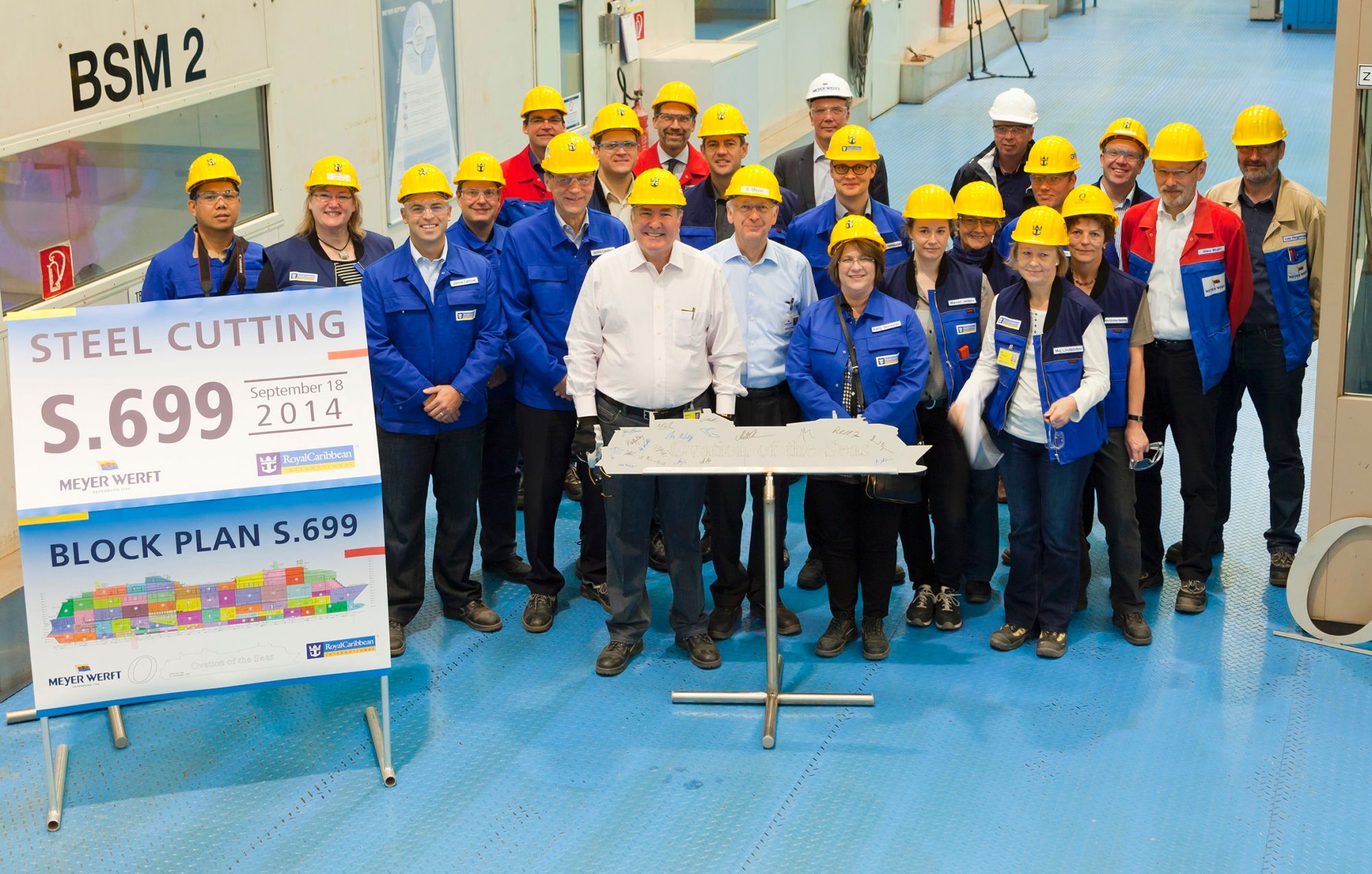
Meyer Werft: steel cut for the third Quantum cruise ship "Ovation of the Seas"

Meyer Werft: steel cut for the third Quantum cruise ship "Ovation of the Seas"

Shortly before the completion of the new Quantum of the Seas today there are another milestone for Royal Caribbean International: the steel section and thus the start of construction of the third cruise ship the new Quantum-class. 

The Smartship named Ovation of the Seas. The completion at the Meyer Werft shipyard in Papenburg is planned for autumn 2016.

Photo: Royal Caribbean International
The ships of the new Quantum class perform other ground breaking innovations at sea a (maiden voyage Quantum of the Seas November 2014 from Cape Liberty, New Jersey, maiden voyage Anthem of the Seas in April 2015 from Southampton). The Quantum class of ship boasts a number of new additions; skydiving simulator "Ripcord by iFly', the 90-meter-high swinging arm" North Star ", the largest indoor sports and entertainment complex at sea" SeaPlex "with bumper cars, roller-skating and much more, as well as the biggest and most versatile cabins. 

The cruise ships each include 18 decks and a tonnage of 168,666 GT. With 2,090 cabins they provide space for 4,180 guests at double occupancy.

Britannia revs up her engines


Britannia revs up her engines

PHOTO: JAMES MORGAN

Suzi Perry starts up Britannia's engines at Monfalcone todaySuzi Perry starts up Britannia's engines at Monfalcone today
The engines onboard P&O Cruises’ Britannia, under construction at Fincantieri’s Monfalcone shipyard near Trieste in Italy, were started up for the first time by Formula One racing TV presenter Suzi Perry. Also on hand were captain of the Britannia, Paul Brown and chief engineer, Sinclair Ross.
When working to full capacity, Britannia’s four engines will generate 62.4 Megawatts or 84,000 horsepower which is equivalent to the power generated by 168 supercars, allowing the 141,000gt ship to cruise at 22 knots.
Britannia’s maiden voyage from Southampton to the Mediterranean is on March 14, 2015.


 Suzi Perry starts P&O's new flag ship Britannia's engines

Wednesday, 17 September 2014

Carnival's vacation guarantee renewed

Carnival's vacation guarantee renewed

By Tom Stieghorst

Carnival Cruise Lines is renewing its Great Vacation Guarantee for another year, after guests used it 47 times to get refunds since its debut in September 2013.

Since then, about 4.5 million people have cruised with Carnival. Jim Berra, Carnival's chief marketing officer, said someone is statistically more likely to date a supermodel than to ask for a refund, based on those figures.

The guarantee provides for a 110% refund, complimentary transportation home and a $100 shipboard credit on a future cruise if guests are dissatisfied with their vacation for any reason.

The guarantee must be invoked within the first 24 hours of the cruise. The program applies to U.S. and Canadian passengers only and those using it must have a valid passport to return to their countries by air. 

5 Ways to Get a Cruise Ship Cabin Upgrade

5 Ways to Get a Cruise Ship Cabin Upgrade 
A Verandah Suite on the Seabourn Quest Cruise Ship2013 Cruisers' Choice Awards: Best Cabins
Unusual Cruise Ship Balconies
Best Cruise Ship Suites
We wish there were a magic elixir you could whip up to get a free or low-cost cabin upgrade on a cruise ship. We'd be chugging it all the time. But sorry -- no can do. Even if there was, as Cruise Critic member Sail7seas wisely pointed out when we polled message board readers on how to nab upgrades, "Do ya really think we'd post it on a public forum?"
True enough.
If you're sitting by the phone, waiting for the upgrade fairy to call, there are a few basic things to know about upgrades. First off, understand that cruise lines deem certain cabins better than others, even within the same cabin type (inside, outside, balcony, suite). An upgrade means you're moved to a cabin in a better category than the one you originally booked. Does that mean you will relocate from the lowest inside cabin on the ship to a balcony suite? Yeah, right, and the upgrade fairy does have wings and a magic wand. More likely, you'd be moved to a cabin that's very similar to the one you booked but is somehow better in the eyes of the cruise line (on a higher deck, in a more convenient mid-ship location, etc.). You might not notice a difference, but you can brag about being upgraded later.
Second, free upgrades -- where your cabin is relocated to a better one at no additional cost -- are fairly rare. "Free upgrades are more of what I consider a thing of the past," says Melissa Gower-Pence, a group cruise specialist with Craft Cruises in Steamboat Springs, Colorado. More common are "upsells," or upgrades for a reduced cost.
But if you're still yearning for that upgrade, how do you get one? We contend the best way to land an upgrade offer is to hope and pray, because for the most part, there's little rhyme or reason to who gets a bump. Member paul929207 nailed it on the head when he wrote, "If there was something you could do [to] get an upgrade, everyone would be doing it."
Other Cruise Critic members echoed the same sentiment. "I have cruised more than 50 times on a variety of lines and itineraries and have only received one upgrade, so I really do think it is luck of the draw," CRUISERTN wrote on our message boards. "We have had two upgrades in the past couple of years with Princess Cruises, but how and why we really don't know," Putterdude posted.
The agents agree. "There is no magic button, it's not that common, and it's always best to book the cabin in which you'll be content," says Jennifer Lennox, a Disney cruise specialist with the agency Off to Neverland in Keller, Texas.

That being said, Cruise Critic members do report some strategies that have increased their odds of getting offered an upgrade. Their best recommendations include these five tips -- and one warning why a freebie upgrade isn't always what it's cracked up to be.

An Oceanview Cabin on Rhapsody of the SeasBook a guarantee cabin. A "guarantee" means you're assured a cabin in the category you requested, but are not assigned a specific cabin until a short time before departure -- usually a week, give or take. If you book a guarantee in a certain category and it's full, you might get upgraded for free. On the other hand, someone else (perhaps a member of the past-passenger program with higher status) might nab the upgrade, and you'd get their cabin in your category. There's no way to know. (Learn more aboutguarantee cabins.)

Member CraftyEC reserved a guaranteed Verandah Suite on a Seabourn cruise, which had six subcategories of cabins, all at different prices. "It could have been anything from V1 to V6, and we got V5, which would have cost us more if we'd chosen this." How much more? To give one example, when Cruise Critic checked a V1 suite on Seabourn's seven-day "Turkey and Greek Isles" voyage in August 2015 was listed as $4,999 per person; a V5 cabin like the one CraftyEC nabbed was $800 per person more.
Bottom line: Don't book a guarantee in any given category unless you would be satisfied with anycabin in that category.

Pair of Carnival Cruise Ships
Cruise the same line often. Just like airlines and hotels reward their loyalty program members, cruise lines do, too. An important point to remember is that the more frequent the cruiser, the more likely he or she would be offered a free or paid upgrade. Merely joining a cruise line's loyalty program won't get you automatically upgraded -- even after you've taken a handful of cruises. (Check out our guide to cruise line past-passenger programs.)
Cruise Critic member B-52, a Gold-level member (the lowest level) of Royal Caribbean's Crown & Anchor Society loyalty program, reported going online two nights before departing on a cruise to find a suite upgrade awaiting approval. A $35 fee was assessed "either for taxes or a suite room attendant -- I'm not sure, but it did not matter. Paid it immediately and printed out a new Set Sail Pass!" B-52 wrote.
Complimentary upgrades are generally reserved for those in the highest echelons of loyalty programs -- Crown & Anchor members who have taken at least 55 cruises, for example -- but exceptions certainly happen.

A balcony cabin on MSC's Poesia cruise ship
Book a free upgrade promotion. Cruise lines occasionally offer special promotions in which two different cabin grades are priced equally -- so if you book the usually pricier cabin at the lower-cabin cost, you're theoretically getting a free upgrade. These "free upgrade" offers can either be for cabins within the same category type or from one category to another (i.e., outside cabins at inside rates or balcony cabins for outside prices).

When Dapaddo saw such a promotion, the Cruise Critic member jumped at the chance for an upgrade and ended up with a Spa Deck-level cabin with floor-to-ceiling windows, "and we didn't have to pay anything extra."
AceDoc monitors the Internet for such offers. But if you truly want the inside scoop on when such a promotion might happen, book your sailing through a travel agent who's well-versed in cruising. "Travel agents get advance notice of promotions such as this and are then able to offer the upgrade to their clients," said vacation specialist Renee Gerber with Cruise One in Woodstock, Maryland. You can also sign up for cruise line promotional emails to get notices of sales in your inbox. Check out Cruise Critic's frequently updated cruise deals section, too.

Vacation CalendarSail during low-demand seasons. Ships tend to sell out during peak periods. But during slow times, they may set sail with some cabins left open. Those open spots thus create wiggle room to provide passengers with upgrades.
If your off-peak cruise isn't full and the cruise line decreases fares in an effort to boost bookings, that's a good time to ask your travel agent or cruise line representative for a free upgrade -- especially if you're not eligible for the price reduction.
"I watch prices before final payment is due," geoherb wrote on the message boards. "On our last two cruises, we've been able to upgrade to better cabins at lower prices a few months before final payment. In one instance, we went from an inside cabin to an outside."

What's considered off-peak? The periods between Thanksgiving and Christmas and right after New Year's often see fewer bookings, in general. For specific destinations, low seasons include: May and September in Alaska (when the weather is often chillier than in the summer), September through November in the Caribbean (peak of hurricane season, kids back in school), and early January and May in the Mexican Riviera (when young ones return to school after holidays). Find out more about off-peak times for your preferred cruise destination in our story, Best Time to CruiseFind an Off-Peak Cruise

Oasis of the Seas Jr. Suite
Just ask. You're really rolling the dice with this one, but why not just ask? What do you have to lose?
"Maybe the secret is calling without expecting anything and being very polite," said momoftwinteens, who once landed a free upgrade from an obstructed-view cabin to an oceanview cabin. She made the telephone call directly to Norwegian Cruise Lineafter noticing a price drop once her final payment went through.

Most free upgrade decisions are made by cruise line directors or other higher-ups in the revenue department. If you're willing to pay for an upgrade, call your agent or cruise line about two weeks before departure, suggests Gower-Pence, the cruise specialist from Colorado. "These offers are on a first-come basis, and as the agent I act immediately because I know my experienced cruisers really want to take advantage of them," she said.
But make sure you work with an agent who has experience in this arena. "I have found that some [travel agents] are better at this than others," kazu said. "Some have relationships with the lines or know their workings. Others do not."

Monday, 15 September 2014

Holland America Line: New flagship will be called MS Koningsdam

Holland America Line: New flagship will be called MS Koningsdam

New ship of Holland America Line is called MS Koningsdam

Holland America Line is to name of their new flagship known to be put into service in February 2016: MS Koningsdam. The name underscores the company's long tradition and the deep roots of the shipping company in the Netherlands. Simultaneously, a new era is ushered in the 141-year history with this strong name. 

Designed for 2,650 passengers cruise ship establishes a new class of Holland America Line, the Pinnacle class, and is an evolution in design and equipment.Currently, the new ship in the Italian Fincantieri shipyard is under construction. 

The new name is Holland America Line's existing since 1883 tradition about ending their ship name with the syllable "dam". The word "Koning", in German "King", underlines the importance of the new cruiser and at the same time honouring the Dutch King Willem-Alexander, the first king in the Netherlands for over 100 years.

"By choosing the name Koningsdam we bow to our Dutch roots and indicate at the same time entering into a new era of the company" , said Stein Kruse, CEO of Holland America Group. "This new ship is the trend for our fleet, so it was the task of finding a name that expresses exactly the same and represents our timeless traditions. "

Photo: Holland America Line
Dutch roots
Holland America Line has enjoyed a long history with the Netherlands, because the shipping company was founded in 1873 as the Dutch-America Steamship Company, with headquarters in Rotterdam. The original building still stands today as Hotel New York on Wilhelmina Pier. All 15 ships of the company flying the Dutch flag and bring almost a million passengers each year to more than 400 ports around the world. 

To date, much of the staff, especially captains and officers of Dutch origin. In addition, most of the ships of Holland America Line were baptised members of the Dutch royal family in the past 75 years, most recently in 2010, the MS Nieuw Amsterdam by Queen Máxima, Princess of the Netherlands. The MS Eurodam was baptized in 2008 by the then reigning Queen Beatrix.

New design for new ship class
The MS Koningsdam is expected to be commissioned in February 2016. At 99,500 gross tonnage and a passenger capacity of 2,650 people and 1,025 crew members it is the largest ship, the Holland America Line was ever built. Innovative concepts of space aboard the MS Koningsdam preserve the classic charm of Holland America Line ships and go at the same time breaking new ground in design and equipment.

 For the fresh look aboard the world-renowned hotel and restaurant designer Adam D. Tihany provides. Together with the renowned ship architects Storbraaten Bjorn, who also created the MS Eurodam and Nieuw Amsterdam MS, is responsible for the design and the interior.

The keel of the new ship was laid in late August.

Interesting cruise industry facts, tidbits & statistics

Interesting cruise industry facts, tidbits & statistics

Passengers
More than 10,000,000 people take a cruise each year. About 80% will do it in North American waters.
Ports of call
There are over 2000 ports of call around our planet that cruise ships can visit.
Most popular starting ports
About half of all passengers on major world cruise lines begin their trips in one of these three Florida ports: Miami, Port Canaveral, and Fort Lauderdale.
Most popular destination
More people cruise to the Caribbean than any other destination in the world.
Non-destination
For some cruisers, the ship itself is the primary destination, not the ports of call.
Cruise length
The average length of a cruise is slightly over seven days.
Cruise ship population
There are more than 300 sea-going cruise ships in the world. They can collectively accommodate over 300,000 passengers per day.
Individual capacities
The latest super-sized ships carry over 4 thousand people (counting passengers and crew). They would dwarf the Titanic and are as tall as a sixteen-story building.
Construction cost
Those gargantuan ships can cost a cruise line a half-billion American dollars before the first passenger boards.
The big three
Today, 3 cruise line groups (Carnival, Royal Caribbean and Star/NCL) control roughly two-thirds of world's cruise passenger capacity.
Travel agents
Almost 90% of cruise tickets are sold through travel agents.

CLIA: Capacity up in developing markets

CLIA: Capacity up in developing markets

By Tom Stieghorst

CLIA’s annual report on the economic contribution of the cruise industry highlights growth in less developed cruise territories, including Asia, the Australia/Pacific region and South America.

The report said these three areas recorded 20% capacity growth in 2013 and accounted for more than half the global increase in available bed days. Europe’s capacity growth slowed from 18% in 2011 to 3.5% last year.

CLIA said the number of passengers carried in 2013 by its member lines rose 3.9%, to 17.6 million (river cruises are not included in the tally).

Bed days increased 4.8% because the average cruise was longer and capacity was higher, CLIA said.

Passenger embarkations at U.S. ports fell 1.3%, to nearly 10 million, the first time in at least four years that happened. CLIA attributed the decline primarily to redeployments to markets more distant from the U.S.

Direct spending by cruise lines, passengers and crew in the U.S. crossed the $20 billion threshold, rising 2.4% to $20.1 billion in 2013. More than 80% of that was for wages, taxes, and goods and services. Passengers and crew accounted for $3.63 billion in spending.

CLIA member cruise lines in North America showed a net increase of one ship in 2013, to 178, with a combined capacity of 338,505 berths, the study said.

Friday, 12 September 2014

New chief executive appointed for Carnival UK

New chief executive appointed for Carnival UK

New chief executive appointed for Carnival UK
David Dingle has been appointed chairman of Carnival UK, with current executive vice-president of operations David Noyes (pictured) taking over as chief executive.
Noyes will have operating responsibility for P&O Cruises and Cunard from October 1, and both he and Dingle will report to Carnival Corporation president and chief executive Arnold Donald.
Donald said: “This moves allows us to strengthen further our overall leadership in the critically important UK marketplace, while also promoting from within to leverage the skills, experience and capabilities of our executive team.”  
Dingle, who became chief executive in 2007, joined P&O Cruises in London in 1978 where, after holding a series of commercial positions, he became managing director in 2000. At the time of the merger of P&O Princess Cruises plc and the Carnival Corporation in April 2003, he became managing director of Carnival UK.
Noyes joined Carnival UK in 2011, in his current position.  Prior to joining Carnival, he worked in the UK travel industry for 25 years, mainly with British Airways, where he was responsible for BA’s worldwide customer services operation, and latterly with Gray Dawes Travel as chief executive.
Elaine Holt will join Carnival UK on October 1 as David Noyes’ replacement as executive vice president operations following a career in the rail, road and airline industries. She has led a series of transformational programmes as executive chairman of East Coast Mainline and before that as managing director of First Capital Connect.  Most recently she has acted as a non executive director of the Highways Agency.  
Dingle said: “David Noyes is exceptionally placed to lead P&O Cruises and Cunard into the future and grow the business for the next generation. Elaine brings with her a strong blend of operational and customer services skills and will be a very valuable addition to our executive team.”