This Blog is for New to Cruise and the well Traveled , on this site we will publish information about Cruise and Holiday information, with some insider stories in the travel press.
Showing posts with label Mississippi river. Show all posts
Showing posts with label Mississippi river. Show all posts
Sure, it may not be growing as aggressively or rapidly as the European river cruise market, but the U.S. river cruise industry continues to see a steady number of new vessels being launched each year, the latest being a passion project of Cincinnati native Capt. Joseph Baer.
And while it's always exciting to see new vessels coming online, to get the first sneak peeks at interior renderings and to witness the ways in which different companies are interpreting the U.S. river cruise experience onboard, what some of these new vessels symbolize is more than just new hardware; some are promising to take U.S. river passengers on entirely new river routes and new ports.
For instance, the 70-passenger paddlewheeler Grand Majestic, being launched by Baer's Grand Majestic River Co. this fall, will reportedly be able to sail along some smaller inland waterways due to its shorter height and shallower draft. Baer said that the smaller size of the Grand Majestic means it can clear some bridges and sail in shallower waters that will enable it to cruise to or near Tulsa, Okla.; Omaha, Neb.; Sioux City, Iowa; Charleston, W.Va.; and into the outskirts of Chicago by next year.
American Cruise Lines, too, has said that it plans to look into some new and different waterways in the U.S. as it develops a fleet of five more modern riverboats for the U.S. market. The first two of those are slated to hit the more traditional Mississippi River System and the Columbia and Snake rivers in the Pacific Northwest, but the company has previously said that it has its eye on numerous additional waterways, including the Sacramento River, San Joaquin River, Missouri River, Des Moines River, Wabash River, Illinois River, Apalachicola River, Gulf Intracoastal Waterway, Mid-Atlantic Intracoastal Waterway, Erie Canal, Hudson River, Oswego Canal, Potomac River and Alaska's Inside Passage.
Hopefully the trend will continue. Because while everyone wants to see places like New Orleans, Memphis and Portland, Ore., when it comes to U.S. river cruising, there is clearly still a fair amount of untapped potential in terms of where to go and what to see.
ACL's first 'modern' Paddlewheeler to launch in 2019
American Cruise Lines (ACL) has pushed back the expected launch of its more modern fleet of river cruise vessels by two years, to 2019.
Last year, when ACL first laid out plans for a fleet of modern ships for American rivers, they were slated to begin launching in 2017. This month, ACL said that construction is under way on the first of those riverboats, but that it is now expected to debut in 2019. The steel is currently being fabricated for what the company described as a "modern" paddlewheeler that will carry approximately 195 passengers.
ACL did not provide any additional details about the new vessel, such as where it will sail, but did say that it is being built with the standards of European river cruising in mind and "with a level of comfort unprecedented on the American rivers."
Timothy Beebe, vice president of ACL, said in a statement that by "continually designing and building brand new ships", the company was able to increase the quality of its product.
Earlier this year, American Cruise Lines launched its eighth ship, the 185-passenger Mississippi paddlewheeler, the America.
ACL has also begun construction on two new coastal cruise ships, with the first expected to launch in May 2017, and the second in 2018.
A rendering of the American Constellation.
American Cruise Lines said it has two new coastal ships under construction that will carry 170 passengers each.
The first ship, the American Constellation, is expected to begin cruising in May. The second ship, yet unnamed, is scheduled for completion in 2018.
The summer inaugural season will be devoted to a new 10-night round-trip itinerary from Boston to destinations including Bar Harbor, Newport, Martha's Vineyard and Nantucket.
Both ships are being built at Chesapeake Shipbuilding in Salisbury, Md., which is affiliated with American Cruise Lines. The design includes marbled tile bathrooms and large sliding glass doors in each cabin.
Viking to Launch American River Cruises from New Orelans
ON .
Today, Governor Bobby Jindal of Louisana and Viking Cruises Chairman Torstein Hagen announced the selection of New Orleans as the homeport for Viking River Cruises’ first North American river cruise itineraries, starting in late 2017.
The Mississippi River cruises will operate from docking facilities near the French Quarter in New Orleans. According to the Governor, Viking’s new service will result in the creation of 416 new direct jobs for Louisiana-based operations and vessel crews, with an average salary of $40,000, plus benefits; and the Louisiana Economic Development (LED) estimates the project will result in an additional 368 new indirect jobs, for a total of more than 780 new jobs in the Southeast Region of the state.
Plans call for the construction of six new vessels over the next three years at an estimated cost of $90 million to $100 million per vessel, all of which will be built in U.S. shipyards and crewed by U.S. citizens. The vessels will be owned by Tennenbaum Capital Partners, a Los Angeles-based alternative investment management firm, and time-chartered to Viking.
Viking River customers are expected to travel to New Orleans from across the U.S., Europe and beyond, and bring new business to hotels, restaurants, museums and other attractions in the city, expanding sales for local merchants. More than 90 percent of sales created by the project are expected to come from out-of-state customers.
With the launch of cruise operations on the Mississippi River in late 2017, two boats will be deployed per year, for a total of six new boats in the first three years. Cruises will take passengers on a journey along the Mississippi River from New Orleans to itinerary stops in St. James, East Baton Rouge and West Feliciana parishes; continuing upriver to Memphis, Tennessee; St. Louis; or St. Paul, Minnesota, depending on the season.
The specialty-built riverboats will have a full complement of luxury amenities and host up to 300 passengers.
LED began discussing expansion possibilities with Viking in November 2013. To secure the project, the State of Louisiana offered the company a competitive incentive package that includes a $4.5 million performance-based grant for site preparation at the company’s docking locations in Louisiana. The company also will receive the customized solutions of the nation’s No. 1 state workforce development program, LED FastStart®, which will include partnerships with the Louisiana Workforce Commission and local educational institutions.
“Having the top river cruise company homeport in New Orleans will be an outstanding chance to tell the story of the Louisiana renaissance to the world,” said President and CEO Michael Hecht of Greater New Orleans Inc. “Viking River Cruises choosing greater New Orleans is a testament not only to our culture and river, but also to our outstanding teamwork at the state, regional and local level. GNO Inc. is proud to have been an integral part of the team that met with Viking on two continents to bring them to New Orleans."
“We are thrilled by the choice of the Port of New Orleans as Viking’s initial entry into the North American market,” said Port of New Orleans President and CEO Gary LaGrange. “Viking is one of the premier cruise brands throughout Europe and Asia. Their worldwide reputation underscores New Orleans as a destination city for both international and domestic leisure travelers. The Board of Commissioners of the Port of New Orleans has worked with the Viking team for nearly two years to determine the proper venue for the new ships within the port and along the Mississippi River, and we couldn’t be happier to add Viking to the port’s cruise portfolio.”
“Viking River is an exciting and compelling addition to the opportunity-rich New Orleans destination,” said President and CEO Stephen Perry of the New Orleans Convention and Visitors Bureau. “They will bring a diverse domestic and international clientele drawn not only to enjoyment of the river through cruising, but to the New Orleans part of their visit in this historic capital of American music and food as well.”
“It was an honor to be part of Governor Jindal’s recent economic development trip to Europe, encouraging companies to locate in our great state,” said Chairman Greg Rusovich of the Louisiana Board of International Commerce.
“The decision to locate Viking’s North American homeport in New Orleans speaks to the operational capabilities of our port, the expertise of our hospitality workforce and the increasing popularity of river cruising around the globe,” said executive board Chairman Henry Coaxum of the New Orleans Business Alliance. “We welcome Viking to the New Orleans business community and look forward to its success.”
American Cruise Lines to give U.S. river cruising a new look
American Cruise Lines (ACL) has big plans for the future of U.S. river cruising that go far beyond the handful of paddlewheelers currently plying the Mississippi and Columbia rivers.
The Guilford, Conn.-based river cruise line has unveiled an ambitious strategy to begin building a fleet of modern vessels alongside its existing and forthcoming paddlewheelers. Starting in 2017, the company says, this new fleet will begin sailing inland waterways across the U.S. — many of which haven’t seen overnight passenger cruising in a very long time, if ever.
The list of waterways that ACL is eyeing for development include the Sacramento River, San Joaquin River, Missouri River, Des Moines River, Wabash River, Illinois River, Apalachicola River, Gulf Intracoastal Waterway, Mid-Atlantic Intracoastal Waterway, Erie Canal, Hudson River, Oswego Canal, Potomac River and Alaska’s Inside Passage.
In terms of the company’s cruising options, ACL President Charles Robertson said, “There’s more than 15,000 miles of navigable waterways in the United States.”
In April, ACL will launch on the Mississippi its second paddlewheeler built from the ground up, the 150-passenger American Eagle. It will join the company’s 150-passenger paddlewheeler, the Queen of the Mississippi, which launched on the river in 2012, as well as the refurbished Columbia River paddlewheeler Queen of the West and four yacht-style coastal cruisers: the Independence, American Star, American Spirit and American Glory.
Following the launch of a new paddlewheeler on the Columbia and Snake rivers in 2016, Robertson said he expects the pace of construction of new vessels to start ramping up, starting with at least two new vessels in 2017.
Asked whether the modern-style river vessels will look more like the river ships in Europe, Robertson responded that in fact, they will not look like the European models, or like anything else for that matter.
“You won’t look at one of these and say, ‘Oh, that’s like a European boat,’ ” he said.
On the other hand, he added, “You won’t say, ‘Oh, it looks like a Mississippi Victorian riverboat,’ because it won’t look like that either. It will be a new look.”
In Europe, the dimension and size of the vessels is much more constrained by the height of bridges and the size of locks than it is in most of the U.S. So in designing its new fleet, ACL has much more freedom to play with the dimensions of each vessel.
Each will be built to accommodate the specific constraints presented by the waterway it will navigate. For example, he said, the locks and the bridges on the Erie Canal are much smaller and lower than they are on the Mississippi, and the constraints along the western portion of the Erie Canal are different from the eastern part of the Erie Canal.
Some of the vessels will be smaller than ACL’s current vessels, while others will be the same size or larger. As for the overall look and feel, generally speaking, these more modern vessels are being designed to feature more glass to let in more natural light and will feature more open layouts, he said.
On the other hand, ACL doesn’t plan to stop building paddlewheelers, which the company will continue constructing alongside the modern vessels, Robertson said.
“If you look at the Mississippi River, it just sort of screams for a Victorian riverboat with all of the history of the Mississippi River and Mark Twain and so on,” he said. “That’s less true on some other waterways. … The Victorian feel of it becomes less important, and that gives us more freedom to do stuff with glass and more contemporary designs.”
Even so, where the paddlewheeler style fits a particular river, ACL will go with it.
“We spent a lot of time talking to folks, particularly travel agents, about what their customers would like, and we think there’s another portion of the market that would be more attracted to something with a more contemporary feel,” — ACL President Charles Robertson.
Pricing for cruises on the more modern vessels will be in line with pricing for those on the paddlewheelers.
“We spent a lot of time talking to folks, particularly travel agents, about what their customers would like, and we think there’s another portion of the market that would be more attracted to something with a more contemporary feel,” Robertson said.
He added that along with a growing demand in the U.S. river cruise market in general, river passengers in the U.S. are increasingly expecting something more in line with the amenities and services they experience in the evolving, rapidly modernizing hotel and ocean cruise markets, whether than means private balconies, quick and efficient elevators or larger cabins.
Hardware aside, Robertson seems determined to introduce travelers to some of the country’s less well-known scenic waterways and the towns and cultural and historical heritage through which they wind. Many areas of the country, he said, are “gorgeous.”
He acknowledged that ACL is not the only player that senses opportunity along these untapped waterways.
“I don’t expect that we’re going to be the only ones in this business,” he said.
Indeed, in 2013 Viking Cruises teased plans to bring a version of its latest European river vessels, the Viking Longships, to the U.S. in 2015. But by the end of the year, Viking said it was exploring options on the Mississippi for the 2016 season.
As for the other major player on the U.S. rivers, American Queen Steamboat Co. (AQSC), its senior vice president of sales, Bill Diebenow, said that while AQSC has considered looking into other North American waterways, its current focus is “to maximize our two terrific assets on the rivers we currently cruise.”
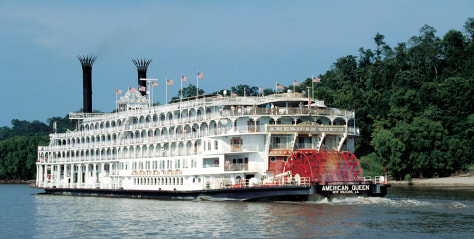
AQSC owns and operates the 436-passenger American Queen on the Mississippi, and the 223-passenger American Empress on the Columbia and Snake rivers in the Pacific Northwest.
Mississippi paddle wheeler to be named American Eagle
By Michelle Baran
American Cruise Lines’ new Mississippi paddle wheeler has been named the American Eagle and will sail its first revenue cruise on March 28.
After announcing last December that it would introduce four new U.S. riverboats between 2015 and 2017, ACL has finally provided details about the first of those vessels, the 149-passenger American Eagle.
The paddle wheeler is being built at the Chesapeake Shipbuilding yard in Salisbury, Md. It will feature 19 single staterooms and 65 double cabins, ranging from between 300 and 600 square feet.
With the exception of six lower-deck cabins, staterooms will have floor-to-ceiling sliding glass doors with private balconies.
The public areas will include the Magnolia Lounge, the Sky Lounge, the Paddle wheel Lounge, the Grand Dining Room and the Mark Twain Library and Chart Room.
An outdoor exercise area and putting green will be located on the sun deck. Elevators will be available with access to all decks.
There will be guest laundry service, complimentary wireless Internet and complimentary breakfast room service.
The American Eagle will sail mostly seven-day cruises along the Mississippi River. It will join ACL’s existing Mississippi paddle wheeler, the 150-passenger Queen of the Mississippi.
ACL has said that a Columbia and Snake river paddle wheeler will be launched later in 2015, but no details on that riverboat have been provided.
River cruising across continents -- the same, but different
By Michelle Baran
Whenever anyone would ask me about the similarities between river cruising in Europe and river cruising in other parts of the world, I used to answer one of two ways.
Half the time, I responded with something along the lines of, “No matter where you are in the world, river cruising is basically the same.” The other half, I said something like, “Aside from the fact that it’s a river cruise, that’s where the similarities end. Totally different experience depending on where you are.”
In truth, both are correct. (And I’ve started responding with a combination of the two, for the record. Apologies to those I misled prior to this new policy.)
As the river cruising industry shifts its focus from a busy launch season in Europe this spring, toward a slew of newbuilds coming out in Southeast Asia this fall, the change in destination backdrop begs for some comparisons between river cruising in Europe and elsewhere in the world.
Indeed, Europe has set the standard for river cruising in the world. It’s where the market is most developed, it’s the product that is marketed the heaviest, and it’s usually the destination where people often first learn about and experience river cruising.
It sets the bar, so to speak. And then, passengers get the river cruise line’s brochure and see that they might have a ship that sails the Mekong in Vietnam and Cambodia, or that they offer an itinerary on the Peruvian Amazon. That’s when things start getting interesting.
Maybe they find out from some friends they can even river cruise right here at home on the Mississippi or Columbia rivers. Who knew?
The question is, will they like these other river cruises if they liked river cruising in Europe? Well, first off, let’s address what will be the same or similar between European river cruising and its numerous cousins scattered about the globe.
For one, the floating-hotel notion is similar. During the river cruise portion of their itinerary, regardless of the destination, passengers will pack and unpack once and their river cruise ship/floating hotel will carry them from one destination to the next, often to small ports from which they can walk into the nearby town.
Additionally, floating on down the river offers a very similar sensation regardless of whether that river is the Mississippi, the Nile, the Irrawaddy or the Danube. Of course the scenery along the river will vary greatly, but that peaceful, gliding feeling is almost universal.
As for what’s different, the ships themselves, for one. There are vastly different types of river cruise vessels suitable for different rivers. European river cruisers might be surprised to find how large the river cruise ships in the U.S. and China are, or how small those in Southeast Asia and Peru are.
And of course, the destinations themselves are where many of the differences are. The bustling river life in Vietnam and Cambodia is nothing like the more reserved rivers of Europe. Floating past Egyptian desert landscapes is quite different from sailing past quaint American towns.
But despite all the differences, I could totally see how someone could love river cruising across continents. Because really, it’s the same. But different.
American Queen repositions due to Mississippi River flooding
By Michelle Baran
The American Queen Steamboat Co. (AQSC) is moving its 436-passenger paddle wheeler American Queen to the Ohio River for the remainder of July due to high water levels on the Upper Mississippi River.
Torrential downpours in recent weeks in the Midwest have resulted in flooding along stretches of the Mississippi River.
Consequently, the American Queen is moving to the Ohio River for its next three sailings, which will impact the originally scheduled July 9 sailing between Cincinnati and St. Louis and the July 15 and 23 sailings between St. Louis and St. Paul, Minn.
"Sometimes river conditions are outside our control," AQSC President and COO Ted Sykes said in a statement. "We recognize the need to cruise on the Ohio River for our July 2014 itineraries and will then return to our regularly scheduled itineraries."
The new itineraries will sail between Cincinnati and Paducah, Ky., calling on Cave-In-Rock, Ill.; Henderson, Ky.; Louisville, Ky.; Madison, Ind.; and Augusta, Ky. Guests on the July 9 voyage will travel by motorcoach from Paducah to St. Louis at the conclusion of the sailing and resume their return home as scheduled. The July 15 pre-cruise hotel stay in St. Louis remains, and guests will be transferred to Paducah to join the American Queen.
The July 23 voyage will now depart Cincinnati, replacing St. Paul, and details on that itinerary will be available shortly.
Guests booked on the July 9 or 15 itineraries have the option to stay on their deviated voyage and receive a $100 onboard credit, per person, and a $500 future cruise credit per stateroom. Guests preferring to book an Upper Mississippi River voyage in late 2014 may roll forward their booking with a one stateroom category upgrade (subject to availability), noted AQSC.
The Mississippi River continued to gradually rise on Tuesday, the Associated Press reported, but overnight rainfall wasn't as severe as predicted.
As river cruise lines glide into their busy sailing season, high water levels on the Mississippi and some lower levels on the Danube and Elbe rivers in Europe serve as a reminder that conditions on the rivers are as changeable as they are charming.
And while river cruise executives themselves often admit there isn’t anything they can do about the water levels (despite likely wishing they could!), the way river companies respond is indicative of the fact that the product is adaptable and water level issues are often somewhat solvable with a bit of innovation and operations juggling.
Recently, water levels on the Elbe River and a stretch of the Danube River between Regensburg and Passau in Germany were lower than normal, Viking Cruises informed passengers on its website.
In response, Viking is having impacted guests begin their itineraries on a different sister ship than was originally scheduled located on the other side of the impassable lower water area. Can’t pass through? No problem. There’s an identical ship waiting on the other side.
Scenic Cruises did what many river cruise lines do in this situation: It had passengers who couldn’t continue their itinerary on one vessel swap ships with passengers on the other side of the lower water level area.
“It is not that unusual for the rivers of Europe to go through phases of low or high waters — remember last year’s historic high water levels?” noted Elliot Gillies, spokesman for Scenic Cruises and Emerald Waterways.
In order to reduce the amount of impact, Gillies noted that parent company Scenic Tours builds its Scenic Cruises and Emerald Waterways river cruise vessels with the lowest drafts possible to be able to pass through shallower waters.
But at the end of the day, the issue is in the hands of Mother Nature.
“Water levels are generally influenced by the snow pack in the mountains of Central Europe and the amount of rain during the season. As long as there is enough water in total running into the rivers, operations can be expected to run smoothly,” noted Patrick Clark, managing director of Avalon Waterways, which does not operate on the Elbe and only faced some minor itinerary adjustments due to the lower waters.
Indeed, the ebbing rivers in Europe are a small operational blip compared to last year’s flooding in Central Europe that wreaked havoc on the region and the river cruises running through it.
In the U.S., the Mississippi is once again showing its erratic side (there have been ups and downs on this river as well in the past couple of years that have caused delays and itinerary disruptions).
Heavy downpours in recent weeks in the Midwest have resulted in flooding along stretches of the Mississippi River, and forced the American Queen Steamboat Co. (AQSC) to move its American Queen paddlewheeler to the Ohio River for the remainder of July.
AQSC President and COO Ted Sykes observed that “sometimes river conditions are outside our control.”
I think it’s safe to say they’re always out of river cruise lines’ control, but their tides still flow in favor of the river cruise industry at large.
Monday, 10 February 2014
ACL newbuilds to ply Mississippi, Pacific Northwest rivers
By Michelle Baran
American Cruise Lines (ACL) will place the first two if its four upcoming new riverboats on the Mississippi River and on the Columbia and Snake rivers.
The company announced in December that it would introduce four new vessels for U.S. river cruising between 2015 and 2017.
Construction has begun on the two riverboats at the Chesapeake Shipbuilding yard in Salisbury, Md. They will join ACL’s existing vessels on the Mississippi and Columbia rivers — the 150-passenger Queen of the Mississippi and the 120-passenger Queen of the West.
The new Mississippi riverboat will have a similar capacity to that of the Queen of the Mississippi and will enter service in March 2015. The new Columbia riverboat will be launched later in 2015 with a planned capacity of 175 passengers. Both will feature functioning paddlewheels.
“Demand on the Mississippi is high, and the Columbia River has not seen a new riverboat in many years,” Timothy Beebe, vice president of American Cruise Lines, said in a statement.
Both riverboats will feature historic accents and large staterooms with sliding glass doors offering passengers views from private balconies. A glass-enclosed dining room and various public lounge venues are planned.
Ups and downs in the life of a river cruise market
By Michelle Baran
In terms of cruising, the world’s rivers are all at different stages of maturation. Whereas the Nile River is an old-timer, with a river cruising tradition that dates back decades, Europe’s inland waterways are the sage adults of the river cruising industry, having benefited from years of unprecedented growth, investment and development.
And then there are the industry’s newer entrants, destinations like Southeast Asia’s Mekong River and Peru’s Amazon, where product and infrastructure have been gaining strength in recent years.
There are also rivers like the Mississippi that are experiencing a recent rebirth.
And of course, the river cruise industry is always looking for the next breed of rivers, destinations like Myanmar’s Irrawaddy and India’s Ganges that are just now coming onto the scene.
Regardless of where the river stands in the maturation process, there are advantages and disadvantages at each stage of development. Where Europe benefits from years of tweaking and perfecting the product, it also now faces the challenge of crowding and increased competition.
In emerging markets, the competition is less and the opportunities great, but so too are the frustrations of trying to building vessels that meet European standards in countries still rife with bureaucratic and economic problems.
A company like Breckenridge, Colo.-based Haimark is looking for opportunities in the emerging river cruise markets, hoping to capitalize on a river cruise industry that appears to be looking past the European boom.
Companies like Viking River Cruises, on the other hand, continue to invest heavily in the firmly established European market, where Viking clearly believes there is room for further growth as it prepares to launch another 14 ships there in 2014.
Are there some prenatal rivers on the horizon? Certainly. But river cruise lines are keeping pretty tight-lipped about them if there are.
High waters force American Queen to alter itineraries
By Michelle Baran
The 436-passenger American Queen will alter its July 5 and 13 itineraries, previously scheduled to operate between St. Louis and St. Paul, Minn., due to high water levels on the Upper Mississippi River, the American Queen Steamboat Co. said on Wednesday.
Severe downpours struck across the Midwest on Wednesday, according to news reports.
Because of the resulting high water levels, the two affected itineraries will now sail between St. Louis and Cincinnati, calling on Chester, Ill.; Cape Girardeau, Mo.; Paducah, Henderson and Louisville, Ky.; and Madison, Ind.
The July 4 precruise hotel stay in St. Louis remains as scheduled at the Hilton St. Louis. The Hilton Cincinnati Netherland Plaza will now serve as the precruise hotel on July 12.
“Delivering a safe, predictable cruise itinerary for our guests is a priority, and sometimes river conditions are outside our control,” American Queen Steamboat Co. President and COO Ted Sykes said in a statement. “We recognize the need to cruise on the Ohio River for our first two July 2013 itineraries and will then return to our regularly scheduled itineraries.”
Guests booked on the July 5 or 13 sailings have the option to rebook a 2013 cruise with no additional fee or stay on their altered itinerary and receive a $500 future cruise credit per stateroom.
When Viking River Cruises placed an order last month for two oceangoing ships for a new
brand, Viking Ocean Cruises, it stirred a great deal of talk about the river and
ocean cruise markets: how they compare and how they compete.
Former cruise executive Bill Smith, now
Virtuoso’s vice president of cruise sales and exclusive product, called Viking’s
action a bold move.
“I think it’s a good strategy to capitalize on cross-selling their
repeat cruisers onto deep-water ships. There was never that bridge before,
between the two,” said Smith, a former senior vice president of sales and
marketing at Crystal Cruises.
“I’ve always
wondered: What if Crystal did this, or Silversea? They have great past-guest
loyalty programs. Would those people cross over? It’s interesting to think
about.”
The move marks one of the few times
in memory that a river cruise operator has made the jump to deep-water cruising,
and it has many in the industry wondering if other river cruise lines might
follow.
For Rudi Schreiner, president of
Ama Waterways, the answer is no. He said Viking’s Hagen has a “love of blue
water and ocean cruising.”
“He was at
Royal Viking Line [where he served as CEO] for years,” Schreiner said. “I think
that’s one of his dreams. From my side, there’s really not much interest there.”
Bruce Nierenberg, a veteran of both the
ocean- and river-cruise industries and now CEO of United Caribbean Lines,
agreed.
Hagen, he said, is “one of the few
that has had his feet in both places historically. Torstein would probably find
[the ocean cruise market] very comfortable. ... I can’t see the other river
players having that same comfort level.”
Officials from river cruise companies Avalon Waterways and
Uniworld Boutique River Cruise Collection were not available for comment last
week.
But other industry insiders said it
made sense for both river-cruise and ocean lines to eye each other’s markets for
possible entry and look to mergers and acquisitions.
Nierenberg, for example, said, “I wouldn’t be surprised at all if
one of the big [ocean cruise lines] decided to buy up one of the successful
river ventures.”
He said brands such as
Viking or Avalon “would fit very well within any of the empires of Royal
Caribbean or Carnival.”
Schreiner, on the
other hand, said he wasn’t so sure that river cruising would be a good fit for
the deep-water cruise companies. While allowing that crossover marketing
opportunities exist, he cautioned that the economies of scale are completely
different.
“The ocean cruise lines will
stay away from the river cruise product,” he predicted. “The numbers are very
different. An ocean cruise line like Royal Caribbean [carries] on one [sailing]
as many passengers as we put on one ship in an entire season.
“The logistics are a different environment.
For me, it’s a very different business model.”
Nierenberg noted the vast differences in hardware.
“From a technical aspect, running ships around
the world is a lot more complicated,” Nierenberg said. “Riverboats are barges
with an engine on them that act as hotels. People spend a lot more time on a
cruise ship than they do on a riverboat.”
Despite such differences, industry executive Jeff Drew said,
“Cruise lines are really looking at river cruises as stiff competition.”
A senior vice president of sales at the Great
American Steamboat Co. and a former executive at Oceania Cruises, Seabourn and
Cunard Line, Drew said the big cruise lines see the river operators as “taking
market share.”
“They’ve done an excellent
job, and all the cruise lines are starting to notice,” he said.
As for the timing, Virtuoso’s Smith said that
Viking Ocean Cruises’ future competitors, such as Oceania and Seabourn, have
added capacity in recent years.
“Does
traditional cruising need more 800-passenger ships right now?” Smith asked.
“That’s a different subject. But Oceania is very successful, and Seabourn is
doing great. We’re seeing demand go up and yields go up. I think maybe the
timing is right.”
Nierenberg said his
sense was that Viking executives were starting to get “some of the financial
results that they like” and consequently had the ability to expand their
position in the marketplace.
One of the
rare examples of a cruise company that had a hand in both river and ocean
markets was Peter Deilmann Cruises, which owned and operated eight river-cruise
ships and a 513-passenger oceangoing vessel, the Deutschland.
Peter Deilmann Cruises declared insolvency on
its river-cruise business at the end of 2009 and exited the market, but its
parent company, Reederei Peter Deilmann, still operates the Deutschland.
While new ships will continue to
launch on Europe's inland waterways in 2012, the year will see some notable
advancements in river cruise markets both nascent and reborn.
From the Mississippi to the Mekong, river
cruising isn't just a European phenomenon anymore.
Mississippi resurrection
Two companies next year will be resuscitating the Mississippi
River cruising market, which has lain dormant since one of the largest domestic
river operators, Majestic America Line, ceased operations at the end of 2008.
Guilford, Conn.-based American Cruise Lines
is building a 140-passenger paddlewheeler, the Queen of the Mississippi, slated
to enter service in August. And the Memphis-based Great American Steamboat Co.
is in the process of renovating the 400-passenger American Queen, which will
relaunch in April. (The Delta Queen Steamboat Co. launched the American Queen in
June 1995, and the vessel was turned over to the U.S. Maritime Administration in
2008 after Majestic America Line's parent company, Ambassadors International,
defaulted on a guaranteed loan.)
Both
companies are pulling out all the stops in their effort to breathe new life into
the Mississippi River cruise market.
Tim
Rubacky, senior vice president of sales, marketing and product development for
the Great American Steamboat Co., said the new American Queen will be
"significantly upgraded from [when it was owned by Majestic] in terms of food
and service. They had cut everything to the bare bones. We are upping the ante
on every level."
Indeed, the American Queen's culinary program, spearheaded by
executive chef Regina Charboneau, offers four specialty dining venues, including
the main J.M. White Dining Room and the Front Porch of America, which will be
open 24/7.
"We're bringing the boat back
to [its] mid-1990s heyday," Rubacky said, adding that back then, when the ships
were owned by the Delta Queen Steamboat Co., they were considered on par with
Seabourn and the Queen Elizabeth 2 in terms of food and entertainment. "We're
getting away from the nickel-and-dime mentality."
The entertainment options will include nightly dancing to swing,
big band and Dixieland jazz music as well as concerts featuring the ship's
calliope.
Departures will run from April
13 through Dec. 28 and will range from three to 10 days in length.
American Cruise Lines, which is currently
building the Queen of the Mississippi in Salisbury, Md., plans to ramp up the
entertainment offerings aboard its ship, as well.
According to the company, the program will feature entertainment
"reminiscent of America's legendary steamboating era," including Dixieland bands
in the vessel's Paddlewheel Lounge. Passengers will also be invited to play the
ship's calliope.
Both ships will sail
between Louisiana and Minnesota on the Mississippi and as far East as Pittsburgh
on the Ohio River.
The Mekong's
maturation
What was once a
slow burn on the Mekong River has grown to a roaring blaze, with the planned
launchings of a slew of newbuilds in Southeast Asia.
In 2012, Viking River Cruises will charter Pandaw River Cruises'
66-passenger Tonle Pandaw; Avalon Waterways will lease the 32-passenger Avalon
Angkor, which will launch in September; and Uniworld Boutique River Cruises is
partnering with Pandaw on a three-year charter of the 60-passenger River Saigon,
which will launch in January. Moreover, Uniworld has already inked a second deal
with Pandaw for an additional ship on the Mekong, the 60-passenger River Orchid,
launching in January 2013.
Those ships
will join Pandaw's existing three ships on the Mekong River and Ama Waterways'
two ships: the 94-passenger La Marguerite and the 124-passenger Amalotus.
Ama does not plan to introduce a new ship in
2012, but the company has said that it is looking into options for more vessels
in 2013 and beyond. And Viking has also hinted at plans for a possible 2013
newbuild.
The classic Mekong cruise sails
a route from Siem Reap, Cambodia, across Tonle Sap Lake, through the Cambodian
capital of Phnom Penh and on to Vietnam's largest city, Ho Chi Minh City. Many
itineraries also include a flight to Hanoi for an overnight cruise through
Halong Bay.
Europe: Longships and
Panoramas
In 2012, Viking
River Cruises will launch an unprecedented six ships in Europe that fall under a
new class of vessels the company calls Longships. The six new ships will be the
Viking Freya, Viking Idun, Viking Njord, Viking Odin, Viking Embla and Viking
Aegir.
The 190-passenger Longships,
designed by maritime architects Yran & Storbraaten, will be 443 feet long,
with 95 cabins each. They will have several defining elements, not least of
which will be their reconfigured layout. By shifting the central corridor over
and adding two suites at the aft of the ship, Viking will be able to accommodate
balcony space. Consequently, three-quarters of the cabins on the new ships will
feature a balcony, French balcony or both.
And instead of having only larger cabins on the upper decks and
smaller cabins on the lower deck, there will be a mix of larger and smaller
cabins on all the decks because of the off-center corridor.
In addition to new cabin configurations, the
Longships will have an indoor/outdoor Aquavit Terrace at the front of the ship,
a feature Viking was able to add by squaring off the bow rather than having it
come to a point.
The plan is for the new
Viking Longships to sail existing itineraries within Europe, with an emphasis on
adding capacity to Viking's two most popular programs: the 15-day Grand European
Tour, from Amsterdam to Budapest, and the reverse; and the eight-day Romantic
Danube, sailing from Budapest to Nuremberg, Germany, and the reverse.
The six newbuilds will bring the Viking-owned
fleet to 25 by the end of 2012.
Viking
originally estimated that the new ships would cost about $30 million each, about
$5 million more than its previous class of ships.
Additionally, in 2012, Avalon Waterways will introduce two sister
ships to the Avalon Panorama: the 128-passenger Avalon Visionary and the
164-passenger Avalon Vista. With the Vista and Visionary, Avalon's Europe fleet
will total 11 ships in 2012, increasing the company's capacity in Europe by 22%


 American Cruise Lines (ACL) has big plans for the future of U.S. river cruising that go far beyond the handful of paddlewheelers currently plying the Mississippi and Columbia rivers.


 “I think it’s a good strategy to capitalize on cross-selling their
repeat cruisers onto deep-water ships. There was never that bridge before,
between the two,” said Smith, a former senior vice president of sales and
marketing at Crystal Cruises.
“I think it’s a good strategy to capitalize on cross-selling their
repeat cruisers onto deep-water ships. There was never that bridge before,
between the two,” said Smith, a former senior vice president of sales and
marketing at Crystal Cruises.  Despite such differences, industry executive Jeff Drew said,
“Cruise lines are really looking at river cruises as stiff competition.”
Despite such differences, industry executive Jeff Drew said,
“Cruise lines are really looking at river cruises as stiff competition.”  Indeed, the American Queen's culinary program, spearheaded by
executive chef Regina Charboneau, offers four specialty dining venues, including
the main J.M. White Dining Room and the Front Porch of America, which will be
open 24/7.
Indeed, the American Queen's culinary program, spearheaded by
executive chef Regina Charboneau, offers four specialty dining venues, including
the main J.M. White Dining Room and the Front Porch of America, which will be
open 24/7.