Tuesday, 11 November 2014

Cruise Lines Focus on Meetings at Sea

Cruise Lines Focus on Meetings at Sea

Onboard meetings are a lucrative market for travel agents

<p>Seabourn Cruise Lines is one brand ready to host meetings on the move. // © 2014 Seabourn Cruise Lines</p><p>Feature image (above): Given the...
Relatively few travel agents are sales specialists in the lucrative meetings market. That could change, however, as cruise lines increase their focus on attracting meetings business and develop specific tools and services to help agents tap into the market.
Meetings are big business in the U.S., according to a study released earlier this year by PricewaterhouseCoopers US. The study, which quantified the size of the U.S. meetings market in 2012 and updated a similar survey conducted in 2009, sized the market at 1.8 million meetings that drew 225 million participants and generated $280 billion in direct spending. The participant volume represented a 10 percent increase over the results in 2009. 
Given the sheer scope of the market, it is no surprise that the cruise industry is embracing onboard meetings by designing vessels with state-of-the-art meeting space and high tech audio/visual capabilities that rival — or exceed — what is available at land-based resorts. 
“Over the past several years, there has been an explosion in the popularity of conducting meetings and conferences at sea,” says Lori Cassidy, director of global corporate meetings, incentives and charters for Royal Caribbean International. “For the past three years, our line has shown consistent double-digit growth in group meetings at sea.”
Why the upswing in corporate and special interest bookings? When comparing a land-based resort to a similar-class cruise ship and including costs for meals, entertainment, presentation equipment and meeting space, an all-inclusive meeting on a cruise ship can shave 20 percent to 30 percent off the cost of the event. 
“Cost savings are historically in the double-digit range, considering the wide scope of inclusive amenities and experiences aboard a cruise ship,” says Ron Gulaskey, global director of corporate, incentive and charter sales at Celebrity Cruises. “These benefits, along with the seamless support we offer agents both in selling tools and event planning, make meetings at sea a no-brainer.”
Tax breaks are a major incentive for businesses considering booking a meeting at sea. According to IRS tax codes, any ship that holds a meeting program within the North American region (including the U.S., Puerto Rico, Guam, the U.S. Virgin Islands, the Pacific Islands, Canada and Mexico) will qualify for a tax deduction.  
While this can become a major selling factor for agents whose clients are looking for the biggest bang for their meeting buck, there are many caveats to the tax code. The best approach is for agents to consult with the cruise line directly for clarification on applicable tax deductions — if that is the client’s goal.
Another major selling point is the novelty and fresh perspective a meeting at sea offers corporate clients. 
“Taking people to an environment they don't experience often or have never been to shifts their perspective altogether,” says Jo Kling, co-founder of Landry & Kling.  “They're not in a hotel ballroom, thinking: 'Here we go again.’”
How to Get Started
There is considerable help available for agents interested in getting involved in booking meetings at sea.
One resource is the Landry & Kling. The company was founded in 1982 as a distribution channel linking the cruise industry and corporate America. Landry & Kling arranges meetings at sea for its own clients and works with travel agents who want assistance on booking onboard meetings based on a revenue sharing program. The company’s website contains numerous documents on tax implications and cost savings available to clients who book meetings at sea.
Inspirational Journeys, another company that specializes in arranging corporate meetings at sea, also has information on its website regarding tax implications of onboard meetings. 
Travel agents can also get help from individual cruise lines. 
Holland America Line (HAL) prides itself on taking a highly personalized, concierge-style approach to helping travel agents plan and sell meetings at sea, according to Eva Jenner, vice president, North America, of field, charter and incentive sales for HAL and Seabourn. One key service offered is a pre-cruise conference call with all critical shipboard managers, the booking travel agent and a representative of the client, to ensure that everything goes as planned onboard.
While the market for meetings at sea is booming, many travel agents are unaware of the meetings facilities and services available onboard. 
“Perhaps the biggest challenge our cruise line faces is getting agents who haven’t sold a meeting at sea onboard a ship,” Cassidy says. “Once they see what we can bring to the table, they get it.”

Royal Caribbean’s rollout of RFID wristbands will be gradual

Royal Caribbean’s roll out of RFID wristbands will be gradual

Royal Caribbean RFID wristbandFORT LAUDERDALE — Royal Caribbean Cruises Ltd. President Adam Goldstein said it will be several years before the Sea Pass wristbands being used for room keys on Quantum of the Seas can be rolled out fleetwide.

Goldstein said the radio-frequency identification (RFID) wristbands are simple, but they go hand-in-hand with a new shipboard property management system that takes a fair amount of time to install.

“The next-generation embarkation and the RFID bands will kind of follow that process,” Goldstein said in a speech at the CruiseWorld conference, a Travel Weekly event.

Royal Caribbean will proceed ship by ship with the installations. He did not say which would be the next ship in line for Sea Pass.

Goldstein said that older ships such as Majesty of the Seas that look their age next to Quantum have been given extended life by adding newer features in scheduled drydocks.

“We’ve found across the bo
CruiseWorld - Adam Goldsteinard — and this is industrywide — that we’ve been able to inject a lot more features from the newer ships onto the older ships than probably any of us thought possible.”

He also noted that RCCL has six brands and that older Royal Caribbean and Celebrity Cruises ships such as Majesty of the Seas have traditionally migrated to its other, primarily European, brands.

Goldstein said pressure on concessionaires to be more efficient has resulted in smaller footprints for areas like the photo gallery on Quantum. That has freed up more space for a variety of extra features that make the ship more exciting overall, he said.
Goldstein said he’s never been a big fan of the contemporary-premium-upper premium-luxury continuum that many use to label the market segments of the cruise business, and that the edges of those categories are increasingly blurring into each other.

“If you’re in a loft suite on Oasis of the Seas, you’re in a pretty luxurious product,” he said.

“Very often our bigger brands are the second choice for couples that are normally cruising on small luxury ships,” Goldstein said. He said those passengers want the attributes of a large ship with all of the luxury amenities of a small one. “It is an interesting marketing challenge.”

Monday, 10 November 2014

Value trumps price

Value trumps price

By Tom Stieghorst
When all-inclusive drinks packages were introduced two years ago, cruise lines hoped to earn some extra revenue, figuring some people wouldn't drink as much as they expected to.

But the drinks packages are also being used as a kind of loss leader for several cruise lines. They're dangled for free to help induce passengers to book a particular line or sailing.

Such promotions have reshaped cruise marketing in the past few years. Be it a reduced deposit, free gratuities or onboard spending credits, it's a rare guest who sails today without something extra in his or her pocket.

For cruise lines, value-add items have been the ladder out of the deep-discount pit they fell into after the economy tanked in 2008. Prices on some seven-night cruises fell as low as $113 per person as financial gridlock made a cruise seem like an extravagance.

Prices have improved, in part because value-add has augmented discounting as a ship-filling strategy.

"We're really working hard to create more promotions," said Royal Caribbean Cruises Ltd. Chairman and CEO Richard Fain. "I think we can do a better job offering more for the same money rather than just discounting."
Value trumps priceDiscounts do more than harm revenue, said Adam Snitzer, president of Peak Revenue Performance, a Miami Beach consulting firm that specializes in revenue management.

"You see a cruise for $499, it creates this perception that, OK, a seven-day cruise is worth $499," Snitzer said. "And then if you try to raise prices, there's still that lingering reference price in consumers' minds, that this is what one should pay for a seven-day cruise."

When demand is not filling ships to the 100% level that the industry's business model calls for, cruise lines have to do something to get balky consumers off the sidelines.

"So it's very smart to go into the value-add position for a few reasons," Snitzer said. "One is you offer a higher price, so you raise that reference price. And what you bundle in often has a higher perceived value in the customer's mind than the cost for the cruise line."

Cost vs. perception of value

Take the example of the drinks package. Snitzer said the profit margin at cruise ship bars can be up to 90% of the drink price. If a guest gets a $100 onboard credit and spends it at the bar, the value in the customer's mind is $100, but it only costs the cruise line $10, he said.

Other promotions cost even less. The promise of a reduced deposit may ease the decision for prospective buyers, and it has immediate value in managing their budgets, but in the end it costs the cruise line nothing.

"They're going to collect that money," Snitzer said. "They're just going to collect it later."
Royal Princess' SeaWalk and balcony cabins.A two-category upgrade, a popular value-add in Carnival Cruise Lines promotions, has a perceived value of whatever the difference in brochure cost is between the two cabins.

"But if those cabins aren't full, then there's no lost revenue," Snitzer said.

Some value-adds, such as onboard spending credit, can actually drive incremental revenue by making things affordable that might otherwise seem out of reach.

For example, a family that can't afford the whole price of a swim-with-the-dolphins tour, one of the more expensive excursions in the Caribbean, might reconsider if they have a spending credit to soak up part of the cost.

For travel agents, the focus on promotions has several benefits.

First and most important, it buoys ticket prices, which keeps commissions higher than they might otherwise be.

"A price drop obviously affects our earnings potential," said David Crooks, senior vice president of product and operations at World Travel Holdings. "A value-add has more impact on the cruise line's economics than it does on the trade."

Second, value-adds make shopping a little more challenging for the consumer. No longer can they simply type dates and locations into a search engine to find the best deal.

A $599 price at one line might not be as good as a $699 price at another if the second offer also includes a night in a specialty restaurant, or a reduced deposit or a money-back guarantee.

"It helps us keep the client rather than having them go direct," Crooks said. "We can navigate them through the different offers, tell them what they mean."

Stephanie Turner, president of Brentwood Travel, in St. Louis, agreed that value-add promotions can enhance the agent's role as a knowledgeable adviser to clients.

"I've always said that if our suppliers make it complicated enough, we do become valuable," Turner said.
Lotus Spa on Royal Princess.However, Crooks said it's important that the offers not become too complex. He said promotions that are not combinable with other offers are especially frustrating to agents and consumers.

"There's a perception of a bait-and-switch. Those that allow it to be combined with the best price tend to be most successful," he said.

Another attribute of a good value-add promotion is that it be fairly broad. Joni Rein, Carnival Cruise Lines' vice president of worldwide sales, cites the line's Great Vacation Guarantee as one example.

Vicki Freed, Royal Caribbean International's senior vice president of sales, trade support and service, said prepaid gratuities and shipboard credits are among the most popular value-adds with consumers.

"They tend to favor shipboard credits over things we pick," Freed said. A free beverage package only appeals to a certain audience, she said: "If you're not a big drinker, that beverage package isn't a value to you."

Some cruise lines have attacked that problem by offering a suite of value-adds from which to choose. Celebrity Cruises has its 123Go! and Pick Your Perk promotions, in which passengers can choose among free gratuities, a beverage package, a $300 onboard credit or airfare savings of up to $600, depending on which is most meaningful.

Other premium lines have followed suit. Princess Cruises has 3 for Free, and Holland America Line calls its version Explore 4.

Norwegian Cruise Line has even experimented with a kind of package of packages, which offers virtually every value-add item in its inventory.
Norwegian Breakaway's Shanghai Noodle BarCalled the All-Inclusive, the product bundles Norwegian's Ultimate Dining and Ultimate Beverage packages with Internet minutes, plus a bevy of other items not included in the cruise fare.

The package, priced at $899 for a seven-night cruise, was offered in August and September for 2015 cruises.

MSC Cruises recently introduced its own take on packages and value called "Inclusive Experiences," which essentially does away with cabin categories and instead offers consumers four amenity levels from which to choose.

Although big globally, MSC has been a small player in North America until this year, when it positioned the 3,959-passenger MSC Divina in Miami. The Genoa-based line has historically offered value-adds such as a standard "kids sail free" policy that other lines have avoided.

In the new structure, the most price-conscious travelers can choose the entry-level "Bella" experience, in which most amenities are a la carte. The levels progress through "Fantastica," which costs $30 to $60 more per person, and "Aurea," which costs an extra $400 per person, to the top "Yacht Club" experience, MSC's ship-within-a-ship enclave.

Ken Muskat, MSC's executive vice president for sales, said the Bella experience satisfies MSC's bargain customer who will give up choice of cabin location and dinner seating for a "bottom of the barrel" price.

He said the Fantastica level adds another $250 of hard value. "So it's very easy for the travel agent to upsell you for another 50 bucks, give you a better location stateroom choice, give you a priority confirmation on dining room time preference, and you get $250 value in drink vouchers, the free room service, the 50% off fitness classes, etc.," Muskat said.

"And then it goes up from there," he said.

Breaking free of the discount trap

Of all cruise lines, none has a greater interest in shifting the conversation from price to value than MSC. The brand's unfamiliarity to most North Americans has consigned it in some cases to filling ships with price.

But price is what most cruise lines had to resort to in the 2008-09 period when the financial panic, a foreclosure crisis and high unemployment left few people game to cruise without a discount fare.

One of the first cruise lines to break out of that trap was Regent Seven Seas Cruises, which in early 2009 introduced "ultra-inclusive" pricing. Regent was already hailed for including things like drinks and gratuities in the overall ticket price.
The Celsus Library in Ephesus, Turkey.To hold the line on rate, Regent added a selection of free shore excursions to prime the demand pump. Regent and sister line Oceania Cruises have continued to refine the model since then.

Snitzer said the two Prestige Cruise Holdings brands start with a "truly high" brochure price, then add back free air, free Internet, free gratuities and, in the case of Regent, free shore excursions.

The kicker is an offer of two-for-one fares, "the strongest offer that's ever been invented," Snitzer said. "They've added so much value, so many things to the cruise, that the price becomes impossible for anyone to understand, what is this really worth?"

Snitzer said a cynic or a sophisticated buyer would say that many of the free items are really built into the cruise price.

"But at the same time, a lot of consumers don't go through that arithmetic," he said. "That's just not the way they approach things. They say, 'It looks like a great deal, so I think I'll do it.'"

Some cruise lines say that enhanced product is just as important as tactical promotions in transmitting value signals to consumers.

Several luxury lines such as Azamara Club Cruises and Crystal Cruises have recently added dedicated shore events as a value component. At Windstar Cruises, they are called Private Events.

Examples include a fire dancer performance and dinner in Tahiti or a two-day tour of Luxor in Egypt. Windstar also takes every opportunity to tout its small size, high service and intimate port lineup.

"The whole value discussion always starts with us explaining what a small-ship luxury experience on Windstar is all about," said CEO Hans Birkholz.

Enhanced product value goes to the heart of each brand. At Royal Caribbean, it means innovation, Freed said.

"Nobody has the bells and whistles that we do," Freed said, citing the AquaTheater on the Oasis of the Seas or atrium aerial shows on multiple ships as examples.
Seuss at Sea on the Carnival FreedomAt Carnival, upgrades such as Seuss at Sea or the Carnival Live concert series have added value that helped its business recovery from negative publicity surrounding the Carnival Triumph engine room fire in 2013, Rein said.

While the emphasis on value is enabling cruise lines to raise fares, cross currents have kept ticket prices from rising to the level that prevailed before the 2008-09 recession.

"What we've seen, as the economy has rebounded, cruise line net ticket revenue yields are still running probably 8% to 12% below where they were at peak," Snitzer said. "That of course is a concern."

Several safety and service incidents have contributed to that, starting with the Costa Concordia capsizing in 2012, and continuing with fire episodes on the Carnival Triumph and Grandeur of the Seas last year.

A second factor has been a glut of berths in the Caribbean starting last fall, which led to both price discounting and an avalanche of promotions.

"I think this year we've sort of undone some of the good, if you will, because we needed to," Rein said. "I think consumers now are more inclined to look at the value-add and the price.

"We've seen the most creative promotional season I've ever seen since I've been in the business for 30 years," she said. "It almost became the price couldn't be low enough and the value-adds couldn't be rich enough. Those two concepts collided this year."

Rein said she hoped that will change in 2015 as some of the excess Caribbean capacity begins to clear.

"For 2015, we're going to continue down that path of being creative and trying to maintain pricing, which I think we're all very concerned about," Rein said. "I think we're open to being more creative because 2014 taught us that creativity is not necessarily bad."

Three Fred Olsen ships to be revamped before Christmas

Three Fred Olsen ships to be revamped before Christmas

Three Fred Olsen ships to be revamped before Christmas
Three Fred Olsen Cruise Lines’ ships - Black Watch, Braemar (pictured) and Balmoral - are to be refurbished before Christmas.
The vessels are all due to enter dry dock in Hamburg in November and December in preparation for the forthcoming winter cruise season.
Work has started with 804-passenger Black Watch ahead of a 14-night mystery cruise departing from Tilbury on November 15. An additional 27 balcony cabins are being built as part of the revamp.
The 929-passenger Braemar will arrive in Hamburg on November 12 for work prior to a three-night cruise to France from Southampton on November 20.
Balmoral’s dry dock work starts on December 9 with the 1,350-passenger ship leaving the shipyard for a two-night pre-Christmas sailing from Southampton on December 19.
The line’s managing director, Mike Rodwell, said: “We experience extremely high demand for balcony cabins across our fleet, and in particular on board the smaller-sized Black Watch, and our new balcony terrace cabins are an innovative response to this.
“We are also looking forward to being able to give guests the experience of fine coffee and chocolates on board Balmoral and Braemar, as they have already been enjoying on Boudicca and Black Watch.
“Fred Olsen Cruise Lines is pleased to be returning to Blohm+Voss for this important work. Balmoral and Braemar are both well-known to the Hamburg shipyard, as they both underwent mid-section extensions in 2007 and 2008 respectively.”

Friday, 7 November 2014

Regal Princess named in star-studded 'Love Boat' festivities

Regal Princess named in star-studded 'Love Boat' festivities

 
'Love Boat' cast with Regal Princess Capt. Edward Perrin (right)'Love Boat' cast with Regal Princess Capt. Edward Perrin (right)
 
In star-studded festivities that featured the original 'Love Boat' cast as godparents, Jack Jones crooning the show's famous song, actress Florence Henderson as emcee, a tribute to Princess Cruises founder Stanley McDonald and even a little 'cuchi-cuchi' from Charo, Regal Princess was named Wednesday night at Port Everglades.

Fifty bottles of champagne smashed against the starboard side of the ship in honor of Princess Cruises' 50 years, and 'The Love Boat' stars led by Captain Stubing pulled a lever to release a giant 51st bottle before a crowd on Regal Princess' immense top pool deck.

Performing the naming honors were Gavin MacLeod (Captain Stubing), Fred Grandy (Gopher, the chief purser), Ted Lange (Isaac, the bartender), Bernie Kopell (Doc, the ship’s doctor), Lauren Tewes (Julie, cruise director) and Jill Whelan (Vicki, the captain’s daughter).

Whelan conducted gold carpet interviews with celebrities who made guest appearances on 'The Love Boat,' including Loni Anderson, Joyce DeWitt, Jamie Farr, Pam Grier, Christopher Knight, Diane Ladd, Lorenzo Lamas, Rich Little, Kristy McNichol, Lee Meriwether, Don Most, Tracy Nelson, Mackenzie Phillips, Doris Roberts, Marion Ross, Frank Sinatra Jr., Charlene Tilton, Joan Van Ark, Dick Van Patten and Adrian Zmed.

Marion Ross, who with Florence Henderson was a co-godmother of Emerald Princess in 2007, proclaimed Regal Princess 'primo—better than any of the other ships.' Rich Little said he got lost trying to find his room on board.
Jack Jones sang 'The Love Boat' and Charo spiced things up with a zesty guitar performance.


Princess president Jan Swartz said the company's story for the past 50 years was characterized by passion—from its passionate founder Stanley McDonald, one of the fathers of cruising, to the officers and crew and many others involved in the brand's success.

Video tributes captured highlights over 50 years and featured the origins of the company with its first ship, Princess Patricia, how Princess became the first line to use television advertising and McDonald's coining of the term 'Mexican Riviera' to lend the cachet of the French Riviera to an important early destination.

By video McDonald, now 94 and retired in Seattle, recounted how 'The Love Boat' television debut 'made the cruise industry jump ahead years and years in that one program.' He added: 'I'm so proud of the company. Princess gave me the best years of my life. Here's to another 50 years!'

One of the naming ceremony guests, veteran senior cruise executive Mark Conroy, proclaimed the evening 'amazing' and quipped: 'The good thing is the business has gotten old enough that we have a history.'

Holland America Line Announces Name For New Ship

Holland America Line Announces Name For New Ship


Holland America Line’s new Pinnacle Class ship, set to debut in February 2016, will be named ms Koningsdam.
ms Koningsdam, Dutch for king, pays tribute to the line’s proud, Dutch heritage and King Willem-Alexander, the first king of the Netherlands in over a century. The name not only continues the Holland America Line tradition of naming ships with the dam suffix, but is the first time in Holland America Line’s 141 year history a ship will sail under the Koningsdam name.
“In choosing the name Koningsdam, we are honoring our rich while reflecting that we’re entering a new era as a company,” said Stein Kruse, chief executive officer of the Holland America Group. “This new Pinnacle Class ship will be our largest, most contemporary vessel, and it was only fitting to give it a name that embodies great achievement for the future, while embracing timeless tradition.”
Holland America Line has also released a rendering of ms Koningsdam, showcasing her exterior and general layout. At first glance, the ship appears to share similar traits with the earlier Vista Class ships with the exception of a single funnel versus a double. On the upper decks, the tops of cabanas can be seen just aft of the radar, confirming the presence of the Cabana Club. It would appear that Holland America Line’s signature teak promenade will also have a place aboard the new ship.
ms Koningsdam is currently under construction at Fincantieri’s Marghera shipyard and is slated to debut with the line in February of 2016. The new 99,500 ton ship will launch a new class of ship for Holland America Line, introducing new dining experiences, entertainment, and other onboard venues. In addition to new venues and features, ms Koningsdam will also feature a more modern and contemporary interior design compared to her earlier fleetmates.

Thursday, 6 November 2014

AmaWaterways suspends Russia river cruises for 2015

AmaWaterways suspends Russia river cruises for 2015

By Michelle Baran

AmaWaterways will not operate its 212-passenger Amakatarina on Russia’s Volga River for 2015.

“Russia has been a strong product for AmaWaterways,” said President Rudi Schreiner. “However, due to what has been taking place in Russia and Ukraine, the AmaWaterways senior leadership team has given careful thought to how to best handle, in order to ensure the best possible experiences for our guests. At this time, we have decided not to operate cruises aboard the AmaKatarina in 2015.”

In 2011, AmaWaterways launched the Amakatarina, a ship that was originally built in the 1980s but was redesigned and rebuilt from the hull. It was converted to accommodate 212 passengers, down from 400.

Ama contributed capital to the refurbishment, and signed a five-year lease with the ship’s owner, Russian company Vodohod, with the option to renew.

The decision to suspend Russia river cruises comes just as the results of elections held in two eastern Ukraine states on Monday put support behind rebel separatist leaders, an outcome supported by Russia and denounced by Ukrainian President Petro Poroshenko and Western countries, news media reported.

Russia annexed the Crimean Peninsula from Ukraine in March.

River cruise and tour operators have reported softness in Russia bookings throughout much of 2014.

Tuesday, 4 November 2014

Princess partners with Discovery Channel parent for shore excursions

Princess partners with Discovery Channel parent for shore excursionsPrincess Cruises in early 2015 will introduce Discovery at Sea, onboard activities and shore excursions based on programming from Discovery Communications, the parent company of the Discovery Channel, TLC, Animal Planet and the Science Channel.

Some of the integrations guests will experience are based on popular themes and programs such as “Shark Week,” “Mythbusters” and “Deadliest Catch.”

For example, the Shark Week at Sea activity will “challenge adults and kids alike, testing their knowledge of the ocean with trivia games.”

On shore, guests will see a destination’s native animals up close during Animal Planet tours. Guests will pan for gold in an excursion inspired by the Discovery Channel show “Gold Rush.”

“This is such an exciting partnership between our two companies because we are both passionate about exploring the world,” said Jan Swartz, president of Princess Cruises.

Cruise & Maritime Voyages expands fleet

Cruise & Maritime Voyages expands fleet

Cruise & Maritime Voyages will add the Grand Holiday cruise ship to its fleet next spring and will change the vessel’s name to Magellan.

The 29-year-old ship currently sails for Ibero Cruises, a line owned by Carnival Corp. It entered service in 1985 as the Carnival Holiday.

At 1,250 passengers, Magellan will become Cruise & Maritime Voyages’ largest ship. It will operate adults-only cruises (age 16 and over), its first being a 12-night sailing to Iceland and the Faroes from the Port of Tilbury near London on March 15.

U.K.-based Cruise & Maritime Voyages currently has two ships, the 800-passenger Marco Polo and the 600-pasenger Astor. The 550-passenger Azores also will join the fleet in 2015.

John Dennis, the cruise line’s vice president of sales and marketing, said the Magellan “will be very well suited to our U.S. and Canadian guests sailing from the U.K. throughout Northern Europe.”

“Having already sold 65% of capacity for next year, we remain confident that Magellan will help satisfy the growing demand for our product,” he said.

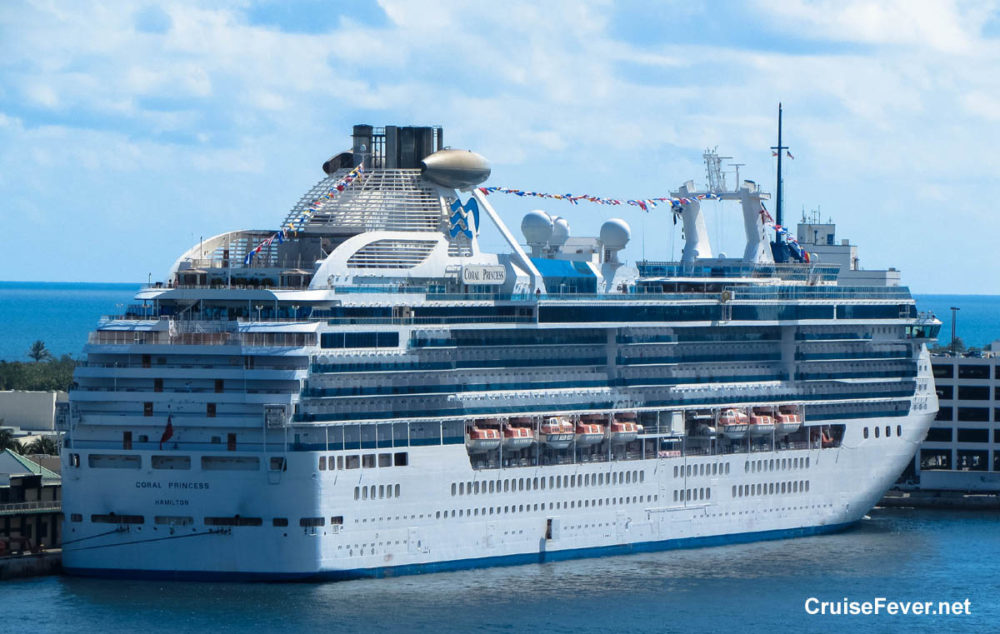
Crew Member Dies in Life Boat Accident on the Coral Princess

Crew Member Dies in Life Boat Accident on the Coral Princess


A crew member on the Coral Princess was killed last Friday in a tragic accident involving a lifeboat while the cruise ship was in Colon, Panama.  The incident was first reported by Cruise Law News.

Two crew members were in a lifeboat doing maintenance work on the hull of the Coral Princess when a cable snapped dropping the boat into the water.  Both of the workers were sent to a local hospital for treatment but one of the men died from injuries.
Reports are stating that the cable snapped as the lifeboat was being raised back onboard the ship.
The crew member that passed away was Husnan Fauzan, a 10 year veteran who served as a SCP1 for Princess Cruises.  The other worker was Bosun Steven Bagshaw who is currently still in the hospital in stable condition.
Cruise Fever reached out to Princess Cruises and received the following statement:
“On October 24 two of our crew members were in one of the ship’s rescue boats doing some maintenance work on the hull of the Coral Princess.  When the boat was being raised back onboard the ship, one of the cables that raises and lowers the boat parted, and the boat dropped back into the water with our two crew members inside.
We immediately responded and discovered that these crew members had, unfortunately, sustained injuries which necessitated their transfer to a shoreside hospital for evaluation and treatment.
It is with an extremely heavy heart that we confirm that one of our crew members subsequently passed away from his injuries. This has devastated everyone across the entire Princess Cruises organization.
We are, and will continue to support his family during this difficult period.”
Our hearts and prayers go out to the family of Husnan Fauzan and the crew of the Coral Princess as they deal with this tragedy.
The Coral Princess is a 2,000 passenger cruise ship that has been in service since 2003. The ship was on a 12 night cruise out of Fort Lauderdale, Florida that was sailing to the Southern Caribbean and Central America at the time of the incident.

Quantum mechanics: Robot bartenders and RFID wristbands

Quantum mechanics: Robot bartenders and RFID wristbands

Quantum of the SeasSOUTHAMPTON, England — Quantum of the Seas is bound for the U.S., departing on a transatlantic trip to New York following a two-night preview cruise here.

About 2,700 travel agents, vendors, media and VIPs were treated to afirst look at the ship, fresh out of the Meyer Werft shipyard where it was under construction for 20 months.

Although Meyer Werft typically delivers early, according to Royal Caribbean Cruises Ltd. Chairman Richard Fain, with Quantum it was just on time. Numerous items are being installed or fine-tuned on the crossing, which is expected to conclude Nov. 10.

The ship’s headline features have been publicized, but the preview cruise group got to see some of the less heralded innovations, and learned a few obscure facts from Fain and other Royal executives.

For example:

• The oversized magenta bear on Quantum’s top deck has been named Felicia by the crew. At a travel agent forum, one agent said she doesn’t know how to explain it to clients and wondered why it was there. “Why not?” Fain replied. “The bear is a little bit ridiculous and certainly unexpected, but isn’t she great?”
Quantum - Bionic Bar• More than 100 bottles of liquor are suspended from the ceiling over the two robotic bar tenders in the Bionic Bar. The robots reach skyward to access pours for the drinks they make. Bar managers believe they will have to restock only once a day. The two ’bots have been dubbed B1O and N1C by supervisors.

• Hand-washing basins have been installed at the entrances to the Windjammer buffet restaurant, and at several other restaurants around the ship. The basins are not an industry first — Princess Cruises’ Royal Princess and Regal Princess have them — but they are a first for Royal Caribbean. The idea is to keep passengers from spreading any illness, norovirus in particular.

• The poolside video screen was installed to the side after Fain concluded that its initial spot at the end of the pool was too obtrusive. One manager said Fain ordered the change. Fain says he doesn’t remember who suggested the move. “If you like it, I take credit for it,” he said.

• Two candelabras in the Wonderland restaurant feature lighted candles. Fain said Royal Caribbean banned open flames for more than 20 years but recently has made some limited exceptions approved by a panel of top executives. He said there is no Coast Guard rule on flames. “I think the candles add to the atmosphere,” he said.

• Metallic was the scent picked to add a sensory note to the North Star observation gondola. The smell is very subtle. North Star’s ascent to a position 300 feet above the ocean is smooth, gradual and silent, except for the whir of an air changer in the roof. The gondola is designed to automatically shut down and retract if sensors detect an unexpected motion.
Quantum -North Star gondola• The pool areas in the Solarium contain several feet of water, deeper than on other Royal ships. They form a series of tiers, leading to a level with hot tubs on either side. A sculpture by Spanish artist Jaume Plensa is a focal point for the cascading pools.

• Jamie’s Italian, the specialty restaurant by British culinary entrepreneur Jamie Oliver, is the first alternative restaurant on a Royal Caribbean ship to have an al fresco dining area. The glass-shielded deck space has five tables for two and six tables for four.

• The Windjammer on Quantum will be the first one fleet-wide to have a section open 24 hours a day. The decision was made in part to accommodate demand anticipated when Quantum moves to China next May.

• The Schooner Bar menu has a retro theme. It features throwback classics such as the Old Fashioned, Sidecar, Brandy Alexander and daiquiri. The printed menu includes vintage photos of memorabilia, such as a typewritten Passenger Landing Card from 1974 and a drinks list with Budweiser priced at $1.35.

• Four key cards malfunctioned. Quantum offers RFID wristbands as an alternative to key cards. “Normally, we would have hundreds of key cards with [magnetic] strips that had become de-magnetized,” Fain said.

Free Up Your Suitcase: 4 Easy Packing Tips

Free Up Your Suitcase: 4 Easy Packing Tips


Many travellers struggle with finding a large enough space to pack all of their clothes, electronics, and other travel necessities. While this predicament could be easily solved by buying a monstrous sized suitcase, most travellers prefer not to rent a moving truck to transport their incredibly over sized suitcase to the airport.
For the rest of the travel world with normal sized suitcases, luckily, there are a few easy ways to free up valuable packing space in your suitcase.
Storing Within
“Storing Within” is most likely the easiest way to free up space. Simply pack any light clothing items, such as socks, underwear, gloves, or small hats into other items already in your suitcase, such as shoes or even water battles. Moving these smaller items into other items will free up plenty of space for larger, bulkier items.
Roll Em’ Up
After a number of studies focused on finding the optimal packing method, travel experts agree rolling your clothes, rather than folding, saves much more space in your suitcase. Rolled clothes take up much less space in your suitcase than a large pile of folded clothing. Roll up and carry on.
Satellite Luggage
Many travellers tend to pack their most valuable and more important clothing items in their primary suitcase. An easy way to free up space in your primary suitcase is to move smaller, less important clothing into your satellite luggage, such as a computer bag, briefcase, or camera bag. Moving items such as socks into other luggage will help free up space for your other larger or more important items, such as your big floppy sunhat. 
Travelling Companion
The “Travelling Companion” method  is very simple and helpful in freeing up more room in your suitcase. If you’re travelling with a friend, a family member, or any other traveling companion, ask them if they have any extra room in their suitcase they won’t be using and move a few items into their suitcase. While this method seems extremely obvious, many people may not think that their travelling companion might just have a little bit of extra space for some of your items.

The Motion Of The Ocean: Battling Seasickness

The Motion Of The Ocean: Battling Seasickness


Seasickness, otherwise known as motion sickness, can end the enjoyment of your cruise quicker than you might think. For some cruisers, even the slightest motion of the ship can bring on the undesirable symptoms of seasickness.
Malaise, nausea, vomit, and headaches are never positively associated with a cruise, but can be the symptoms of seasickness. Luckily, there a few different methods in combating the motion of the ocean.
Sea-BandsOdds are you will see at least one fellow passenger wearing the “silly black bands” during your sailing, but they are far from silly. In recent years, Sea-Bands have become one of (if not) the most popular remedies for seasickness. Made popular by their simple nature and lack of medication, these bands help alleviate motion sickness and vomiting through acupressure in the wrists. While you may find a red mark on your wrist from the bands, you will not be finding yourself in the ship’s medical centre any time soon. So, when the waves get a little rough, slap on your bands and head on down to your shuffle board game on the promenade deck.
DramamineIf your not a fan of drug free remedies, Dramamine is the solution for you. Dramamine is an over the counter, fast acting medication that helps alleviate motion sickness and vomiting. Cruisers can find this seasickness remedy in both tablet and liquid form with specific dosages for adults and children.
ScopolamineOne of the classic seasickness remedies, “that patch behind the ear,” formally known as Scopolamine, is one of the most popular medications used to treat seasickness. Passengers need only to wear a small patch behind the ear, which releases small dosages of medication into the skin. The small doses of medication ultimately interfere with the communication between the nerves and area of the brain that controls vomiting.
Additional Remedies
Throughout the history of sailing, mariners have found many unique and questionable ways to treat seasickness. While many may be less effective, many have been proven to reduce the symptoms felt by sailors in rough seas. Passengers looking for additional methods can try:
  • Eating green apples.
  • Eating saltine crackers.
  • Drinking soft drinks, such as Coke, Pepsi, or Ginger Ale.
  • Chewing on ginger.
  • Breathing fresh air on deck.
  • Setting your sights on the horizon.
  • Undergoing acupuncture therapy in the ship’s spa.
  • Take a nap, lie down, or sit still in a comfortable chair.
  • Manually extending the ship’s stabilizers. (Okay, maybe not this one.)
Medical disclaimer: We here at WeTravel2U are far from what any normal person may call a “medical expert.” None of our staff has ever attended what is referred to as “medical school,” nor do any plan on doing so in the foreseeable future. Therefore, we advise you to consult with your real medical expert prior to using any of the aforementioned seasickness medication.

Monday, 3 November 2014

Carnival Corp. embraces hybrid WiFi technology

Carnival Corp. embraces hybrid WiFi technology

By Tom Stieghorst
Carnival TriumphCarnival Corp. has begun rolling out a major upgrade in the way its ships access the Internet that the company says offers a tenfold average speed improvement over the previous system.

The platform, based on a different technology than the system used by Royal Caribbean Cruises Ltd. (RCCL), has already been installed on 10 ships in the Caribbean. Most of those are in the Carnival Cruise Lines fleet, but some are also operational on Princess Cruises and Holland America Line vessels.

As the Princess and Holland America ships move to Alaska next summer, the technology will be inaugurated in that region.

Eventually, Carnival plans to use the system globally on all 101 ships sailing in its brands’ fleets, said Ramon Millan, Carnival Corp.’s global chief information officer.

“The dream of having reliable and fast Internet access is what we’re trying to offer,” Millan said.

Balky, slow Internet access is one of the chief frustrations for cruise passengers. As more bandwidth has become available over the past decade at ever cheaper prices on land-based systems, cruise ships have been hamstrung by their dependence on satellite connectivity.

Most satellite-based systems use geostationary satellites, requiring signals to travel 23,000 miles up into space and back, which creates a latency that slows page loading. The technology required to use such satellites at a reasonable cost also creates bottlenecks that slow messages leaving and arriving to the ships.

Carnival and RCCL both have now abandoned geostationary satellites as a sole vehicle for their Internet data.

The Carnival solution is a hybrid system that only uses satellites for some Internet connections and switches to land-based connectivity whenever it’s available. It relies on sophisticated routers to switch among several different types of WiFi and satellite services fleetwide to find the fastest, clearest, cheapest route for signals at any given time.

Millan said the hybrid system enables ships to adapt to their regional situation as they move along their itineraries.

Transmission rates, he said, are “not the same when you are in the middle of the ocean, in the Gulf of Mexico, or when you are close to Florida.”

One key to the hybrid approach is a form of long-distance WiFi that ships will use within 40 miles of shore.

Millan said it operates much the same as regular WiFi, but with the help of powerful amplifiers. “It is similar to what you have at home but with an amplifier that allows us to send the WiFi signal up to 40 miles away from shore.”

Switching to the long-range land-based WiFi when available also frees up satellite bandwidth for ships farther out at sea, which boosts their speeds as well.

Millan cautioned that the service speeds he cited were only averages and might be slower in areas such as the open Atlantic, where only satellite connectivity is available. He said the bandwidth improvement claims have not been audited by independent third parties, but that Carnival has tested the claims of its vendors.

“We do have our own technology team onboard, and we use our own tools,” Millan said.

Among th
Ramon Millane suppliers for the new hybrid system will be Harris Caprock and MTN Satellite Communications, one of the pioneers of the hybrid approach to ship connectivity.

Millan said the system has been tested in pilot projects over the past year and a half, and one of the key tests has been how many seconds it takes a given technology to load test pages, including those from banks, which have robust authentication protocols that require extra bandwidth.

He said Carnival has also been using routine crew communications in field testing.

The line has been surveying guests about their experience of the new system and converting their answers into system scores. He said the scores with the hybrid approach are more than 50% higher than they had been with previous systems.

Millan said the new capacity will enable guests to access websites that had been blocked previously because they absorbed too much bandwidth, primarily social media sites such as Facebook.

He said social media sites are increasingly embedding video into their presentations, which takes even more capacity. “The world is changing,” he said. “And what these guys are offering — Google, Facebook, Twitter — is something that demands more bandwidth, more connectivity.”

Carnival Corp.’s largest competitor, RCCL, is taking a different approach to connectivity that relies on the use of mid-orbit satellites to increase Internet speeds.

Unlike the geostationary satellites used by most systems, midorbit satellites circle the Earth at much lower orbits, reducing the latency in the transmissions to and from the ships. But because they are not always in the same point above the Earth, they must be tracked as they move across the sky from horizon to horizon, requiring more sophisticated technology.

The system has been in testing on the Oasis and Allure of the Seas and is expected to debut on the Quantum of the Seas when that ship arrives to start Caribbean cruises from New York later this month.

Recent tests show the midorbit services supplied by O3b Networks achieving transmission speeds of 500 megabits per second.

Millan said Carnival is not providing a speed comparison. “This is not about megabits,” he said. “And the reason I say that is because that is misleading. You may have a lot of megabits but the experience is not good. There are many factors that contribute to a good experience.”

Millan said Carnival started out looking for a single solution but came to the conclusion that a hybrid system provided more flexibility to adapt and less risk.

Besides, he said, the Carnival system, which will be known as WiFi@Sea, is orbit agnostic and could eventually incorporate midorbit satellites such as those used by O3b.

“At this point, we’re using C-band and K-band, the conventional satellite frequencies, but we are not precluding using low-orbit satellites,” Millan said. “We have the footprint to adopt new technologies into the model as they become available.”

Pricing for the new service is being left up to each brand, Millan said. Most Carnival Corp. brands charge 75 cents a minute for Internet access, with various discounted volume plans available.

Millan said that WiFi@Sea will be the foundation for new services in the future. “We do have some applications we are testing in some of these brands,” he said. Possibilities include news delivery, port information and online gaming services, he said.

He emphasized that Carnival Corp. believes that flexibility is the key to designing a cruise ship Internet service.

“The technology is changing so fast that the one that is the best right now may be obsolete in a week,” he said.

Quantum of the Seas: It's familiar yet innovative

Quantum of the Seas: It's familiar yet innovative

Quantum-NorthstarSOUTHAMPTON, England — For all of its innovation, Quantum of the Seas will be familiar to anyone who has traveled on Royal Caribbean International’s Freedom-class ships. The footprint for Quantum is a step back from the radical ship design of Oasis of the Seas.

Quantum doesn’t have a Viking Crown Lounge, and the central promenade is a little different than on Freedom- and Voyager-class ships. But the overall impression is of a Freedom-class ship with a number of very innovative features bolted on to the prototype.

The “wow” features are new, of course. The North Star observation gondola looked quite inviting on a beautiful fall day before Quantum’s departure on a two-night preview cruise here.

The SeaPlex, an open indoor rec area, looked like fun with its bumper cars idling along its sides. It feels airy and open, with lots of windows illuminating the space so it doesn’t feel dim.

The Ripcord by iFly commands the aft part of the upper deck, along with a hulking magenta bear sculpture that serves as a conversation piece and is a bit unlike anything else on a Royal Caribbean ship.
Quantum-RobotBartenders-BionicBar-TSThe big attention-getter so far, however, has been the Bionic Bar. Crowds are consistently watching the two robotic bartenders pour their libations. There is something fascinating about the precision movements of these blue, impersonal robots.

Interior cabins are brightened by the floor-to-ceiling virtual balcony screens, another add-on that has also been installed on Royal’s Navigator of the Seas.

Perhaps the most noticeable change on Quantum is the number of restaurants, with the main dining room split into five new themed dining venues. Yet even here, the complimentary restaurants are in their usual place on the lower aft decks, except for Coastal Kitchen, a new concept for suite guests only, which is high on Deck 14.

Windjammer and the Solarium, also on Deck 14, are staples of Royal’s recent ship layout. The line’s trademark design elegance, quality materials and attention to detail is there, too.

The windows on the Two70° lounge (named for 270-degree panoramic sea views) at the back of the ship look enormous, defining the rear profile of the ship. But I have not seen the evening entertainment programming yet in Two70°, nor in the Music Hall, or the Royal Theater.
Quantum-SeaPlexAnother standout feature of Quantum is the poolside movie screen, which is mounted to one side of the pool, rather than at the end of the pool as on most designs.

The passenger mix on this two-night cruise reflects Royal Caribbean’s increasing international outreach. There was a noticeable contingent of Chinese guests, who were there to see the ship in anticipation of its deployment to Shanghai starting in May 2015.

June Arlen Eggesbo Lundeby, general manager of USA Spesialisten, a travel agency in Oslo, Norway, said that Quantum will appeal to clients from Norway who will combine a cruise with a pre- or post-cruise stay in New York.

“Cruise in Norway has been booming,” Lundeby said, as appreciation grows that on ships such as Quantum many passengers are not retired, and that it is a relative bargain.

“The prices are of big interest,” Lundeby said. “You would never find the same value in a four-star hotel vacation in Miami Beach,” she said.

Royal Caribbean International: Explorer of the Seas damaged by rogue wave

Royal Caribbean International: Explorer of the Seas damaged by rogue wave

Photo: Ocean Liner Pictures

The 311 meter-long cruise ship Explorer of the Seas (commissioning September 2000), the US shipping company Royal Caribbean International, was today taken early around 5 clock of an approximately 12-meter high rogue wave while partially damaged.

What force can put in such enormous wave, demonstrates a photo that is currently in circulation. It shows a total of 26 lifeboats, which are located between the top 4 and 5. The impact was so violent that one of the boats apparently triggered by the davits and hit the promenade deck. One can question the right, what would have happened if several lifeboats would have been affected and used in a possible evacuation of up to 3,114 passengers and 1,180 crew members.

Was injured, according to initial information nobody. Only a few elevators and automatic sliding doors to deck 4 aft fell out temporarily, so that an ordinary thrust succeeded in sea water in the board inside. Currently the ship is on the way to the safe haven of St. Maarten. At the moment it is assumed that the Explorer of the Seas is the continuous routes expire as scheduled.
Video below show's the moment a rouge wave hits the ship.
 Video of the damaged caused

Sunday, 2 November 2014

Damen Entrusted with MSC Magnifica’s Refit

Damen Entrusted with MSC Magnifica’s Refit

Damen Entrusted with MSC Magnifica's Refit

Damen Shiprepair Rotterdam, part of Damen Shiprepair & Conversion, has been awarded a cruise repair and maintenance contract from MSC Cruises.

The 2010-built cruise ship MSC Magnifica arrived in Rotterdam on October 20 and is berthed at the yard’s largest drydock, where the ship is expected to stay for 18 days.
The repair scope includes extensive steelwork, cleaning, painting and replacement piping, as well as the entire renewal of the rudder system.
The vessel is 293 m long and has a capacity for more than 2,500 passengers.
Khalil Benjelloul, Cruise Vessels Product Manager of Damen Shiprepair & Conversion, said  that the project is certainly a challenge given the timeframe. “During the drydocking the 700-strong crew will largely stay on the vessel and they have to be able to carry out their normal activities safely, so it is quite a logistical operation. 
At the same time, there could be up to 300 of our workers and subcontractors dealing with the project.”
 
“Rotterdam was the preferred yard because it offers the large capacity needed and additionally, the MSC Magnifica will sail straight on to Hamburg, where she picks up her passengers for her next cruise.
 
“Every hour is needed to get the vessel ready on time. For the cruise industry, getting the job done within the deadline is crucial. We cannot have thousands of passengers waiting.”
Press Release

MS Marco Polo Runs Aground in Norway

MS Marco Polo Runs Aground in Norway

MS Marco Polo Runs Aground in Norway

Cruise ship MS Marco Polo has run aground with 750 passengers on board while manoeuvring to anchor near Leknes in Norway’s northern Lofoten Islands.

Cruise & Maritime Voyages (CMV), a passenger shipping company headquartered in Essex, UK  informed that due to adverse wind conditions experienced by their cruise ship MS Marco Polo when approaching her berth in Leknes (Lofoten Islands), Norway, it was decided, in the interest of safety, to take anchor.
“Whilst manoeuvring and as the tide was retreating, the ship touched a mud bank and became lodged. A subsequent inspection by divers has revealed that there has been no damage to the vessel’s hull or propulsion systems,” the company said in a release on Saturday, November 1st.
According to CMV, Marco Polo has been successfully manoeuvred off the mud bank with the assistance of the evening high water tide and resumed her 14 night voyage to Norway and the Land of the Northern Lights en-route to Alta.
There has been no oil pollution arising out of the incident and none of the 763 mainly British passengers or crew have been injured.
“Passengers wishing to go ashore were transferred by tender and the local tour programme continued as scheduled,” the release added.
Chris Coates, Commercial Director of CMV commented, “The comfort and safety of our passengers is our top priority and our passengers have been kept fully updated of the situation.”