Showing posts with label ship sinks. Show all posts

Thursday, 2 January 2014

Pandaw river ship sinks

Pandaw river ship sinks

By Michelle Baran

Pandaw River Expeditions’ Saigon Pandaw sank last week while being towed, a representative of Pandaw confirmed.

The 60-passenger Saigon Pandaw launched in 2012 and was sailing the Mekong River in  and Cambodia. It was being repositioned to Myanmar when it sank.

Pandaw said that the company is still investigating the cause, but that early reports indicate that strong winds were to blame. There were no deaths or injuries, as the vessel was being towed as cargo without any crew onboard.

For the remainder of the season, Pandaw is going to deploy the 10-passenger Kalay Pandaw in Myanmar, a vessel that launched in 2013.

Pandaw has two additional 40-passenger river cruise vessels launching in Myanmar in July, the Kindat Pandaw and the Kalaw Pandaw, on which the company plans to accommodate passengers affected by the loss of the Saigon Pandaw.

“Our reservation and sales team is working to shift all bookings and if necessary to offer alternatives,” the company said.

Uniworld Boutique River Cruise Collection had previously chartered the Saigon Pandaw as the River Saigon, but the company now exclusively sells the 60-passenger River Orchid for Mekong cruises. The River Orchid launched last January.

Wednesday, 5 June 2013

Italian investigators detail Concordia ‘chaos and confusion’


Italian investigators detail Concordia ‘chaos and confusion’

By Tom Stieghorst


The severity of the Costa Concordia shipwreck was chiefly due to the “unconventional behavior” of its captain and weak emergency management, an Italian safety agency has concluded.

The findings of the Italian Marine Casualties Investigative Body are part of a definitive 176-page report on the 2012 accident.

While it did not absolve Costa Cruises’ shoreside oversight, the report said Capt. Francesco Schettino lied about the extent of damages to authorities. It further said that his delays in declaring an emergency and in deciding to abandon ship had fatal consequences.

Had passengers been called to lifeboats earlier, “all of them could have reached their salvation out of the Concordia,” the report said.

The report variously describes the evacuation as adequate and chaotic and faults the bridge team for being too passive. But it said the key mistakes lay in the navigation planning phase of the voyage and in Schettino’s reluctance to accept that the ship was sinking.

In Italy, the board plays a role similar to that of the National Transportation Safety Board in the U.S. Separately, an Italian judge has accepted the indictment of Schettino on manslaughter and other criminal charges. A trial is scheduled for July 9.
The report includes recommendations to safety regulators. It urges reforms for bridge officer training and consideration of a double hull skin to surround key electrical and propulsion gear.

The Concordia was all but doomed from the start by the decision to change the plotted course to one close to Giglio Island in order to offer its residents a salute, the report said.

“The ship was sailing too close to the coastline, in a poorly lit shore area, under the Master’s command who had planned to pass at an unsafe distance at night time at high speed (15.5 knots). The danger was considered so late that the attempt to avoid grounding was useless,” the report said.
Schettino’s attitude in reviewing the navigation plan was “arbitrary,” the report asserted.

“The passive attitude of the staff on the bridge is just as reprehensible,” it added, chiding the officers for failing to waive Schettino off the risky course despite having criticized it among themselves before his arrival on the bridge.
The Concordia hit the rock that ripped a 175-foot gash in its side at 9:45 p.m.

Rather than sound the emergency alarm, Schettino told passengers only that the ship had an electrical blackout, a lie he would repeat to the Civitavecchia harbor master and the Coast Guard station there, the report said.

Not until 10:33 p.m. was the general emergency alarm sounded, the first announcement calling passengers to their muster station followed at 10:36 p.m. By that time, the ship was already listing 11 degrees. It isn’t until 10:54 p.m. that the ship’s second officer communicated “abandon ship” in English over the public address system.

By that time, some passengers had boarded lifeboats on their own. The report said many procedures set for emergency management were not followed.

“There was chaos and confusion, lack of communication,” the report stated. “In other words, a complete disorganization, mainly because nobody by the bridge coordinated the emergency according with the muster list and the related procedure for abandoning ship.”

Still, the crew performed “adequately” under increasingly dire conditions, it said.

It also noted that while the work language of the ship was Italian, officers such as the Bulgarian first engineer said they didn’t fully understand Italian.

Conversely, the helmsman said he sometimes couldn’t follow orders given by the captain in English.

The report said had passengers been mustered at roughly 10 p.m., when the bridge first learned that three watertight compartments of the ship had flooded, they could have been in lifeboats before 11:12 p.m., when listing of 30 degrees started to make it hard to lower them to safety.

Although the Italian Navigation Code says the captain must be the last person onboard to abandon ship, the report says Schettino departed at 11:19 p.m. with 200 to 300 passengers and crew still aboard the Concordia, leaving only a single officer temporarily on the bridge to manage their escape.

At 12:30 a.m. the Coast Guard reached Schettino by radio in a lifeboat, which he said he had tumbled into as the ship listed. He was ordered to return to the ship but did not.

In accordance with the International Convention for the Safety of Life at Sea, the Concordia was designed to survive the flooding of two of its watertight compartments beneath the bulkhead deck, but five compartments were breached, which led to the accelerated listing.

In addition, once it rose high enough, water began spreading through openings in the bulkhead deck to other compartments. The ship was built with a double bottom, but the gash occurred farther up on the side, where only a single hull kept water outside the ship.
The report’s recommendation section suggests a double skin be considered for watertight compartments where critical electrical and propulsion gear are located, so that they could survive to run pumps, for example.

It also recommends that new ships be built with fewer openings in the bulkhead deck to reduce the progress of a flood.

More separation of compartments with the ship’s essential systems should be considered, along with wider distribution of bilge pumps and a relocation of the main switchboard rooms above the bulkhead deck.

The report recommends an emergency light in each cabin to highlight the location of the lifejacket.

Bridge officers should be required to pass courses in Bridge Team Management and their training should emphasize “an enhanced collective decision making process and ‘think aloud’ attitude,” the report recommended.

More care should also be taken to document that crew members with muster duties have the certifications to perform their emergency jobs, the report said.


Friday, 12 April 2013

Costa to pay $1.3 million fine over Concordia: report


Costa to pay $1.3 million fine over Concordia: report

By Tom Stieghorst
Costa Cruises has agreed to a $1.3 million fine levied by the Italian government to settle criminal charges over the sinking of the Costa Concordia, according to a Reuters report from Italy.

The fine applies to the corporation, not to crew members and executives who have been charged and are expected to be prosecuted individually.

The prosecution is satisfied with the ruling by the preliminary court judge, Valeria Montesarchio, and will not appeal, prosecution sources said, adding that the fine was close to the maximum allowed by law.

"This is a balanced decision," Costa Cruises lawyer Marco De Luca said after the ruling. "It is the most reasonable solution."

The company spokesman confirmed De Luca's comments, originally made to Italian media, and said the company had no further statement.

Wednesday, 25 January 2012

The Costa Concordia and disaster management


The Costa Concordia and disaster management

By Donna Tunney
It’s hard to imagine how Carnival Corp. and its Costa Cruises brand could have put a positive spin on the Concordia accident, but that’s what one academic expert on tourism and economic development said they should have tried to do – and very quickly.
Insight“They needed to immediately reassure people that [cruise passengers] are in good hands, that it’s business as usual, that the lines operate under strict regulations,” said Simon Hudson, who holds an endowed chair at the South Carolina Center of Economic Excellence in Tourism and Economic Development at the University of South Carolina.
Hudson spent several years working in the tourism industry in Europe and is the author of several books on the travel business, including “Marketing for Tourism and Hospitality: A Canadian Perspective.”
Human error involved in the Concordia disaster will dent consumer confidence in both Carnival and Costa, he said, but likely only in the short term.
“It’s like when we get a plane crash and everyone’s up in arms," he said. "The cruise industry is one of the safest ways to travel and has been very responsible over the years."
But he’s not sure that the move by Carnival and Costa to “deflect blame” onto the Concordia’s captain, Francesco Schettino, instills the level of confidence the companies should be striving for.
“To me it’s interesting,” Hudson said. “It’s almost as if they’re saying, ‘It’s not directly our fault; it’s a captain error.’ But that doesn’t give much confidence to the cruise line.
Schettino faces multiple charges after he allegedly allowed the ship to hit rocks near the Italian island of Giglio and then abandoned the vessel while passengers and crew were still onboard. He is under house arrest in Italy.
“I would imagine that Carnival and Costa will have a strategy in place, but they don’t seem to have reacted that quickly from a public relations point of view,” Hudson said.
Carnival Corp. brands last week all posted messages on their Facebook pages that addressed the lines' safety procedures. Carnival Cruise Lines went the furthest, linking to its lifeboat-drill video on YouTube and leading Facebook discussions about its safety procedures and navigational technologies.
Carnival Corp. chairman and CEO Micky Arison, meanwhile, has regularly issued statements and used Twitter posts to express the company’s concern for the families of passengers and crew who were confirmed dead or are missing.
And late last week, the company announced it would begin a “comprehensive audit and review of all safety and emergency response procedures across all of the company’s cruise lines.”
But some agents are questioning Carnival’s behavior, even while acknowledging that the captain appears to be culpable.
“I wish that Carnival Corp. would stop complaining about their financial losses [and] try to help the families who sustained such terrible losses unnecessarily,” one retailer wrote in the comment section of Travel Weekly’s Jan. 18 agent survey about the Concordia accident.
In fact, Carnival Corp. was not complaining about losses. By immediately estimating the extent of financial damage it would incur from the accident, it was simply complying with Security and Exchange Commission rules requiring that public corporations reveal such losses to investors and potential investors. But against a backdrop of human suffering, even the most mundane communication can seem insensitive in the public arena.
Another agent suggested that other industry brands should be talking about the Concordia accident, too, in a bid to reassure clients.
“Cruise lines need to address the issue of safety at sea," the agent suggested. "They need to address why the Costa Concordia incident cannot happen on their line."
On Thursday, CLIA, which represents all the major cruise lines, took a broader approach, making the case that cruising, regardless of line, is safe, during a panel at the Passenger Ship Safety Conference in London.
Other retailers who responded to the survey were clearly angry, including one who wrote this: “I think it is horrendous how Carnival Corp has handled this matter. Forget Costa… this is a Carnival company [and] they need to take responsibility! … I [will] gladly steer away my clients from the Carnival portfolio of products unless I see some quick and immediate amends made to the passengers.”
But there were also several positive observations from retailers, such as this one: “Clients are asking about any deals that may come up in the aftermath of what happened. They are more worried about [the safety of] driving their car than they are to take a cruise.”

Saturday, 21 January 2012


Cruise safety revisited after Costa Concordia disaster

By Donna Tunney and Arnie Weissmann
In the aftermath of the Costa Concordia tragedy, CLIA, Congress and two former Costa Cruises executives last week were revisiting assumptions about cruise safety, taking into account the perfect storm of events that led to the loss of life and the harrowing experiences of survivors in the waters off the Tuscany coast.

Meantime, cruise lines took action independently. Royal Caribbean Cruises Ltd. tightened passenger muster rules for all its brands.

And on Thursday, Carnival Corp., the parent of Costa Cruises and nine other cruise brands, announced a “comprehensive audit and review of all safety and emergency response procedures across all of the company’s cruise lines.”

CLIA called upon the International Maritime Organization (IMO), which sets global standards for ship safety, to undertake a “comprehensive evaluation from the findings” of the accident investigation currently being conducted by Italian authorities.

And in Washington, lawmakers are poised to review safety measures in light of the Concordia accident. Rep. John Mica (R-Fla.), chairman of the House Transportation and Infrastructure Committee, said his committee would conduct a hearing on the subject.

“The Costa Concordia tragedy is a wakeup call for the United States and international maritime organizations to carefully review and make certain we have in place all appropriate standards to ensure passengers’ safety on cruise ships,” Mica said.

The CLJohn MicaIA announcement was made by the organization’s CEO, Christine Duffy, before introducing a panel at the Passenger Ship Safety Conference currently under way in London.

Tom Allan, a member of the panel and chairman of the Cruise Ship Safety Forum, who has held a number of senior positions in the IMO, said that after the Italian authorities conclude their work, other member states may want to propose international guidelines.

The process may take years, but he said that the industry will likely be proactive and go forward with its own initiatives in a shorter timeframe.

After the panel, which was simulcast to journalists in New York, J. Michael Crye, executive vice president of CLIA who liaises for the organization on regulatory matters, said “The Italians will be the ones who make determinations about what went wrong and what needs to be improved, if anything. The results will be taken to the IMO, where it will be debated and discussed by international experts among the 170 member nations. They will look to see if the treaty needs to be modified, and will take into account any recommendations made.”

CLIA has two seats on the IMO board.

Crye agreed that the lines may move forward on their own. “Each (line) has an affirmative obligation to seek out means to identify and improve [safety],” he said. “No one in the industry wants to have this type of blot on the cruise industry. We will identify best practices and apply them. It has already begun within each individual cruise line.”

Bruce Nierenberg, who served as president and CEO of Costa Cruises before Carnival Corp. bought a controlling share of the line in 1997, said, “There is a dynamic that is in play here that several senior execs in the business used to discuss 10 to 20 years ago when the ships were really starting to get big. Even the technical and maritime engineering experts at the companies where I worked were concerned that regardless of the safety equipment onboard and the modern technology of the ship, the industry was beginning to build ships that were too big to be really safe in emergencies.”

“The industry, in its drive for profits has not been considering enough of the problems that can be created by enclosing thousands of people in a confined space, by expecting to evacuate upwards of 6,000 to 8,000 passengers in the largest ships, and by ignoring the basic human instinct to panic in such a situation,” he said.

The Concordia was carrying 3,200 passengers and about 1,000 crew. There were 26 nationalities represented on the ship.

Panelists in London felt that a ship’s size did not make it inherently less safe. Both Allan and Captain William Wright, senior vice president of marine operations for Royal Caribbean International, suggested that larger ships might actually have their own benefits in an emergency situation.

Bigger ships, Allan said, were designed to include more flexibility in the subdivision of safety options and in some ways provide a “bigger” and “better” platform to survive.

“The safety standards are no different,” he said. “Smaller ships have certain advantages over larger, and vice versa.”

Wright added that as ships grow larger, the evacuation routes and lifeboats are scaled accordingly.

Also on the topic of large ships, panelist Vice Admiral Alan Massey, CEO of the U.K.’s Maritime and Coast Guard Agency, said “we are satisfied ... that we’re in touch with what the industry is doing and the risks associated with it. Safety standards have kept pace.”

Bruce NierenbergNierenberg said, “There will be regulation changes, I’m sure, because of this accident, in terms of crew language requirements and training. And I’m sure it will become law that lifeboat drills have to take place before the ship leaves the harbor.”

In London, Wright said that “the vast majority” of muster drills occur before sailing. He noted that while the Concordia’s actions were “in keeping with regulations,” the practice will come under scrutiny.

According to the U.S. Coast Guard’s Cruise Ship National Center of Expertise, the International Convention for the Safety of Life at Sea (SOLAS) requires an evacuation drill within 24 hours of port departure.

“Each cruise line has its own business practice, and in most cases the drill is held soon after departure,” a spokesman for the center said. “That’s the spirit of the regulation, but we can’t require ships to do that.”

In the case of the Concordia, two embarkation ports were offered to passengers: Barcelona and Cititavecchia, the Italian port about 50 miles from Rome. The nearly 700 people who boarded the ship in Civitavecchia on the day of the accident had not yet participated in a safety drill. Their drill was to have been held the next day.

Nierenberg said it takes time for passengers to become acclimated to a large ship. Expecting them to find their way around almost immediately after boarding — without a muster drill, in the dark and with language barriers between passengers and crew — is a stretch.

Following the Concordia accident, Royal Caribbean Cruises Ltd. (RCCL) directed its fleet — including all ships operated by Royal Caribbean International, Celebrity Cruises and Azamara Club Cruises — to hold passenger muster drills on the day of departure.

Until now, all RCCL vessels have held muster drills 30 to 60 minutes prior to departure on the day of embarkation or turnaround, the company said. But on “rare occasions,” primarily due to very late departure times, the drill could be held to the following morning.

Not anymore.

The Concordia crew had intended to meet the 24-hour rule, with its drill planned for the following day.

Mitch Schlesinger, vice president of sales and marketing at Voyages to Antiquity, agreed that the timing of lifeboat drills in the wake of the Concordia disaster will become an industry issue.

“And,” he added, “there will be other issues tied to that. For example, on some ships it’s now optional to bring a life jacket to a boat drill. People were tripping over the straps, and cruise lines were trying to do this with 3,000 or 4,000 or 5,000 people. Was that new regulation the right thing to do?”

The bottom line, said Schlesinger, an industry veteran who formerly was a marketing vice president at Costa, is that “you need to understand how to put on your life jacket.”

On some large ships, including Royal Caribbean's Oasis-class vessels, passengers report to a designated public area, such as a lounge or a theater, to watch a safety video while a crew member demonstrates how to don a life jacket. On others, passengers still are required to report to their assigned lifeboat station, sometimes wearing their life jacket and sometimes not.

“It will be like the airports after 9/11,” Schlesinger said. “And I think it will happen for the right reasons. It might seen inconvenient, and you might only need them in the rarest of circumstances, but you need to know where to go and what to do.”

Schlesinger also asserted that in the Concordia case, the captain “invited a problem” by taking the ship too close to Giglio.

At the CLIA panel, the captain’s decision to attempt to bring the Concordia closer to shore after a rock tore through the ship’s hull raised the question of whether current thinking that “safe return to port” standards would be reviewed.

(According to Crye, “safe return to port” standards apply to ships built since June 2010. He said that improvements in stability and redundancies of systems has increased the likelihood that it may be safer for a damaged ship to attempt to get to a port rather than deploy lifeboats. He said what procedure to initiate — return to port, deploy lifeboats or go to deep water and initiate counter-flooding — is up to the captain’s discretion.)

The decisions and behavior of the Concordia’s captain, Francesco Schettino, contributed to what Nierenberg referred to as a “perfect storm.”

“It used to be that it took 25 years to get promoted to captain,” he said. “But today, the lines probably are under pressure to accelerate training because there are so many slots to fill.”

Nierenberg added that the Concordia accident also argued for psychological evaluations of ship captains.

Schettino faces multiple charges and is under house arrest in Italy after steering the ship into the rocks and allegedly abandoning the vessel while passengers and crew remained onboard.

“How does a guy like that get to be captain?” Nierenberg wondered.

Perhaps, he suggested, large ships should have more than one captain.

“Now that the big-ship animal has been created, we have to figure out how to deal with it,” he said.

Journalists at the London panel also questioned crew readiness for an emergency, from the captain down to cabin stewards.

Richard Evenhand, managing direct of V.Ships Leisure UK, the world’s largest third-party ship-management firm, said on the panel that the IMO sets standards for seafarers and that competencies are required before they can join a ship. He said there were further “comprehensive packages of training.”

He added that the ability to speak relevant languages was part of the selection process, in reference to some criticism that language played a role in confusion aboard the Concordia.

Wright said that all ships have emergency plans that are reviewed every week, and every member of the crew has a specific duty. For example, there are crew members who have instructions to bring life jackets to muster stations, he said.

Crye noted that “a bartender who is taking muster would not necessarily have the expertise to lower and operate a lifeboat,” but is trained in some aspect of emergency procedure.

In New York, Bud Darr, CLIA’s director of environmental and health programs, observed that “there are specific training standards and requirements applied universally across the maritime world.”

The CLIA panel was questioned about whether there were regulations regarding voyage plans and the discretion that a captain has in straying from the preplanned route.

Wright said that there are standards for “bridge resource management,” and that those require that if one varies from a voyage plan, the change must go through a two-person check to verify its appropriateness. “Not just the captain, but the entire bridge team,” he said.

In London, a journalist asked if the notion of a captain going down with the ship was outdated. Massey said there is no basis in international law for the concept. “Individual companies may have policies, but in the context of law, it’s more myth than reality.”

And women and children first?

“There is a requirement to take specific note of accessibility issues of passengers and accommodate them on a personal basis,” Crye said.

Carnival chief Arison orders 'comprehensive review'


Carnival chief Arison orders 'comprehensive review'

Carnival chief Arison orders 'comprehensive review'Costa Cruises’ parent Carnival Corporation is to undertake a “comprehensive review” of all safety and emergency response procedures across its nine cruise lines which run 101 ships worldwide.
Carnival also gave its backing to a call for thorough evaluation of safety regulations by the International Maritime Organisation, requested yesterday by the Cruise Lines International Association.
The moves came as Costa confirmed that survivors of the Costa Concordia will receive a refund for the abandoned cruise after the ship run onto rocks off the west of Italy and “all material expenses relating to it”.
The Italian company added that it was in contact with passengers and consumer protection associations “to determine indemnity for the hardship endured, with the support of the tour operator association of each country”.
This came as a video emerged showing the crew of Costa Concordia reassuring passengers nothing was wrong, after the ship had begun taking in water.
In the amateur footage, a crew member says “everything is under control” and a generator problem will be fixed. She asks passengers to go to their cabins.
The vessel ran aground off Italy's coast with 4,200 people on board and listed on its side. At least 11 people died and 21 are still missing.
Italian media broadcast what is claimed to be the first phone conversation between port officials and crew of the vessel about 30 minutes after the ship hit rocks. In the exchange, a crew member is heard saying it is experiencing only a blackout, the BBC reported.
Carnival chairman and CEO Micky Arison admitted the Costa Concordia tragedy “has called into question our company’s safety and emergency response procedures and practices”.
He added: “While I have every confidence in the safety of our vessels and the professionalism of our crews, this review will evaluate all practices and procedures to make sure that this kind of accident doesn’t happen again.”
The action by the company, which includes UK-based P&O Cruises and Cunard Line together with the likes of Princess Cruises, Carnival Cruise Lines, Holland America Line and Seabourn, will be led by retired US navy captain James Hunn, the organisation’s senior vice president of maritime policy and compliance.
Hunn and senior health and safety executives from each of the lines will review all safety and emergency response policies and procedures, officer and crew training and evaluation, bridge management and company-wide response and support efforts. He will report to the Carnival’s health, environment, safety & security committee and to chief operations officer Howard Frank.
Carnival also announced that the committee is engaging outside “industry-leading experts” in the fields of emergency response organisation, training and implementation to conduct an audit of all of the company’s emergency response and safety procedures and to conduct a thorough review of the Costa Concordia accident.
Frank said: “This company-wide initiative will identify lessons learned and best practices to further ensure the security and safety of all of our passengers and crew.”

Friday, 20 January 2012

Concordia captain navigated ship off course, says Costa CEO


Concordia captain navigated ship off course, says Costa CEO

By Donna Tunney
Francesco Schettino, captain of the partially sunken Costa Concordia, diverted from the cruise line’s normal route from Civitavecchia to Savona, Italy, Costa Cruises CEO Pier Luigi Foschi said in a media briefing Monday.

Foschi explained that Costa ships sail the Concordia’s northern route out of Civitavecchia 100 times a year, using detailed charts.

Schettino, who has been detained by Italian police, diverted from the route so that passengers could view the Tuscan island of Giglio up close, Foschi said.

The cruise ship struck rocks near Giglio on Friday, and the ship tilted into the sea.

Since the Italian authorities have seized the ship and all navigational records, Foschi said it is unclear which charts Schettino was using.

“We are working with investigators who will understand what happened. We have to inform all of you that the prosecutor has the ‘black box,’ which has all the information to enable us to understand what happened,” Foschi said.

Emergency search-and-rescue teams have been combing through the wrecked ship since the weekend and found three survivors and the bodies of two passengers who died inside the vessel.

The death toll from the accident is six, according to reports. Twenty-nine people are still unaccounted for, the Italian Coast Guard said on Monday evening. Authorities earlier said that 16 people were missing.

Four crew members and 25 passengers are still missing. According to Fox News, a U.S. couple from Minnesota is among the missing.

There were more than 4,200 passengers and crew aboard the Concordia.

Costa hired a salvage company on Sunday to determine how to remove the ship from its location in about 98 feet of water.

Foschi said the company is “very, very concerned” about environmental impact, since the Concordia was loaded with 2,300 tons of fuel. The ship had departed Civitavecchia on a seven-day Western Mediterranean cruise a few hours before the collision.

Initial reports that the ship had grounded may have been mistaken, given the confirmed depth of the water.

Foschi said that arrangements would be made for passengers booked on future Concordia sailings. “This has not been our priority right now,” he said.

Foschi added that it’s too soon to determine whether there will be an inordinate number of cancellations in the wake of the disaster.

“We will be looking into that,” he said.

He said that Costa’s loyal customers and its “quality track record over 60 years” would help ensure its future operations.

Costa’s reputation eventually will emerge as strong as it was before the Concordia disaster, said Foschi.
This report was updated Monday evening to add that 29 people on the Costa Concordia were unaccounted for.

Saturday, 14 January 2012

Italy cruise ship Costa Concordia aground near Giglio


Italy cruise ship Costa Concordia aground near Giglio


The Independent's travel editor Simon Calder: ''It is unbelievable ... that this should happen to a 21st Century ship"

Related Stories

Three people are confirmed dead after a cruise ship carrying more than 4,000 people ran aground off Italy.
There were scenes of panic as the Costa Concordia hit a sandbar on Friday evening near the island of Giglio and listed about 20 degrees. People reached land by lifeboats but some swam ashore.
Rescue teams have been going from cabin to cabin, searching for survivors.
Italians, Germans, French and British were among the 3,200 passengers. There were also 1,000 crew on board.
Helicopters evacuated the last 50 people on the deck who were in a "worsening" situation.
Three people were confirmed dead, Italian coast guard officials said on Saturday morning - fewer than the six or eight deaths reported by Italian media earlier.
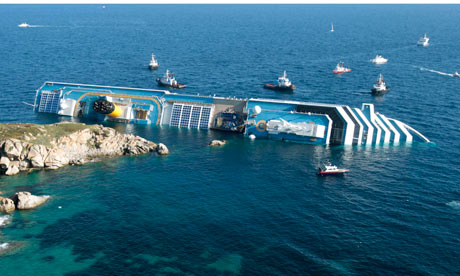
Costa Concordia with hole in its hull (14 January 2011)The Costa Concordia was carrying more than 3,200 passengers when it ran aground off the Italian coast
Mediterranean cruise
The Costa Concordia had sailed earlier on Friday from Civitavecchia port near Rome for a Mediterranean cruise, due to dock in Marseille after calling at ports in Sicily, Sardinia and Spain.
One thousand passengers were Italian, with 500 Germans and 160 French.
Cabin steward Deodato Ordona says the ship suddenly began to tilt.
Some "tens" of British passengers are believed to have been on board, said the UK Foreign Office, which is sending a team to the scene.
Some passengers told the Associated Press the crew had failed to give instructions on how to evacuate the ship. An evacuation drill was scheduled for Saturday afternoon.
"It was so unorganised, our evacuation drill was scheduled for 17:00 (16:00 GMT)," Melissa Goduti, 28, from the US told AP. "We had joked what if something had happened today."
'Groaning noise'
Passengers were eating dinner on Friday evening, when they heard a loud bang, and were told that the ship had suffered electrical problems, one passenger told Italy's Ansa news agency.
"We were having supper when the lights suddenly went out, we heard a boom and a groaning noise, and all the cutlery fell on the floor," said Luciano Castro.
Passenger Mara Parmegiani told Italian media there were "scenes of panic".

Costa Concordia

  • Entered service in 2006
  • Built by Fincantieri in Italy at a cost of 450m euros (£372m; $570m)
  • Capacity for 3,780 passengers
  • 1,500 cabins, including 12 suites, five restaurants and 13 bars
  • Four swimming pools and five Jacuzzi whirlpool baths
  • A 6,000 sq m (64,600 sq ft) spa with gym, sauna, Turkish bath and solarium
  • Sports pitch, cinema, theatre, casino and disco
Source: Costa Cruises and cruise industry websites
"We were very scared and freezing because it happened while we were at dinner so everyone was in evening wear. We definitely didn't have time to get anything else. They gave us blankets but there weren't enough," she said.
The 290-metre (950 ft) vessel ran aground, starting taking in water and listing by 20 degrees, the local coast guard said.
Orders were given to abandon ship, Deodato Ordona, a cabin steward on the Costa Concordia, told the BBC.
"We announced a general emergency and took passengers to muster stations," he said.
"But it is hard to launch the lifeboats, so they moved to the right side of the ship, and they could launch."
Costa Concordia seen from land (14 January 2011)The cruise operators thanked the authorities and citizens of the island of Giglio for rescuing those on board the Costa Concordia
Hypothermia
Elderly passengers were crying, said Mr Ordona, adding that he and some others jumped into the sea and swam roughly 400 metres to reach land.
Rescued passengers were accommodated in hotels, schools and a church on Giglio, a resort island 25km (18 miles) off Italy's western coast.
Most have now been moved to the mainland, Elizabeth Nanni from Giglio's tourist information service told the BBC.
"Usually there are 700 people on the island at this time of year, so receiving 4,000 and some in the middle of the night wasn't easy," she said. "Some people jumped in the sea so they had hypothermia."
Searches are still going on for "possible missing people", regional official Giuseppe Linardi told the Italian broadcaster RAI.
Once the search of the cabins above the waterline has been completed, scuba divers will then check the decks which were submerged by the crash.
map
Coast guard official Francesco Paolillo, a local coast guard official, told the AFP news agency there was a 30m hole in the ship but that it was too early to say what exactly had happened.
"We think this happened as a result of sailing too close to an obstacle like a reef," he said.
Costa Cruises, the company which owns the ship, said it could not yet say what had caused the accident.
"The gradual listing of the ship made the evacuation extremely difficult," a statement said. "The position of the ship, which is worsening, is making more difficult the last part of the evacuation.
"We'd like to express our deepest gratitude to the coastguard and other emergency services, including the authorities and citizens of the island of Giglio, who did their best in saving and helping the passengers and crew."
Two years ago, a Costa Cruises ship crashed into a dock at the Egyptian Red Sea resort of Sharm al-Sheikh, killing three members of the crew.