This Blog is for New to Cruise and the well Traveled , on this site we will publish information about Cruise and Holiday information, with some insider stories in the travel press.
After a 900-day gap, Xiamen, China, is now officially opened for domestic cruising, according to a local news report.
On July 2, the former Viking Sun, now operating as the Zhao Shang Yi Dun, marked the return of cruise operations to the Chinese port as part of a new itinerary in the region.
The five-night cruise departs from Shenzhen and includes a call in Xiamen, in addition to two full days at sea.
At the time, the 930-passenger vessel - which is now operated by a joint-venture between Viking and China Merchants Shekou – kicked off a program of cruises to Sanya.
The ship’s new operation is hoped to revive the cruise economy and the cultural tourism industry in Xiamen, the news report added.
Previously one of the biggest homeports in the country, the Xiamen International Cruise Terminal had been out of service since the beginning of the COVID-19 pandemic.
While a new 68,000-square meter cruise terminal is set to be completed later this year, the port’s current facilities underwent a renovation before the return of the cruise passengers.
The port is also undergoing a major development project known as the Sea World. The commercial building complex is expected to open in September and was planned to, among other goals, improve the core competitiveness and influence of the region.
In 2019, before the outbreak of the pandemic, Xiamen is said to have received a total of 136 cruise ships, in addition to 413,700 passengers.
Sailing under the Chinese flag, the Zhao Shang Yi Dun is currently the only cruise ship in revenue service in China.
While international brands redeployed vessels that were previously sailing in the country, local cruise operators continue to have their entire fleets in operational pause.
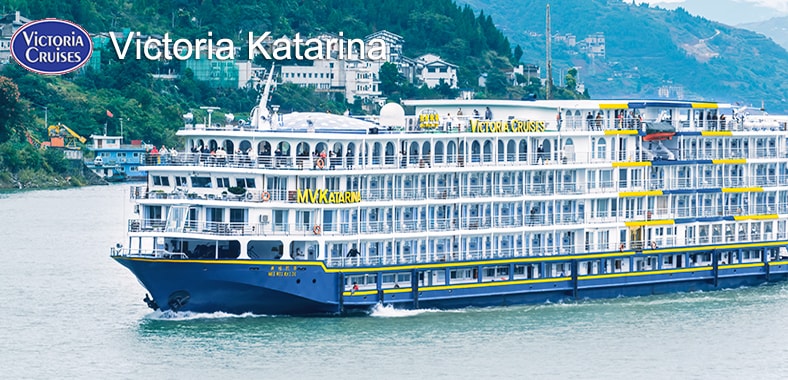
Victoria cancels Yangtze cruises over coronavirus concerns
MVKatarina
Victoria Cruise Lines says it has cancelled six cruises on China's Yangtze River due to concerns about the coronavirus.
"While
operations have not been directly impacted by the situation in Wuhan --
more than 500 miles away from the American-managed company's Chongqing
office -- many passengers travel through transportation hubs which have
been affected by proactive measures taken by the Chinese government,
creating logistical difficulties," the company said in a statement.
Additionally,
the company said China's Ministry of Culture and Tourism has asked the
tour sector to temporarily suspend operations. In response, Victoria
said, it has cancelled all sailings through Feb. 16, six offseason winter
departures. "Victoria Cruise Lines will monitor the situation in
the interim and continue to prioritize the safety and enjoyment of its
valued guests," the company said.
From left: Alan Buckelew of Carnival Corp., Adam Goldstein of Royal Caribbean Cruises Ltd., Frank Del Rio of Norwegian Cruise Line Holdings and Gianni Onorato of MSC Cruises.
BEIJING -- To U.S. travel agents, the themes that emerged from this week's CruiseWorld China might have seemed reminiscent of issues that surfaced over the past three decades of cruise industry development in the U.S.
"We need to bring across the idea that the cruise is the destination, instead of just a mode of transportation," said Zheng Weihang, executive vice president and secretary general of the China Cruise & Yacht Industry Association.
Adam Goldstein, chairman of CLIA and president and COO of Royal Caribbean Cruises Ltd., added: "A vast number of people have no idea what a cruise vacation is about, what happens onboard and how it offers great value."
And Anthony Kaufman, executive vice president of International Operations for Princess Cruises, counseled that a travel agent's responsibility includes "understanding the uniqueness of each cruise product and imparting that knowledge to the consumers."
Although much of the conversation sounded like Cruise Sales 101, not all of the issues facing a quickly-growing, rapidly evolving industry have a North American parallel. The vast majority of cruises in China are charters, with cabins sold by a handful of mega-agencies, some of them larger than the cruise lines themselves. They, in turn, rely on a network of sub-agencies to help them fill ships.
The sustainability of the charter model was called into question by most of the cruise executives present, though none called for abandoning it outright. The general consensus was that it has helped the market get to where it is today, but more diversity in sales options will be healthier for long-term growth.
Calling charters a "force-feeding" model, Zinan Liu, Royal Caribbean International's president of China and North Asia Pacific region and chairman of CLIA North Asia, said the charter model was successful in the past six years when consumer awareness was low and the sales force of cruise lines small. He predicted it will likely continue to coexist with other distribution models.
Kaufman noted that it continues to be the foundation for China's cruise market and at present enables travel agencies to maintain better control of the customer experience and pricing. But, he said, whether it continues to dominate might depend on individual company strategies.
That each of the four largest cruise lines was represented by a top corporate executive suggests that China's potential is still very much front of mind:
• Carnival Corp. COO Alan Buckelew provided an overview of the company's 10 brands and revealed that the most luxurious Princess ship yet built will sail Chinese waters.
• Goldstein wore two hats. As chairman of CLIA, he provided an overview of industry growth, with a focus on China, and as president and COO of RCCL, he promoted Royal Caribbean International ships.
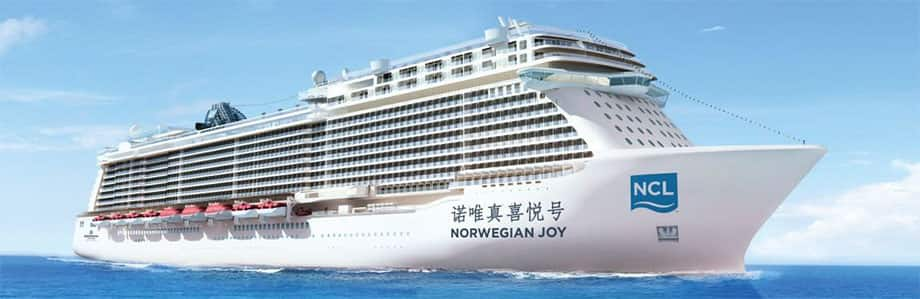
• Norwegian Cruise Line Holding Ltd. CEO Frank Del Rio provided updated details about the Norwegian Joy, a ship being built specially for the Chinese market, whose inaugural cruise is slated for June 23.
• MSC Cruises CEO Gianni Onorato provided more details after having announced the day before that a second ship, the Splendida, would be heading to China to join the Lirica.
In addition to the international development and regional line executives quoted above, onstage were Buhdy Bok, president of Costa Group Asia; David Herrera, president of Norwegian Cruise Line Holdings China; Roger Chen, chairman of Carnival Corp. China; Harry Sommer, executive vice president for international development at Norwegian Cruise Line Holdings; Helen Huang, president of Greater China, MSC Cruises; and Fan Min, chairman and CEO of SkySea Cruise Line.
The 4,200-passenger Norwegian Joy, a new ship bound for China next year, will feature a large red phoenix on its hull, the latest in a series of hull paintings for Norwegian ships.
Chinese artist Tan Ping is responsible for the design, which will also include waves and other stylized nautical motifs.
“The Phoenix symbolizes beauty and good luck in Chinese culture, and Norwegian Joy will bridge across the West and the East and bring Chinese people’s best wish to the world and everyone in her path,” said Tan Ping, a painter, print maker and educator.
Joy, the first Norwegian ship to be custom-built for the Chinese market, is scheduled to begin sailing from Beijing and Shanghai next summer.
Ovation of the Seas joins Royal Caribbean's fleet following delivery ceremony
Richard Fain and Bernard Meyer
There is a new Royal Caribbean ship officially in the fleet, as of today.
Royal Caribbean took delivery of its 24th cruise ship, Ovation of the Seas, in a ceremony held today in Bremerhaven, Germany. Ovation of the Seas is the third Quantum-class ship in Royal Caribbean's fleet.
Royal Caribbean Chairman Richard Fain took delivery of Ovation of the Seas from Meyer Werft Yard’s Managing Partner Bernard Meyer at the official handover ceremony.
“Ovation of the Seas is magnificent,” said Richard. “Our thanks to the Meyer Werft team for their ongoing partnership in designing and building awe-inspiring ships with us.”
“It’s wonderful to welcome Ovation of the Seas to the Royal Caribbean family of ships,” said Michael Bayley, President and CEO, Royal Caribbean International. “We have once again introduced yet another one of the most technologically advanced cruise ships and the very first that has been built for the China market – a market we continue to demonstrate our commitment to expanding. Quantum Class has redefined the status quo, and we are excited for our guests in China and Australia to enjoy their extraordinary vacations onboard this stunner.”
Ovation of the Seas will now sail to Southampton, U.K., where the ship will offer a series of short getaways before she sets sail on her 52-night “Global Odyssey” culminating in the arrival to her homeport in Tianjin, China.
She will begin her first homeport sailing season in China from Tianjin in June 2016. Ovation, together with Quantum of the Seas, Mariner of the Seas, Voyager of the Seas and Legend of the Seas, will make up the largest fleet of any cruise line sailing in China.
Internationally-acclaimed Norwegian Cruise Line (NCL) has unveiled the English and Chinese names for the world’s first purpose-built cruise liner for the China market. The most innovative ship ever styled exclusively for Chinese guests has been named ‘Norwegian Joy’ – translating into Chinese as 喜悦号 (Xǐ Yuè Hào).The name Norwegian Joy emphasizes the experience that the ship will offer -- 尽享喜悦海上乐园, a promise that guests will ‘Experience Paradise on the Sea’.
“After closely studying the Chinese cruise market for several years, we wanted to be clear about what we will deliver to our guests on this spectacular vessel,” said Norwegian Cruise Line Holdings Chief Executive Officer Frank Del Rio. “Norwegian Joy will provide the same sense of freedom and flexibility found on all Norwegian Cruise Line ships, but with resort-style vacation experiences and amenities designed specifically with the Chinese guest in mind.”
Norwegian Joy
With a capacity of 3,900 guests, the new Breakaway Plus-class vessel will debut in China in Summer 2017. Norwegian Joy is designed specifically for the Chinese traveler, with cuisine and onboard experiences that cater to the unique vacation preferences of Chinese guests. This unrivaled customization for the China market has involved detailed consultation with Chinese partners and local experts on the subtleties of Chinese culture and preferences.
The upscale cruise experience especially tailored for modern Chinese travelers extends from world-class entertainment to a wide range of specially curated fine international dining, unrivaled duty-free luxury shopping at sea and a new range of incredible first-at-sea activities onboard.
“Chinese guests will discover an unmatched quality of service, cuisine, entertainment and retail experience onboard Norwegian Joy that is simply not available in the China market today,” said Senior Vice President and Managing Director of China, David Herrera. “With Norwegian Joy, we will unquestionably offer our Chinese guests a superior product and introduce a new standard of innovation and excellence into what will soon be the world’s second largest cruise market.”
Additional details, including the ship’s homeport, accommodations, dining and entertainment will be shared in the coming months.
Nuò Wéi Zhēn
In addition to the ship name, NCL has also revealed a new Chinese name and logo exclusively for the mainland China market. The company’s name will be represented by characters(Nuò Wéi Zhēn), translating as a ‘Promising, Exclusive and Authentic’ cruise line, which perfectly reflects the company’s dedication to offering the premier cruise product in China. Along with outstanding entertainment, dining and upscale accommodations, Norwegian Cruise Line is renowned for a unique style of cruising known as Freestyle Cruising that offers guests the freedom and flexibility to dine, shop and enjoy entertainment on their own time schedule in a fun, relaxed, and energetic atmosphere. Only on Norwegian can guests enjoy their vacation at their leisure, with no set dining times, a wide array of dining experiences and a variety of award-winning entertainment.
To support NCL’s expansion in China, the company has opened offices in Beijing (Guomao CBD) and Shanghai (Xintiandi), supporting all three brands in the company’s portfolio – Norwegian Cruise Line, Oceania Cruises and Regent Seven Seas Cruises.
With a fleet of 14 liners cruising worldwide, Norwegian Cruise Line was this year voted “Europe’s Leading Cruise Line” for the eighth consecutive year in the prestigious World Travel Awards, as well as “Caribbean’s Leading Cruise Line” for the third time and “World’s Leading Large Ship Cruise Line” for the fourth year running.
Royal Caribbean signs deal with China's Forbidden City Imperial Palace to showcase Chinese culture on Ovation of the Seas
Royal Caribbean and the Chinese Imperial Palace Museum (the Palace Museum) held a joint press conference today at a signing ceremony for a Memorandum of Understanding (MOU) agreement in the Forbidden City’s Jianfu Palace.
As part of the agreement, experts from different research fields selected by the Palace Museum will be invited to give lectures of Chinese history and culture to guests on Ovation of the Seas.
The Palace Museum also will provide professional consultation of the ship’s interior décor and art program. In addition, signature pieces from the collections of the Imperial Palace Museum will be on display to promote the traditional culture and arts of China. Paintings and art pieces created by artists from the Palace Museum will be available for guests to purchase at auctions held onboard.
Ovation of the Seas, Royal Caribbean’s newest ship that debuts in April, will be the first to homeport in China immediately after its delivery and will begin service from Tianjin beginning June 2016.
The signing ceremony officially launches the “2016 – Let’s Ovation” campaign in China and marks the countdown to Ovation of the Seas’ maiden voyage in China.
“We are proud of the extensive collection of art and relics that represent the imperial treasures of the Ming and Qing Dynasties and it is our goal at The Palace Museum to showcase the traditional Chinese culture to people all over the world,” said Shan Jixian, Director of the Imperial Palace Museum. “This partnership with Royal Caribbean International and our programs on Ovation of the Seas will help to further these objectives. We are excited to promote the rich heritage of the Forbidden City and China to the guests of the world’s largest global cruise line and we hope to continue to expand on these efforts.”
Dr. Zinan Liu, President of North APAC and China, Royal Caribbean International said: “Cruising is becoming increasingly popular with Chinese travelers and Royal Caribbean’s award-winning and state-of-the-art ships with features found only on Royal Caribbean are very appealing to those consumers looking for a high quality vacation experience. Quantum of the Seas has been very well received by our Chinese guests and we are excited to now bring Ovation of the Seas to Tianjin. Sailing two of the world’s newest and most technologically advanced ships in China demonstrate our leadership and commitment to the market and this partnership with the Palace Museum showcasing China’s rich heritage will bring yet another unique element to our vacation offering.”
Ovation of the Seas will be officially launched in April 2016, when she departs Southampton for Tianjin, China on a 53-day Global Odyssey. She will begin her first homeport sailing season in China from Tianjin in June 2016. Ovation of the Seas, together with Quantum of the Seas, Mariner of the Seas, Voyager of the Seas and Legend of the Seas, will make up the largest fleet of any cruise line sailing in China.
New Princess ship to debut in Europe before China deployment
Majestic Princess.
Princess Cruises’ new ship Majestic Princess is to make its debut in Europe before being deployed to its year-round base in China.
The 3,560-passenger vessel enters service in April 2017 with a short maiden season of five to 28-day Mediterranean cruises from Barcelona, Athens and Rome before moving to China in July.
Sister ships Royal Princess and Regal Princess will be among a further six ships to be based in Europe in 2017.
Royal Princess will run new 11-day Grand Mediterranean and 10-day Western Mediterranean itineraries which can be combined into a 21-day sailing. Seven, 14, 21 and 28-day sailings throughout the Mediterranean will also be available.
Regal Princess, launched last year, returns to northern Europe for cruises to Scandinavia and Russia including an overnight stay in St Petersburg.
The 3,080-passenger Crown Princess will be based in Southampton from April to September to run seven and 14-night cruises to the Mediterranean and Scandinavia.
The 3,140-passenger Caribbean Princess will operate the line’s largest British Isles season with 12 departures from Southampton including a new late evening stay in Belfast and overnights in Dublin on selected cruises.
Smaller Pacific Princess, carrying 680 passengers, will sail from Dover from June to September on northern Europe itineraries.
Both Crown Princess and Pacific Princess will offer North Cape voyages to the Arctic Circle during the peak midnight sun period around the summer solstice.
The 2017 sailings, covering 153 departures to 119 destinations across 27 countries, are open for booking on December 3 from 4pm.
Princess Cruises’ president, Jan Swartz, said: “Our 2017 Europe season is sure to inspire our guests with our newest and largest ships in the Mediterranean and northern Europe.
“We’re especially excited to debut Majestic Princess in the Mediterranean before she officially sails to Asia for her maiden China cruise season.”
Jammed: Overcrowding at the world's most popular tourism sites
A jam-packed scene at Versailles. Photo Credit: pryzmat/Shutterstock.com
This past Christmas, Disneyland and Walt Disney World's Magic Kingdom temporarily reached maximum capacity and were forced to close their gates and turn away guests until the crowds thinned. And while these highly popular theme parks both routinely rank among the 20 most visited sites in the world, they are hardly the only destinations grappling with the challenge of how to balance a surging global traveling population with the finite capacity that tourist hot spots can sustain.
The 10 most visited tourist attractions in the world
10. Forbidden City, Beijing Annual Visitors: 15.3 M
9. Disneyland Park, Anaheim Annual Visitors: 16 M
8. Walt Disney World's Magic Kingdom, Orlando Annual Visitors: 17.5 M
7. Faneuil Hall Marketplace, Boston Annual Visitors: 18 M
6. Grand Central Terminal, New York Annual Visitors: 21.6 M
5. Niagara Falls Annual Visitors: 22.5 M
4. Union Station, Washington Annual Visitors: 32.9 M
3. Central Park, New York Annual Visitors: 37.5 M
2. Times Square, New York Annual Visitors: 39.2 M
1. Las Vegas Strip Annual Visitors: 39.7 M
This list is an excerpt of international home exchange clubLove Home Swap's 50 Most Visited Tourist Attractions in the World. Data was gathered from multiple sources. Attractions that don't sell tickets provided estimates. Attractions that could not distinguish between tourists and general visitors were not included.
In 2014, the number of international tourists reached 1.14 billion, 51 million more than in 2013, according to the World Tourism Organization, making it the fifth consecutive year of above-average growth in global tourism since the 2009 economic crisis. At the same time, the majority of the sites all those travelers are visiting aren't getting any bigger.
"Overcrowding is becoming a major issue at many global touristic destinations," said Randy Durband, president of the Global Sustainable Tourism Council. "All tourism destinations need meaningful destination-management plans and management structures that ensure sustainability in a very broad sense, and that includes [addressing the issue of] overcrowding."
Within private enterprises, such as Disney parks or museums, officials in charge of those institutions can work to implement crowd control measures however they deem fit, but when the problem spills out into public spaces, such as in the entire city of Venice or New York's Times Square, it's a bit less apparent whose problem crowding is.
"There's really nobody who has any authority or jurisdiction to manage this," Durband said.
Indeed, when the problem is not confined to a single institution, crowd management is often tackled by a patchwork of solutions and strategies.
"Who pays for it? If you're at Disney, Disney is going to pay for it," said Harold Goodwin, professor of Responsible Tourism Management at Leeds Metropolitan University and director of the International Centre for Responsible Tourism.
However, when it comes to London, where Goodwin lives, crowding has become a burden on the city and its residents.
"There are parts of London which I would now regard, as a Londoner, as a no-go area because there are too many tourists," he said.
Increasingly, the inevitable logjam of travelers during peak travel periods is creating myriad logistical and security problems for the companies, cities and institutions that manage these tourist draws. At best, travelers are often forced to visit places like Istanbul's Grand Bazaar and New York's Time Square crammed among hoards of selfie stick-toting tourists, or to wait in hours-long lines to get into places like the Eiffel Tower in Paris or Beijing's Forbidden City. At worst, they can't get in at all. The Palace of Versailles now has a "crowded days" calendar on its website asking visitors to simply stay away during those times.
"If you can, avoid the days of high attendance," the website advises. This includes the majority of June, July and August, the high-season months for travel to Europe. But if and when institutions have to actually turn away visitors, or if visitors can't get through the crowds to see what they came to see, that would appear to defeat the whole purpose of travel. That is, in fact, the moment at which the travel industry's success becomes its own downfall.
"Limiting the number of visitors must be seen as a means of last resort," Durband said. "So much can be done long before that step is even considered."
The Grand Bazaar in Istanbul consistently ranks among the most-visited sights in the world. Love Home Swap named it the 11th Most Visited Tourist Attraction in the World. Photo Credit: Michelle Baran
He said that tourism institutions need to explore methods to disperse visitors over various times in the day, seasons of the year and areas within or near the destination, which can alleviate many of the biggest problems with overcrowding. Transportation control issues often hold the key to better regulating visitor flow, Durband said, including policies and practices related to parking, the use of shuttle buses, regulating cruise ship access and requiring visitors to use a public transit system. But anyone who has been physically squeezed while trying to visit a popular museum or a jam-packed event might consider these strategies a case of doing too little too late.
"There is no one-way solution on the crowding of tourist destinations, as the issues and the resolutions are often site specific," the World Travel & Tourism Council (WTTC) wrote in an email statement in response to questions about the issue of crowd control in tourism destinations.
"With more and more people traveling, it is important that travel and tourism grows sustainably," the WTTC wrote. "Nearly 2 billion people are expected to travel internationally by 2030, with significantly more people traveling domestically. Tourism boards, governments and the private sector should work closely together in order to protect and preserve cultural heritage and traditions while accommodating this growing number of visitors at their destinations."
Sample solutions
Companies like Disney, institutions like the Louvre or destination marketing organizations (DMOs) that promote popular cities and countries live with the crowding dilemma day in and day out, and many of them have been quietly ramping up their efforts to address the issue in recent years. They are often working behind the scenes to implement a variety of tactics to improve flow, to disperse visitation over a greater area if possible and to spread attendance more evenly over the course of the year.
According to Atout France, France’s tourism development agency, Sacre Coeur in Paris welcomes some 10.5 million visitors annually.Photo Credit: Michelle Baran
Walt Disney World's Magic Kingdom, for example, has been able to accommodate a few thousand more guests per day during some peak travel periods due to its recently implemented MyMagic+ program. MagicBand radio-frequency identification bracelets enable guests to reserve time slots on attractions, vastly improving park visitation efficiency, according to Disney executives.
Walt Disney Parks and Resorts last month polled guests for their opinion on a potential three-tiered pricing strategy that theme park insiders said could be another step toward alleviating crowding. Disney asked survey participants about a system in which tickets would be sold at three pricing levels, with the highest priced tickets valid any day of the year, the middle-tier tickets valid on most days save for peak and holiday weeks, and the lowest priced tickets valid on off-peak weekdays.
"There's the possibility that such as system could reduce overcrowding on the busiest days in the parks, as higher prices, theoretically, would reduce the demand for those days," Robert Niles, editor of ThemeParkInsider.com, wrote on his site. "The downside is that the demand would shift to less popular days, increasing the crowd sizes on days that now enjoy lighter crowds."
NYC & Company, the tourism marketing arm for New York City, home to several of the world's most-visited tourist attractions, including Times Square, Central Park and Grand Central Terminal, continues to push toward its target of welcoming 67 million visitors by 2021. But it is also looking for ways to get those travelers to sprawl out across the entire city, not just congregate in tourism choke points.
"NYC & Company has a five-borough promotional strategy, and our goal is to spread visitors out across the entire city," said Chris Heywood, the DMO's senior vice president for global communications. "This strategy has been in place for several years. For two and a half years, we have put a stronger focus on neighborhood travel."
The campaign, initially called Neighborhood X Neighborhood, was rebranded earlier this year as NYCGO Insider Guides. Recent neighborhood spotlights have included the Flatiron District and Coney Island, with NYC & Company providing itineraries and insider tips via documentary-style short films about these lesser-known areas of the city. Next, it plans to promote Governors Island, St. George on Staten Island and Jackson Heights in Queens.
"We also have marketing strategies in place to shift demand to slower periods like January and February," Heywood said. "We run programs like Restaurant Week and Broadway Week during those times, for instance."
The trend of DMOs promoting off-season travel and off-beat locales has been gaining momentum in recent years.
Robin Johnson, head of overseas operations for VisitBritain, said, "A big part of our work going forward will be to address the issue of regional dispersal. Only recently, we set a number of targets to counter London-only travel."
Throngs of tourists crowd the entry to Buckingham Palace in London to get a glimpse of the changing of the guards ceremony. Photo Credit: Michelle Baran
In an attempt to address crowding head-on, the Louvre in Paris in the fall released details of an ambitious Pyramid Project, a $59 million initiative scheduled to be completed by 2017 that is intended to improve traffic flow, reduce noise and better accommodate the mounting number of guests who pass through the I.M. Pei-designed crystal pyramid that serves as the Louvre's reception area.
"At the time of their inauguration in 1989, the museum's reception areas were designed to receive 3 to 5 million visitors," said Jean-Luc Martinez, the Louvre's president and director. "Twenty years on, annual museum attendance has reached 9.5 million visitors."
Martinez said that the new project would double the entry points to the pyramid, which should help alleviate the frustrations and challenges of crowding significantly. The museum is attempting to reduce noise pollution through the installation of sound-absorbing partitions and a sheltered ticket office and to offer visitors better access to information through improved signage.
An age-old problem
The crowding problem is as antiquated as some of the ancient treasures tourists are trampling all over one another to see.
The Grand Palace in the Thai capital of Bangkok is said to welcome some 8 million travelers each year. Photo Credit: Michelle Baran
Tom Jenkins, president of the European Tour Operators Association, said, "This is a very old subject. It's been going on forever. Famously, Rome had a major problem with visitor overcrowding in [the year] 1300 when there were too many Jubilee pilgrims. People have been complaining about the crowds at European tourists sites for over 100 years."
Jenkins predicts that the crowding issue will ultimately sort itself out.
"This is a problem of success and has a pattern of being self-regulating," he said. "When people see it's too crowded, they have a tendency to stay away. ... It's not news that popular places are very crowded."
Jenkins represents a segment of the marketplace that in some ways stands to gain from the crowding. Tour operators often benefit from their ability to get groups past the lines and into popular sites after hours.
Likewise, Trafalgar President Paul Wiseman said, "We overcome the crowding with our VIP entrance program," which gets guests past the lines and straight into popular attractions. "That part actually is a huge selling point for us on the guided side."
Wiseman said the crowding of popular destinations during the busy summer months is also beginning to have another effect: increasing bookings in the off-peak travel season. The autumn, winter and spring programs are now upwards of 15% of Trafalgar's business, said Wiseman, who added that the shoulder or off-peak seasons offer three essential selling points: "Beat the crowds, beat the heat, the prices are lower."
Companies like Trafalgar are also seeing more demand for off-the-beaten-path destinations. And while that's as much about repeat travelers searching for new experiences as it is about crowding, a byproduct of extreme crowds in popular destinations is that they can make lesser-known attractions suddenly seem more appealing to the crowd-averse traveler.
A crowd touring the grounds of Beijing’s Forbidden City. Visitors are often forced to wait in hours-long lines to gain access to the attraction, which was named the 10th Most Visited Tourist Attraction in the World by Love Home Swap, a home exchange club that offers 70,000-plus properties in 160 countries.
"There are lots of very cool, very appealing destinations that are being developed," Durband said of up-and-coming destinations that see overflow elsewhere as an opportunity to attract more travelers. "There are places getting ready for more mainstream travel."
Still, the fact remains that many travelers, especially first-time globe trotters of which a whole new crop is emerging from developing source markets such as China, will want to visit trendy locales during the summer, when the weather is likely to be best and, consequently, when the crowds are biggest.
"First-time travelers, they still want to see the icons," Wiseman said. "It can be Rome in the middle of summer, 100 degrees on the busiest day of the year, and they want to see the Colosseum."
That means that the crowding issue is going to continue to challenge the travel industry well into the foreseeable future. According to one industry veteran, it is in fact the single biggest challenge.
"We used to say in the land-tour business that the cruise business was our competition," Arthur Tauck Jr., chairman of Tauck, said recently. But today, he said, "the competition of the entire travel industry is crowds. The world is becoming jammed."
Royal Caribbean to deploy Ovation of the Seas in China
Anthem of the seas shown above
Royal Caribbean International said it will deploy Ovation of the Seas to China in 2016. The ship is the second newbuild that will be devoted to the Chinese market.
The 4,000-passenger Ovation will be homeported in Tianjin, near Beijing, adding a fourth port in China to Royal Caribbean’s lineup.
In May, Royal Caribbean will redeploy its Quantum of the Seas to Shanghai from its current homeport in Bayonne, New Jersey. Ovation is also a Quantum-class ship, meaning two of the three Quantum ships will be sailing from China year-round.
No other cruise line has put a newbuild in China, much less two.
“We are furthering our commitment [to China] by bringing two of the world’s newest and most advanced Quantum-class cruise ships to the region,” Royal Caribbean President Michael Bayley said at a news conference in Beijing.
Ovation of the Seas, the third Quantum-class vessel, is scheduled to enter service in spring 2016. The second Quantum ship, Anthem of the Seas, will make its debut in Southampton, England, on April 22 and will sail from New Jersey after a summer season in Europe.
Bayley said that Royal Caribbean is taking other steps to strengthen its cruise operation in China. It has created a curriculum with Tianjin Maritime College to train culinary and restaurant service employees and hired more than 3,000 students since the academy opened in August 2014, Bayley said.
Also, Royal Caribbean is investigating potential Chinese drydock facilities to revitalize Legend of the Seas as early as 2018 and potential logistics centers in China to supply its ships deployed in the region.
It is also looking at an inbound-tourism business model that would bring thousands of North Americans to visit China.
The addition of Ovation will bring to five the number of Royal Caribbean ships sailing in China by 2016. In addition to Quantum and Ovation, the cruise line has positioned Mariner of the Seas in Shanghai and Voyager of the Seas in Hong Kong. Legend of the Seas will sail from Tianjin in 2016 until Ovation’s arrival, and then reposition to Xiamen.
A 52-day cruise from Southampton to Tianjin on Ovation opens for sale on March 26.
A smaller percentage of cruisers have booked Caribbean sailings for 2015, according to a forecast by Cruise Holidays International.
The survey shows 50.5% of cruise bookings for next year have the Caribbean as their destination, down from 54.8% in 2014.
Europe is gaining, with 12% of ocean cruises booked there next year, up from 10.4%. European river cruises account for 6.7% of bookings, up from 5.7% last year.
Cruise ship capacity in the Caribbean peaked in 2014 and is currently scheduled to begin declining in the second quarter of 2015, leaving fewer available berths.
The 2015 Cruise Trends forecast is based on bookings by 1,300 agents affiliated with Cruise Holidays.
A Dutch waterways cruise beginning in Amsterdam again is the most popular river cruise for 2015, followed by the Rhine/Main/Danube cruise through Central Europe, the Rhine Valley cruise, and a cruise through France on the Seine and Rhone rivers.
River cruises departing from two cities in Myanmar joined the list of top five non-European river cruises, after cruises departing from Beijing and Shanghai (tied for first) and one departing Ho Chi Minh City in Vietnam.
Princess Cruises will enter the China market for the first time next May, homeporting the Sapphire Princess in Shanghai for the summer. The 2,670-passenger ship will offer three- to seven-day cruises to South Korea. It is expected to carry 70,000 passengers over a four-month season, mostly from China.
Princess would become the second Carnival Corp. brand sourcing passengers from China. Costa Cruises began sailing there in 2006.
Carnival Corp. has opened offices in Beijing, Tianjin, Shanghai, Guangzhou and Chengdu to support its operations in China.
The 2014 China season will feature four itineraries: the seven-day itinerary will take passengers to the Korean capital of Seoul, the beach resort of Busan and the island of Jeju before returning to Shanghai; the five-day cruise will call at Jeju and Inchon; the four-day itinerary will call at Busan and Jeju; and the three-day cruise will call at Jeju.