Showing posts with label Glasgow. Show all posts

Saturday, 18 March 2023

Greenock Ocean Terminal Gears up for Record Cruise Ship Year

Greenock Ocean Terminal Gears up for Record Cruise Ship Year


Scotland’s Greenock Ocean Terminal is preparing for the busiest year ever with 91 cruise ships scheduled to arrive throughout 2023.

According to a press release, this number represents a rise of over 25 per cent compared to last year. Greenock will welcome a total of 150,000 passengers and 38,000 crew members over the course of this year.

Jim McSporran, Clydeport port director at Peel Ports said: “We’re extremely proud to be announcing a record cruise year for Greenock Ocean Terminal.

“Welcoming cruise liners to Greenock is a hugely important aspect of our port offering and we’re delighted that we continue to attract and grow cruise numbers to the region.

“This increase in tourism will benefit visitor attractions and businesses across Inverclyde and central Scotland, and we look forward to welcoming these visitors across the season.”

“In an effort to showcase the port as the cruise gateway to the West Coast of Scotland, this year we are also investing in a promotional campaign to feature at the global cruise industry’s key annual gathering in the U.S.”

This year will be the second full season for the port since COVID-19 put a halt on the cruise industry. The port expects the completion of a new £19.2 million cruise ship visitor centre this year. The project is led by Inverclyde Council and is part of the £1 billion Glasgow City Region City Deal funded by the Scottish and UK governments.

Councillor Stephen McCabe, leader of Inverclyde Council, said: “The cruise sector here in Inverclyde continues to go from strength to strength and I’m delighted that this year is set to be the busiest yet with record numbers of ships and passengers, as well as a substantial number of crew visiting these shores.

“It’s timely that with 2023 shaping up to be a bumper year for cruise calls that the finishing touches are being put on our new state-of-the-art Greenock cruise ship visitor centre which will provide our guests from around the world with a first-class welcome to Inverclyde and the west coast of Scotland.

“While we can all look forward to seeing some of the largest and most luxurious ships grace these shores over the coming months, with upwards of 200,000 people expected onboard those vessels there are also economic opportunities there for local businesses as visitors look to discover Inverclyde and the many great things we have to offer.”

Last year, Clydeport welcomed 71 cruise calls, including. Among the ships to visit the port this year are the MSC Virtuosa, one of the biggest ships to dock at the terminal.

Wednesday, 17 August 2022

Ambassador Cruise Line Charters Ship to the Scottish Government

Ambassador Cruise Line Charters Ship to the Scottish Government


Ambassador Cruise Line confirmed it's chartering of the Ambition to the Scottish Government. Formerly known as AIDAmira, the 1,428-guest vessel will be used to house Ukrainian refugees in the country.

“We have agreed to a joint arrangement with the Scottish Government that means we can help the Scottish resettlement program for the Ukraine population, many of whom are fleeing the country,” the company said in a prepared statement.

Currently sailing to Scotland, the cruise ship is set to arrive in Glasgow at the beginning of September, Ambassador explained.

“We are proud to be supporting such an important humanitarian cause,” it added.

Acquired by Ambassador Cruise Line in January 2022, the Ambition was scheduled to launch a service for the brand in March 2023.

While the duration of the charter agreement has not been disclosed, no changes to the inaugural timeline have been confirmed so far.

“We are still finalizing the details with the various parties concerned, but we will be communicating with guests in due course to explain this agreement and we hope you are able to understand our wishes to help with this cause,” Ambassador noted.

Docked in Montenegro for the past four months, the Ambition has been out of service since the start of the COVID-19 pandemic.

Launched in 1999 as the Mistral, the 48,200-ton vessel was built for Festival Cruises.

After the collapse of its original operators, the ship was acquired by Iberojet for further service in Europe as the Grand Mistral.

In 2007, it joined Carnival Corporation when the Spanish tour operator, along with its fleet, was acquired by the U.S.-based cruise conglomerate.

Before being sold to its current owners, the vessel also spent time sailing for Costa Cruises and AIDA Cruises.

As the second ship of Ambassador, the Ambition is now set to provide departures from regional UK ports such as Newcastle, Dundee, Belfast, Liverpool, Bristol and Falmouth.

Tuesday, 10 August 2021

Royal Caribbean extends Anthem of the Seas Season.

Royal Caribbean extends Anthem of the Seas Season.

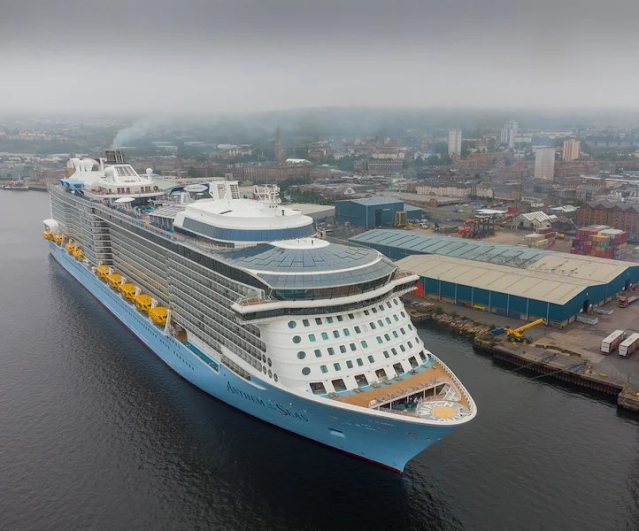
Anthem of the Seas entering the river Mersey, Photo credit Dave Jones

Royal Caribbean International has extended Anthem of the Seas’ UK-based season until October and announced plans to welcome international guests onboard from next month.

The ship returned to the UK for the first time in six years in July to restart Royal’s domestic cruise programme.


In September “eligible international guests” will also be able to sail from Southampton, subject to the latest UK government travel advice and their country of residence.


Fully vaccinated travellers from the US and EU were granted exemption from UK quarantine requirements this week.


Anthem’s British Isles sailings feature calls to Liverpool, Belfast and Kirkwall and Glasgow. All adults must be fully vaccinated and all passengers must provide a negative Covid test result before boarding.


Anthem’s extended season opened for bookings on Wednesday (4 August).


Ben Bouldin, Royal’s vice-president EMEA, said the line was “thrilled” with the response to its UK programme since restarting, with cruises achieving “peak guest satisfaction levels”.


“We welcome the recent update from the UK government, which lifted advice against international cruise travel. While this marks a positive step forward in the global return of cruise, there are still complexities to navigate when calling at multiple European ports of call from the UK,” he added.


“This, coupled with the popularity of our British Isles sailings to date, has led to our decision to extend our sailings around the British Isles, and I’m delighted to welcome international guests to experience these itineraries, starting in September.”


Wednesday, 4 August 2021

ROYAL CARIBBEAN EXTENDS ANTHEM'S UK SEASON

ROYAL CARIBBEAN EXTENDS ANTHEM'S UK SEASON


The ship returned to the UK for the first time in six years in July to restart Royal’s domestic cruise programme.


In September “eligible international guests” will also be able to sail from Southampton, subject to the latest UK government travel advice and their country of residence.


Fully vaccinated travellers from the US and EU were granted exemption from UK quarantine requirements this week.


Anthem’s British Isles sailings feature calls to Liverpool, Belfast and Kirkwall and Glasgow. All adults must be fully vaccinated and all passengers must provide a negative Covid test result before boarding.


Anthem’s extended season opened for bookings on Wednesday (4 August).


Ben Bouldin, Royal’s vice-president EMEA, said the line was “thrilled” with the response to its UK programme since restarting, with cruises achieving “peak guest satisfaction levels”.


“We welcome the recent update from the UK government, which lifted advice against international cruise travel. While this marks a positive step forward in the global return of cruise, there are still complexities to navigate when calling at multiple European ports of call from the UK,” he added.


“This, coupled with the popularity of our British Isles sailings to date, has led to our decision to extend our sailings around the British Isles, and I’m delighted to welcome international guests to experience these itineraries, starting in September.”

Saturday, 11 July 2020

The World’s Cruise Ships Can’t Sail. Now, What to Do With Them?

The World’s Cruise Ships Can’t Sail. Now, What to Do With Them?

Port of Miami

By Fran Golden (Bloomberg) –Hundreds of people lined the banks of Glasgow’s River Clyde a few weeks ago for the rare sight of a small, high-end cruise ship sailing upriver—practically into the heart of the city. The Azamara Journey thrilled socially distanced onlookers by blasting its horn, typically a heralding of lively celebration. But this time nobody was there to wave on the deck of the 700-passenger ship, aside from the couple dozen members of its skeleton crew. This was no celebratory arrival, after all: it was a vessel on life support, just like every other ship dealing with the pandemic’s brutal wake.
Since mid-March, only a small handful of the world’s 400-or-so cruise ships have been able to accept passengers—all on hyperlocal itineraries. A few dozen are sailing the world with purpose, repatriating crew members from every corner of the globe. The rest are sitting idle in cruise ship purgatory, unable to sail commercially for the foreseeable future. (In the U.S., the industry has agreed not to resume business at least until Sept. 15.)
The problem for many cruise lines? Idling through the pandemic isn’t just bad for the company’s bottom line, it’s a potential death warrant for their costliest assets: the ships themselves. From mechanical issues to hurricane risks to regulatory hurdles that can constitute criminal offences, it’s a quagmire that the industry has never faced on this scale before. The expense is staggering. In a recent SEC filing, Carnival Corp.—whose nine brands comprise the world’s largest cruise company—indicated that its ongoing ship and administrations expenses would amount to $250 million a month once all its ships are on pause. With the company saying it’s unable to predict when cruises resume, that’s a long-term line item on a balance sheet that logged $4.4 billion in losses in the second quarter alone.

Here a Ship, There a Ship

As with aeroplanes, the first issue with maintaining an idle cruise ship is simply finding a place to park it. As many as 16,000 planes have been grounded in the pandemic, hiding out in dry and rust-proof places that range from hangars and airport tarmacs to desert boneyards. Ships are similarly scrambling to find the right conditions to weather the storm.
There’s not enough port space for every ship to dock at once, especially for huge ships that ordinarily carry up to 8,880 passengers and crew. This explains the celebratory sounds of the Azamara Journey’s “homecoming” in Glasgow (it docked at a cargo port rather than its usual cruise berth further outside the city). Less lucky vessels have had no choice but to drop anchor at sea, occasionally stopping in to the nearest port for provisions and fuel.
AIS Marine Traffic screen dump showing cruise ships (Blue) laid up.
This week, a cluster of 15 ships from Carnival Cruise Line, Royal Caribbean, and Celebrity Cruises was hanging out near the Bahamas, according to Cruisemapper.com, a ship-tracking site. The 6,680-passenger Symphony of the Seas, the largest cruise ship in the world, was off the Dominican Republic.
According to Bill Burke, a retired U.S. Navy vice admiral and Carnival’s chief maritime officer, getting the company’s 105 ships to their pause destinations—20 in the Caribbean, 40 in Europe, 35 in Asia, and 10 in the eastern Pacific—is a process that will stretch into the third quarter of the year.

High Maintenance

Parking is just the first pain point. To keep things shipshape and avoid costly repairs (much like how your battery might die if you leave your car sitting too long), the vessels must also be kept operating.
“Modern cruise ships are not designed or built to just be turned off and left at a pier,” says Monty Mathisen, managing editor of Cruise Industry News. “You are talking about massive amounts of machinery, electronics, and even steel that needs maintenance, checking, and preventative work.”
That mostly involves one of two scenarios, referred to in the industry as a “warm” or “cold” layup.
In warm layup, most systems are kept functioning; in cold layup more are shut down, such as ballast tanks, turbines, and gearboxes. Cold layups come with extra precautions, too, such as sealing off external doors and windows, moving linens to a dry place, putting mattresses on edge, opening all dresser drawers and closets, and sealing bathroom fixtures, to name a few.
An advantage to warm layup is shipping can quickly be put back into operation. Once the word comes down, Burke says, the ship can resume carrying guests within weeks—though it will still need to get a full crew on board and sail to the appropriate destination.
But warm layup requires more upkeep, and therefore more staff. Each ship has a “safe manning” team—about 120 crew members for a large ship. Among the necessary personnel, according to Carnival’s Burke: a deck crew to drive the ship, an engineering crew to run the electrical power and propulsion, a medical team to tend to staff needs (particularly in the time of Covid-19), security, and enough housekeeping and kitchen staff to keep everyone looked after and fed.
In the event of hurricanes or other bad weather, the ships have to be able to move. They also have to comply with environmental, safety, and other regulations or risk stiff fines, criminal charges, and other penalties, says Burke. In 2016, for example, Carnival received five-year probation and a $40 million fine on a criminal pollution conviction.
But there’s a time limit on this half-on strategy: According to shipping analysts at maritime intelligence company Lloyd’s List, the warm layup is only appropriate in the short term. After as little as six months, ships may lose certain certifications that allow them to sail legally.

A Ship Out of Water

Cold layups require fewer systems to run, and therefore, as little as 40 crew members: a bridge team, engine room operators, fire wardens, and hotel staff. But grinding operations to a near-halt makes it more difficult and expensive to restart. According to Lloyd’s Register’s layup guide, every corner of a ship, from the pump room to the living quarters, needs to be inspected for things like gas leaks and mould; electrical equipment, including the navigation systems, need to be removed from safe storage and reinstalled; and dehumidifiers all need to be removed before furniture and soft goods can be cleaned and put back in place. That’s why cold layups are seen as advantageous only in the event of an outage stretching to many months.
Burke says Carnival could move in this direction in the long term. According to Mathisen, Royal Caribbean has already committed to this tact. Its fleet is largely being protected by dehumidifiers—deployed everywhere from engine rooms to public areas.
When they’re ready to set sail again, the restart “can take weeks to months,” he explains, detailing delays that range from transporting crew back to the ship, going through bureaucratic recertification processes, or even financing expensive dry dock repairs.
A more drastic option is tying up the ship, shutting down all systems, leaving only some emergency generators running and a few fire safety crew and watchmen on duty. Cruise historian and writer Peter Knego paint a grim picture of what can happen in that scenario.
“The first thing that goes is the plumbing,” Knego says. “If you don’t have the plumbing active and somebody’s actually flushing toilets and running water through the system, rust sets in, the pipe starts to disintegrate, and then you have major problems.”
HVAC systems and wiring are next to go. “And then just the fact they are laid up in saltwater, salt air, decaying everything very quickly,” Knego explains. “You literally have to tear the infrastructure to make repairs if a ship has been idle for too long.” With long-term layups, issues like rot start to crop up.
If that sounds like a slow and painful death, some companies are just ripping off the Band-Aid instead. In its second-quarter financial filing, Carnival said it plans to retire at least six older ships, which could potentially be sold another cruise company or for scrap—usually for anyone’s best offer. Costa Cruises brand’s 24-year-old Costa Victoria is reportedly destined for a scrapyard. A ship out of water is, alas, worth less than the sum of its parts.
© 2020 Bloomberg L.P