Showing posts with label Fathom Cruise. Show all posts

Sunday, 15 January 2017

Short windows limit marketing of Cuba cruises

Short windows limit marketing of Cuba cruises

Royal Caribbean's Empress of the Seas is scheduled to sail to Cuba from Miami on April 19, then move to Tampa for its next two Cuba departures.

Travel agents have begun selling cruises to Cuba set to sail in the first half of 2017, but some said the limited number of itineraries approved so far by the Cuban government makes it hard for them to justify a marketing campaign.
Royal Caribbean International has three cruises to Havana firmly scheduled, while Norwegian Cruise Line has five.
"There's definite interest in it, but it's not something that as of yet is a hot seller," said John Rice, president of Vacation Tour and Cruise in Tampa. "We have a lot of people asking about it. We've only done a couple of [sales] at this point in time."
While six brands were authorized in December to carry passengers on a handful of cruises to Cuba, no U.S. cruise line has permission to sail there after the end of May, although most have applied.
And in the U.S., the volatile politics of rapprochement with Cuba could very well signal an end to relaxed travel rules with the change in administrations this month.
That uncertainty is hampering what otherwise might have been a great new market for agents, Rice said.
"Right now, our big problem is we have absolutely no idea what the future will hold," Rice said. "My senator [Florida Republican Marco Rubio] is against this continuing. We've heard negative comments about the program from [president-elect Donald] Trump when he was running."
The latest opening for passengers interested in cruising to Cuba came Dec. 9, when the country approved a number of new entrants, including and Pearl Seas Cruises.
Image result for cruise to cuba
One of the Norwegian Cruise itineraries 

All those companies have opened sales and set dates for at least one cruise, offering consumers a variety of price points, cruise lengths and luxury levels for a U.S. departure that includes Cuba.
In the contemporary segment, the entrants are Royal Caribbean and Norwegian Cruise Line. Royal Caribbean's Empress of the Seas has a five-day Cuba cruise scheduled to depart Miami on April 19, along with a seven-day cruise from Tampa departing April 30 and a five-day cruise from Tampa leaving May 20.
Rice said he is offering the five-day Tampa cruise at a lead-in price of $608 per person.
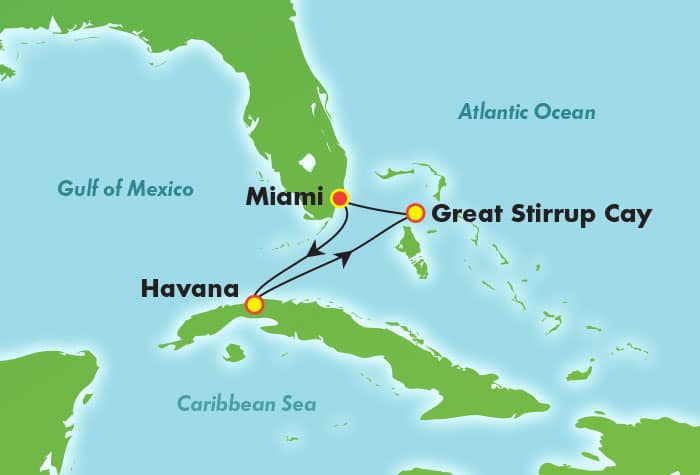
Norwegian Cruise Line has four-day cruises on the Norwegian Sky departing Miami every Monday in May that include an overnight in Havana and a stop at Great Stirrup Cay. Prices for inside cabins start at $699.
Cheryl Scavron, an agent at Dream Vacations in Pompano Beach, Fla., said the prices can seem expensive relative to a typical Caribbean cruise.
"People from here, it's in their minds that Cuba is 90 miles away; it shouldn't cost me that much to go there. They think about it as another Caribbean island," Scavron said.
Frank Del Rio, president of Norwegian Cruise Line Holdings, said in a recent conference call that the Cuba cruises would be priced at a premium because of their relative scarcity and pent-up demand.
Scavron said another hindrance is Royal Caribbean's decision to have just one cruise to Cuba from Miami before repositioning the ship to Tampa for the summer.
"People in this area, from Palm Beach and Broward counties, they don't want to drive to Miami, let alone Tampa," Scavron said. "I have a few of them booked on the inaugural sailing in April, but I was hoping we would be able to do more sailings from here."
"People from here, it's in their minds that Cuba is 90 miles away; it shouldn't cost me that much to go there." -- Cheryl Scavron, Dream Vacations, Pompano Beach, Fla.
Several cruises departing Miami for Cuba are scheduled by lines in the upper-premium segment, offering smaller ships and more luxury than the 1,602-passenger Empress and the 2,004-passenger Norwegian Sky.
Azamara Club Cruises will include an overnight in Havana on a 12-day Azamara Quest departure from Miami on March 21. Prices start at $2,799. And Oceania Cruises will spend from 8 a.m. to 11 p.m. in Havana on March 9 as part of a 14-day cruise on its Marina ship, with prices starting at $3,199.
The Marina has two subsequent 10-day cruises that include overnight stays in Havana.
Luxury operator Regent Seven Seas also has departures from Miami scheduled on April 11 and 18 that will include an overnight stay in Havana. Prices for the seven-night cruises start at $2,999 per person.
Bill Schneider, owner of a Dream Vacations franchise in Tampa, said he has one client in particular who has been waiting for a newer, more luxurious ship such as the Seven Seas Mariner to book his initial cruise to Cuba.
"Regent is the way I'm pushing him," Schneider said.
He said that the Empress of the Seas sailings haven't drawn any calls.
"It really hasn't been promoted that heavily that they're coming, at least in the local market," Schneider said. "As New Year's comes, it's definitely going to be one of my featured sailings."
The Empress Cuba sailings opened for booking on Dec. 9 and have been selling extremely well, said Lyan Sierra-Caro, a corporate communications manager at Royal.
Only one line is offering ports other than Havana initially. Pearl Seas Cruises has a series of 11 10-day sailings from Fort Lauderdale starting Jan. 17 on its 200-passenger Pearl Mist coastal cruiser that will visit seven ports on the island, including Havana, Cienfuegos, Trinidad and Santiago de Cuba. The cruises end in April.
Carnival Corp.'s Fathom brand won permission to visit Santiago de Cuba as a port call on six sailings to the Dominican Republic this winter on the Adonia. In addition, the 704-passenger Adonia continues to sail every other week to Cuba, but those cruises, like the others, end after May.
Rice of Vacation Tour and Cruise said agents can only hope that more approvals are forthcoming after that.
"I think everybody's trying to move the ball forward, hoping that it helps us to try to get the program going," Rice said. "As a Floridian, it's something I've been supportive of for years. As an agency owner, it's just tough to operate in an environment where you don't know what the future's going to hold."

Monday, 2 January 2017

Fathom's Dominican Republic cruises to add Cuba call

Fathom's Dominican Republic cruises to add Cuba call

Carnival's Fathom, ex-P&O Adonia

Fathom, Carnival Corp.'s social-impact cruise line, has been given permission to visit Cuba on cruises scheduled to go to the Dominican Republic.
Fathom will offer a port call in Santiago de Cuba, on the island's southeast coast, on six cruises next year that primarily go to Amber Cove, Carnival's port in the Dominican Republic.
The seven-day cruises will take place during the weeks of February 26, March 12 and 26, April 9 and 23, and May 7. Prices start at $599 per person.
The cruises depart Miami on Sundays. Fathom said the Santiago de Cuba port call will occur on Tuesday from 9 a.m. to 6 p.m. Travelers already booked for those cruises will need to add a $75 Cuban visa.
Fathom's ship, the Adonia, already sails every other week to Cuba with stops in Havana, Cienfuegos and Santiago. Prices for those cruises start at about $1,900 per person.
In November, Carnival Corp. said that Fathom is discontinuing cruise operations next June. The Adonia will be returned to the P&O Cruises  fleet.

Thursday, 24 November 2016

Fathom to lose only ship as Adonia rejoins P&O fleet

Fathom to lose only ship as Adonia rejoins P&O fleet

Image result for adonia cruise


Small ship Adonia is to rejoin the P&O Cruises fleet in 2017 after just a year operating for US-based social impact sister brand Fathom.

Parent company Carnival Corporation confirmed that the 710-passenger vessel would be returning to Southampton-based P&O Cruises for next summer.

Adonia moved across to Fathom in May to launch the first US departures from Miami to Cuba in more than 50 years.

The ship was revamped during a period in dry dock in the Bahamas and has also been running alternate seven-day cruises to the Dominican Republic, using Amber Cove, Carnival Corporation’s dedicated port on the north of the Caribbean island.

The corporation announced earlier in the month that social impact excursions pioneered by Fathom brand in the Dominican Republic are to be extended to six of the group’s other cruise lines including P&O Cruises.

The shore trips include helping at a women's’ chocolate-making co-operative and at a craft-making business using recycled paper.

The company said at the time that it was also exploring additional opportunities globally and with sister brands to bring the Fathom concept on board and on shore to deliver “engaging, purposeful experiences” to a broader audience of travellers.

A spokesman said last night: “The Fathom experience has been expanded across our many Carnival Corporation brands sailing to the Dominican Republic and beyond, and the Adonia is being scheduled to sail in the UK for the summer season for our P&O guests.”

Image result for adonia cruise in Dominican republic
Fathom (P&O Adonia) visiting Cuba

Carnival Corporation has requested approval from Cuba to sail there with other brands from June 2017.

The spokesman said: “We plan to continue sailing to Cuba for many years to come based on the success of our first cruises to the country, which have proven extremely successful.

“Fathom continues to receive some of the highest ratings in the company based on guest surveys, and we hope to expand the Fathom experience to other markets in the future.”

However, demand for Fathom’s Cuba cruises outstripped interest for the Dominican Republic sailings.

Prices for sailings to Amber Cove have been discounted from $449 to $299 for an outside cabin for departures up until May 21, 2017, while the lowest priced Cuba sailings currently cost $999 for an inside cabin.

P&O Cruises senior vice president Paul Ludlow said: "The Fathom experience has been expanded across our many Carnival Corp brands sailing to the Dominican Republic and beyond and we are extremely pleased to have Adonia, our well loved small ship, here for our guests beginning with the summer season, sailing a range of discovery itineraries."


Tuesday, 27 September 2016

Families and Ecotourism: A Natural Fit

Families and Ecotourism: A Natural Fit

Lee County Top Image

Just as the 100th birthday of the National Park Service is casting a spotlight on U.S. national parks in 2016, we can expect an enhanced emphasis on ecotourism throughout 2017—declared the International Year of Sustainable Tourism for Development by the United Nations. 

To be sure, the idea of ecotourism isn’t a new one—it’s already known as one of the fastest growing segments in the tourism industry. Put that together with family travel—another of the industry’s rapidly growing segments—and the time is ripe for family vacations that include ecotourism. 

At its core, the concept of ecotourism is simple. According to The International Ecotourism Society (TIES), ecotourism is defined as "responsible travel to natural areas that conserves the environment, sustains the well-being of the local people, and involves interpretation and education."  

And, as with so many segments of tourism, the line blurs easily, with ecotourism overlapping with adventure travel, wellness travel and voluntourism, to name just a few other popular segments that often go hand-in-hand with ecotourism. 

“Travel agents have a remarkable ability to influence where people go,” says Jon Bruno, executive director of TIES. “Ecotourism provides so many opportunities—and it doesn’t have to be 100 percent. It could be adding on a tour that has an ecotourism aspect to it, choosing accommodations that are a member of TIES, introducing the concept of asking about sustainability practices…”

“Many people automatically turn to big theme parks, giant cruise ships, all-inclusive resorts and those kinds of things when they think of family travel,” says Chris “Chez” Chesak, executive director of the Family Travel Association. “Those are all great products that are appropriate for families—but there’s also such a diversity of experiences that lie outside those products. We’re seeing an increasing interest in ecotourism and suppliers who consider children the next generation and stewards of the earth—they love to educate children about the impact on the land and local communities.” 

A NATURAL ALLIANCE


For some, ecotourism means a group of millennials climbing Mount Everest; for others, it’s a month-long safari tour of South Africa—but for most, it’s a natural integration of the unique environmental and cultural aspects of any destination into a vacation experience. 

“Kids and nature just go together—it’s such an easy match,” says Lauren Goldenberg, founder of the Family Traveler, an agency focused on family travel whose clients tend to be in the deluxe to luxury range. “It can fit into any style of vacation and almost anybody’s trip plan—from making time to kayak at the beach all the way up to going cruising around the Galapagos Islands to learn about Darwin.” 

At the mid-range, Julia Slatcher, owner of Inspire World Travel, sees a similar interest in incorporating nature and learning into any vacation experience. Beyond the pure fun such activities can add to a vacation, she’s also seeing clients who start with the idea of “adding meaning to their travel,” she says. “A lot of parents today are interested in travel that helps their kids learn and care about the world. They want their children to be good citizens of the world, and they’re looking for ways to add that element to their travel—while bearing in mind that they have limited vacation time and also want to have a good time and relax.”  

And sometimes it’s the kids themselves who seek meaning in their travel experiences. Lauren Maggard, a luxury travel consultant at Jet Set World Travel, recently planned a high-end trip to Africa for a family with two teenage daughters. “One of the daughters is vegan and very environmentally focused,” she explains. “They asked us to make sure that every accommodation option we chose had an opportunity for the family to engage in philanthropy or to give back to the community. Budget wasn’t an issue, but it was a challenge to find the right mix of upscale properties with an environmental focus, community outreach and vegan cuisine options.” 

TEAM PLANNING
While Maggard’s challenges for that trip were very specific, other aspects of incorporating ecotourism into family travel are more common. Here’s a look at some of the elements that need to be factored in when planning a family ecotourism trip. 

Decoding the Language 
It’s rare for a client, especially one with a family in tow, to specifically ask for “ecotourism” when they’re describing their needs and desires. “Look for the client who’s saying something like ‘We want something more; we don’t want to just lie by the pool; we’re looking for something rewarding,’ ” says Chesak. “That person might not even know it yet—but if they’re looking for something ‘more,’ the concept of ecotourism should certainly be introduced.” 

The Environmental Cost of Travel

If the eco aspect is a major part of the trip, the accommodations and method of travel choices are key parts of setting the tone. For accommodations, look for those that are certified green (standards may be set by a statewide entity such as the Florida Society for Ethical Tourism, or at the national level, like LEED certification in the U.S.) as well as properties that are members of ecotourism associations. 

The family aspect can add further complications to an accommodations choice. “Not all places have accommodations with connecting rooms, and even some that do won’t guarantee that the rooms will be connecting before the travelers arrive,” says Goldenberg. “In other situations, you have kids who won’t share a bed or a teenager who won’t sleep on a rollaway. We extract all the information we can from the parents to find out what will work best for their unique situation.” 

Unless clients are literally just walking down their own street, there’s going to be some environmental impact from the mode of transportation. Train travel has less of a per-person impact on the environment, but its use is limited by destination choice. Air travel will leave the largest carbon footprint, although moves by the airline industry to make planes more fuel efficient (and more crowded) continue to bring down the impact. Bruno also points out that travelers can contribute to carbon offset programs and that TIES continues to urge airlines to make such programs more easily accessible. 

Age Counts 

While there’s no age limit for ecotourism, some trips naturally lend themselves to older children. “If a family is considering a safari, I recommend waiting until the youngest child is about 10 so they can really participate in and remember the experience,” says Maggard as an example of a trip where age matters. 

On the other hand, Bruno points out, “Children of all ages love animals—and almost any place in the world, you can find a unique animal experience, whether it’s watching baby sea turtles make their way to the sea, a bald eagle nest in a tree, a live moose wandering by. When children see these kinds of things up close, it can have a lifelong effect.” 

And don’t forget multigen travel. Just as very young children add some constraints to the possibilities, so too might grandparents. But that’s certainly not always the case. Maggard cites a recent example where a grandmother was not only part of an ecotourism-focused trip, but the driving force. “She was hell-bent on showing her family that not everyone was as well off as they were,” says Maggard. And to that end, the eco-focused trip to Costa Rica, which included the grandmother, her son, his wife and the grandchildren, included a week of eco-opportunities, such as picking up garbage, recycling and hands-on community work, before a more leisurely stay at a high-end villa. 

The Great Balancing Act
Almost any kind of travel requires balancing disparate needs to some extent—desire vs. budget, activities vs. relaxation, time required to do a trip “properly” vs. available vacation time and so on. Many of these factors become even more exacerbated when children are involved. Here are some specific areas to be sure to consider.  

Know the children’s limitations: A 4-year-old can’t go ziplining and even a 7-year-old is not going to be able to do a full-day hike. Consider if all activities are physically possible, appropriate and desirable for the ages of the kids. “Sometimes we’ve had issues with families that have older children and one much younger child,” says Goldenberg. “In that case, we have to modify the activity or suggest splitting up for part of the day.” For example, can the older children and mom take to the zipline, while dad goes shelling with the younger children? Or can the little ones stay at a hotel kids center while the parents go deep-sea fishing? And if there’s really no good solution? “Sometimes we actually recommend holding off for a few years until the youngest are old enough to really enjoy and appreciate the trip,” says Goldenberg.  

Don’t underestimate the kids: On the flip side, do plan activities that will give children the chance to explore outside their comfort zone and possibly learn that they like things they didn’t know about. “You never know what a child will find interesting,” says Slatcher. “Maybe it’s birding—with the right guide, kids might find they’re fascinated by something they never even thought about before.” 

Prepare the kids ahead of time: Slatcher recommends a reading list for kids so they have some sense of where they’re going. There are kids’ books and movies that take place almost any place in the world, from the beach to the Grand Canyon to India. She also recommends taking cues from the kids in planning the specifics: “If a child has read a book or seen a movie that takes place in the destination and keeps talking about one aspect, we’ll do our best to include that aspect, whether they’ve become fixated on seeing a certain animal or want to go river rafting like their favorite heroine.” 

Schedule—but don’t overschedule: As with any trip, if clients know they want to do something, it’s best to schedule it from the start to make sure it’s available and they’ve left the right time for it. But with kids along, scheduled free time becomes even more crucial. “We try to schedule one or two activities a day and then give options for downtime,” says Maggard. “Kids move at a slower pace and take in things more slowly than adults. They also need time to release energy—maybe there’s an organized bike tour in the morning, but free-time swimming in the afternoon—or even a nap.” Slatcher, too, recommends ensuring plenty of downtime. “With my own family, we like to take an hour or two before dinner to decompress,” she says. “It allows us to maximize the value of the day. Kids need to process what they’ve seen and experienced, even if they don’t know it.”

Monday, 26 September 2016

Fathom creates new Cuba shore excursions

Fathom creates new Cuba shore excursions

Image result for Fathom cruise cuba
Fathom Cruise in Cuba

Fathom has created three new excursions for guests on its Cuba cruises that leave every other week from Miami.
“In Hemingway’s Footsteps” shows off Havana through the eyes of the American author and includes stops at his home, Finca Vigia, and his favorite fishing village, Cojimar, where guests can step into the room in which he wrote “For Whom the Bell Tolls.” The five-hour tour is $59 per person.
In “Beyond Havana: Exploring the Cuban Countryside,” passengers will explore the rural side of Cuba, including coffee and sugar cultivation and visit Las Terrazas biosphere reserve. The nine-hour tour includes lunch and is $69.
Also priced at $69 is “Magic of Santiago Featuring El Cobre.” Highlights include the final resting place of Cuban hero Jose Marti and a tour of San Juan Hill, home to the Rough Riders assault during the Spanish-American War.  
The six-hour tour ventures beyond the limits of the Santiago city center into the Sierra Maestra mountain range for the city of El Cobre, a historic copper-mining town with African influence.

Wednesday, 29 June 2016

Carnival Corp.’s profit skyrockets in ‘remarkable’ Q2

Carnival Corp.’s profit skyrockets in ‘remarkable’ Q2

T0404KONINGSDAM_HR.jpg
The launch of Holland America's Koningsdam was one of Carnival Corp.'s second-quarter highlights.

Driven by higher ticket prices and fuller ships, Carnival Corp. had net income of $605 million in the second quarter, up from $222 million a year earlier.
Net revenue yields rose 3.6%, significantly higher than the range of 1.5% to 2.5% in the company’s earlier forecast.
The results came despite a currency-exchange drag and fuel price increase equal to $127 million.
“This was among the most remarkable quarters in the history of the company,” said CEO Arnold Donald, citing not only the earnings but the introduction of three new flagships (Carnival Vista, Holland America Line’s Koningsdam and the AidaPrima) and the historic launch of Cuba cruises by the new Fathom brand.
Carnival’s revenue advanced slightly to $3.7 billion from $3.6 billion.
The increase in yield was a combination of a 3.5% increase in ticket prices and a 4% rise in onboard spending, CFO David Bernstein said.
Prices for Europe cruises on Carnival’s North America brands are lower although occupancies are up, Bernstein said.
Donald positioned the decision by Britain to leave the European Union as a boost for Cunard Line and P&O Cruises because their fares in the weakened pound sterling are now more competitive with land vacations abroad for British travelers.
Bernstein said every change of 10% or more in the pound’s value has an effect of about 8 cents a share, or about $60 million, on Carnival’s full-year results.
Donald said Carnival has looked at its U.K and European forecasts in light of the Brexit vote. “At this point, we have no reason to adjust anything,” he said.
Cruise stocks, including Carnival’s, were hit harder than the market in general after the British vote. After the earnings release, Carnival shares were up more than 4% but were up less than 0.25% by 11:30 am Eastern.
Asked about the future development of Fathom, Donald said that its cruises to the Dominican Republic are geared toward a “travel segment rather than cruise,” and that Carnival’s ability to access that segment is “challenging.” He said Cuba sailings on Fathom have been successful and are very strongly booked for fall, but that there are still unsold cabins on summer departures.

Monday, 25 April 2016

On a Fathom cruise, a sea day like no other

On a Fathom cruise, a sea day like no other

Impact guide Gil Lang tells Fathom passengers how to improve their storytelling skills. Photo Credit: Tom Stieghorst

Travel Weekly cruise editor Tom Stieghorst is sailing on the first cruise for Fathom, Carnival Corp.'s new social-impact line.
ABOARD THE ADONIA — Fathom’s cruise to the Dominican Republic begins with a day-and-a-half at sea, and the activities onboard really set it apart from any other cruise I’ve been on.
Like all the sessions I would attend on our first day at sea, it was participatory, interpersonal and a bit confessional. This is not a cruise for someone who wants to be left alone.Fathom has a philosophy to impart. After breakfast, everyone was asked to attend the "Being a Fathom Traveler" workshop, where an "impact guide" briefed passengers on the Fathom way.
To organize, Fathom grouped passengers into cohorts of about 10 to 12. The guide asked us each to name a favorite travel destination. Then we were all asked to sit next to someone we don’t know.
Paired off with a stranger, we had five minutes to describe to each other something bold we had done, an interesting fact about ourselves, and what we think the key to happiness is.
Our guide, Jeff, then told us about himself and what Fathom is – transformation through travel.  If Fathom has a motto, it is “Life begins at the end of your comfort zone.”
We were introduced to some of the buzzwords that Fathom employs, such as "alongsidedness," which describes how Fathom passengers and Dominicans work together on the land part of the trip.
Fathom is a cruise with substance, a chance to take stock of who you are and where you’re going.
Some of the workshops are more practical. One teaches phrases in Spanish and another called “Empowering English Tutoring” is for passengers who will spend time helping Spanish-speaking students at school.
Later in the day, I attended “The Story of You,” a workshop meant to strengthen storytelling skills. We paired off again and did five exercises. The first one, creating a secret handshake together, was fun and helped break the ice. We told each other a story about our names and then spent the better part of an hour crafting a story about a dramatic moment in our lives.
We told the story three times to three different people, each time getting some techniques from our impact guide, Gil, to make the stories stronger, more vivid and memorable.
I caught part of another workshop, “The Curiosity Advantage,” about looking at things differently and staying open to fresh ways of doing things.
Impact guide Greg Shapiro with a slide showing the progress of a land-mine removal enterprise in Angola. Photo Credit: Tom Stieghorst
Impact guide Greg Shapiro with a slide showing the progress of a land-mine removal enterprise in Angola. Photo Credit: Tom Stieghorst
My final workshop for the day, “Social Innovation in Action,” was another group exercise. Four groups competed to create a social enterprise that would solve a big problem — overfishing and clearing land mines were the two we worked on.
Afterward, we saw videos of actual solutions created by social entrepreneurs, including the ingenious application of mine-sniffing rats in Angola to speed the de-mining process.
If this is your thing, there’s probably no better cruise than Fathom. It requires an open attitude and a willingness to contribute. The return is learning something about yourself and a jump-start toward knowing your fellow passengers.
Fathom is a cruise with substance, a chance to take stock of who you are and where you’re going. It might not be the cruise you want to do every time, but it won’t be the same old, same old, that’s for sure.

Tuesday, 12 April 2016

U.S. Coast Guard Cancels Carnival's Fathom line maiden voyage

U.S. Coast Guard Cancels Carnival's Fathom line maiden voyage


by kgnadmin (Crew Center.com)
The maiden voyage for the new social-impact cruise line Fathom has been canceled by the U.S. Coast Guard. The cruise ship Adonia, didn’t pass the U.S. Coast Guard safety inspection on Sunday after the authorities find out that 30 fire screen doors were not functioning properly.
MV Adonia was scheduled to set sail on April 10 from Miami on a 7-night voyage to the Dominican Republic, after a major dry dock renovation. Fathom says the April 10 cruise is completely canceled and, plans to make the maiden voyage on April 17.
Fathom passengers received the following letter:
“Dear Travelers
Thank you for being so gracious about the unexpected delay today. We are so sorry we did not sail as planned.
The ship arrived in Miami directly from re-fit and the U.S. Coast Guard is performing operational tests. These tests are still underway and the company hopes to sail once all tests are complete. We want to assure you that we are in constant contact with the Coast Guard and will continue to be throughout the night and into tomorrow to make arrangements to depart Miami.
We have arranged your dinner and breakfast at the hotel and have organized for late check out for you. Your check out is 1 p.m.
At 11 a.m. tomorrow, we will share more information in the lobby.
The Adonia is moving to a new terminal overnight – it will be at Terminal C on April 11.
We apologize that we haven’t been able to sail as planed but we sincerely hope that you have a restful evening.
The Fathom Team.”
U.S. Coast Guard conducts safety inspection when newly transformed cruise ship goes back to service in the United States. In order to provide safe environment in events of emergency, the vessel undergoes series of safety inspections on the watertight doors, fire doors, lifeboats and life rafts and their launch ramps, firefighting equipment and other safety procedures.

Wednesday, 30 December 2015

2015 Year in review

2015Year in review


By Johanna Jainchill

Cuba. Terrorism. Mergers. Lufthansa's GDS fee. Crystal Cruises. Fathom. The sharing economy. The open skies feud. The strong dollar.

For travelers, 2015 was bookended by news about borders. The year began with the nudging open of borders that had been closed to U.S. tourists for a half century but ended with calls to tighten borders worldwide.

In January, the historical thaw between the U.S. and Cuba began a process that makes travel to the long-forbidden island much easier, but by December, there was a very real possibility that the U.S. and Europe might tighten their borders in the face of terrorism, raising new barriers to travel.
The industry can only hope to reclaim the optimism that ushered in 2015. But given the recent terror attacks and the coming election campaign, that's anyone's guess.

Here, in no particular order, are the topics we think made the year most memorable:

Cuba

The extent to which Cuba managed to dominate travel talk for much of 2015 was dizzying.
It's hard to believe that just one year ago this month, President Obama announced that the U.S. would restore diplomatic ties with the Caribbean's largest island nation. Since then, every few months, Washington and Havana have taken steps that seemed to inch the two nations closer to normalized relations, from the U.S. removing Cuba from its list of state sponsors of terrorism to both reopening embassies in each other's capitals for the first time since 1961.

On the travel front, the pace of change was even more frenetic. The administration eased travel restrictions to Cuba in January so U.S. citizens no longer had to apply for individual licenses from the Treasury Department to travel there but could instead self-report that they were visiting under one of 12 categories of allowable travel, ranging from educational to humanitarian to religious reasons.
The industry pounced.

Several major tour operators have since debuted their first Cuba tours, including Apple Vacations, Abercrombie & Kent and Travel Impressions.

In February, CheapAir.com became the first OTA to enable U.S. travelers to book flights between the U.S. and Cuba, albeit through third countries, a capability it expanded to direct charter flights later in the year. Several commercial airlines began increasing charter flight schedules to Cuba, and the GDSs said they had readied or were in the process of readying their systems to accept regularly scheduled commercial flights to the island.

All of that took place well before the U.S. State Department said last week that the U.S. and Cuba had reached an agreement to resume direct commercial flights between the countries.
With hotel development in Cuba still decades behind, it seemed natural that a cruise line would be among the first suppliers to introduce products for the island. Carnival Corp.'s new social impact brand, Fathom, said it would become that line, obtaining a license from the U.S. government to sail to Cuba in the spring of 2016.

The only thing that could stand in Fathom's way of marking that milestone is the pace at which Cuba has been opening to Americans; it's very possible that by then, all travel restrictions will have been lifted, making Cuban ports regular stops on Caribbean itineraries.

Terrorism


Since the 9/11 terrorist attacks 14 years ago, travelers in general have become more inured to threats of violence. But this year, their resilience has been tested by an increasing number of violent incidents.

It started in January with the Paris attacks on the offices of the satirical magazine Charlie Hebdo. Though tourists weren't targeted, the attacks took place in the most visited city in the world.
Then in two separate incidents in Tunisia, cruise passengers visiting a Tunis museum were among the victims of a terrorist attack that left 23 dead, and 38 tourists, primarily from Britain, were gunned down at the seaside resort of Sousse.

Yet there were no serious ripples to the U.S. travel industry at large until November's twin attacks by ISIS. The first brought down a Russian MetroJet airliner taking tourists home from Egypt's Sinai peninsula, killing all 224 people onboard. The second was the terrorist attacks on Nov. 13 that killed 130 people in Paris cafes, a concert hall and a soccer stadium.
The Paris attacks brought tourism in France to a near standstill, as did raids tied to the resulting investigation in nearby Brussels. The events sparked discussions about securing borders in both the U.S. and Europe.

For the tourism industry, the fallout could have serious implications. Talks of reintroducing border controls among Europe's 26 open-border countries would significantly change how travelers move through the Continent.

In the U.S., the attacks prompted the White House to make immediate changes to the Visa Waiver Program (VWP), which allows citizens of 38 member countries to enter the U.S. and stay of up to 90 days without a visa. The concern was that most of the Paris attackers were citizens of France or Belgium, both VWP countries. And shortly thereafter, lawmakers introduced legislation that would add even more restrictions to the program. Members of the travel industry worry that further restrictions could deter the many millions of international travelers who peacefully visit the U.S. every year and add billions to the economy.

Terrorism has damaged tourism industries in places like Egypt and Tunisia, where it represents a crucial part of the gross domestic spending. It remains to be seen if the U.S. and Europe can devise policies to protect their citizens while also enabling them to move freely around the world.

 Merger mania


In recent years, travel industry merger and acquisition news has been dominated by airlines. But in 2015 our attention was grabbed by Marriott International's acquisition of Starwood Hotels & Resorts Worldwide, creating the biggest hotel company in the world by far, and before that by Expedia's triple play: Travelocity, Orbitz and HomeAway.

Analysts quickly predicted that Marriott's $12.2 billion acquisition would necessitate the shedding of some of the combined company's 30 brands. Granted, Marriott CEO Arne Sorenson said shortly after the deal was announced that he expected Starwood's 11 brands to "remain in place." But he also noted that some of those brands compete -- for example, Marriott's Renaissance with Starwood's Le Meridien -- making the future unclear.

Travel advisers undoubtedly hope that Starwood's trade relations approach is the one the company hangs on to. As ASTA CEO Zane Kerby told Travel Weekly last month, Starwood has a track record of being "supporters of the trade industry," while Marriott has been "kind of on and off," a not-so-opaque reference to the hotelier's "Book Direct" campaign.

Top online news stories of 2015

We took a look at the articles on TravelWeekly.com this year and ranked them by page views. Here are the 10 most popular:

1.Celebrity Cruises to go mainly with bundle pricing (June 30)
2.Report: Baha Mar resort 'unlikely' to open this year (May 12)
3.The same old story: Baha Mar opening delayed (May 6)
4.Caribbean and Mexico resorts plagued by sargassum outbreak (Aug. 30)
5.Low water levels plague Europe river cruises (Sept. 2)
6.Dominican Republic tops in Caribbean tourism, and growing (May 21)
7.Margaritaville's presence grows from song to eateries to resorts (Jan. 4)
8.Harmony of the Seas to sail from Barcelona in 2016 (March 13)
9.Drug violence occurs near Puerto Vallarta but not in tourist areas (May 4)
10.RCCL stops discounting close-in bookings for most cruises (April 20)

For OTAs, the Marriott/Starwood merger is not good news because the combined company will have more than 1.1 million rooms globally, giving it substantial distribution leverage.

But OTAs have been busy consolidating, as well. Expedia acquired Travelocity for $280 million in January, Orbitz Worldwide for $1.34 billion in September and HomeAway for $3.9 billion last month. HomeAway and its brands, including VRBO.com, accelerate Expedia's efforts to gain share in the private-accommodations sector, while Orbitz and Travelocity help it compete against Priceline, which itself acquired a $60 million stake in Brazil-based OTA Hotel Urbano.

And just as OTAs can't be thrilled about the Marriott/Starwood combo, the same goes for hotels being wary about Expedia's buying spree. In an objection to the Orbitz deal filed with the U.S. Justice Department, the American Hotel & Lodging Association asserted the deal would raise consumer costs and hurt small hotel operators.

Lufthansa's GDS fee
When the airlines of the Lufthansa Group (Lufthansa, Austrian Airlines, Brussels Airlines and Swiss International Air Lines) in September added a fee of 16 euros to every booking made via a GDS, they were not the first airlines to attempt to circumvent the GDSs and persuade travel agents to book direct.
 
But considering the way Lufthansa has dug in its heels on the issue, it apparently plans to be the first carrier to make the strategy stick. Lufthansa Chief Commercial Officer Jens Bischof said shortly after implementing the surcharge that it was intended to "disrupt" the travel distribution landscape and was about much more than the fee itself.

"We are very aware that our new distribution strategy is disruptive, and it will change the future way of distribution," Bischof told the Association of Corporate Travel Executives.
Bischof's words only further inflamed travel sellers who had been steering business away from Lufthansa since the surcharge went into effect, attempting to send a message to the rest of the airline industry that it should not follow suit.

Rather than reverse direction under the pressure of what at least one GDS reported were depressed Lufthansa sales after the surcharge went into effect, Lufthansa inked an enhanced distribution agreement with Google Flights, signaling that the German carrier was resolute in its trajectory away from GDSs.

Crystal Cruises

In 2015, Crystal Cruises was the mouse that roared. For years, the luxury cruise line's loyal clientele enjoyed a high-quality product on two beautiful but aging ships. Each year travel sellers would ask if the line planned to expand, but for more than a decade, it did not.

Then along came Edie.

Upon taking the helm as Crystal's CEO two years ago, Edie Rodriguez famously said that her plan was to grow the line to "seven ships for seven seas." What she didn't say then was that the boast was just a start.

Rodriguez later said that she only took the job because she had been promised the line would find a buyer willing to grow it. Genting Hong Kong became that buyer, and last summer Crystal announced the most ambitious expansion plan in recent cruise history: three new 1,000-passenger ships, plus an expansion into river cruising, yacht sailings and luxury private-jet tours.

Crystal not only ordered the ships, but to avoid any delays in delivery, Genting bought Lloyd Werft, the European shipyard that had been contracted to build them. Last month, Crystal acquired a Boeing 777-200LR for its Crystal Luxury Air startup, and Crystal Yacht Cruises was scheduled to debut just before Christmas with the Crystal Esprit, an extensively refurbished, 62-passenger yacht.

While some industry watchers might be skeptical that Crystal can deliver all that it says it will, so far it has.

Baha Mar

Bahamas' star-crossed mega-resort was also among the industry's most talked-about projects this year, though for all the wrong reasons.

The $3.5 billion project, the most expensive development in Bahamas' history, was originally slated to open in Nassau by the end of 2014 and fly the flags of luxury brands Grand Hyatt, SLS and Rosewood in addition to an eponymous casino-hotel and the pre-existing Melia Nassau Beach.
Beset by delays, that date was pushed to spring, and by the time spring came and went, the question became not when but if the resort would ever open.

The Chinese-backed project filed for Chapter 11 bankruptcy protection in June under the auspices of wanting to complete construction and open as soon as possible. But instead of moving the project along, bankruptcy only made things messier: Talks among the developer, lender, contractor and the Bahamian government became contentious; Rosewood begged out of its licensing agreement with the development; the U.S. Bankruptcy Court threw out the case in September; Baha Mar laid off thousands of workers in the fall; and Bahamas court officials prepared to start a potential liquidation process in November.

All this, even as Baha Mar officials declared the project 97% finished.

With no imminent resolution likely, it appears Baha Mar has very little chance to capture any of this year's Caribbean high-season dollars, which it sorely needs. The question for 2016 is: Will it ever

The sharing economy

As peer-to-peer travel businesses become ever more mainstream and take a larger piece of the lodging pie, it would make sense for hotels to double down in opposition to home-rental services like Airbnb, which hoteliers insist depress their revenue.

Instead, a surprising trend that emerged in 2015 was of traditional hotel brands doing the exact opposite: cutting deals with the upstarts.

Both Hyatt Hotels and Wyndham Worldwide put their money in home-sharing websites; Hyatt invested an undisclosed sum in London-based Onefinestay, which rents out luxury homes in cities such as New York and Paris, and Wyndham entered into a partnership with London-based home-exchange operator Love Home Swap.

Beyond hoteliers, other traditional travel sellers also moved into the segment. Signature Travel Network entered into an agreement for its travel adviser members to sell Onefinestay's upscale inventory, and Expedia bought HomeAway for $3.9 billion last month, along with its brands, including VRBO.com and VacationRentals.com.

Both deals offered strong indications that the travel distribution side recognizes the value of the home-rental model.

Fathom
Fathom, Carnival Corp.'s new for-profit, social-impact cruise brand, made waves this year for many reasons, one of which was that it was so unusual for Carnival.

Then again, the launch underscored how much Carnival has changed in the last few years under its new CEO, Arnold Donald. Last year, that change was manifested in the line's renewed outreach to the trade. This year, it was the launch of the first do-good cruise line by any major brand.
Fathom will take guests to foreign countries to participate in cooperative social projects, starting in the Dominican Republic in April, followed by Cuba in May.

The launch also pointed to the power of the millennial generation, which seems to have firmly overtaken boomers as the go-to market in almost every business segment. When Carnival launched Fathom, it was clear that millennials were on its mind, primarily ones who would not have otherwise cruised, and even more specifically, the "purpose-driven millennial," according to the brand's founding director, Tara Russell.

Research supports this line of thinking. The results of a comprehensive survey by Tourism Cares on the philanthropic traveler, released in September, found that millennials are particularly tuned in to social-impact travel: On average, they volunteer more than double the hours and donate nearly three times the money that travelers 55 and older do. Further, 81% volunteered during their travels in the past two years, and 50% said they intended to plan more trips around giving back.

Open skies

Few areas of travel regulation seem to divide the industry more than airline policies, and this year, the open skies debate was the most divisive issue of all.

The fight over whether or not Persian Gulf carriers Emirates, Etihad and Qatar should be investigated by the U.S. government for violating open skies agreements has divided the airline industry itself as well as travel marketing organizations and politicians.

At issue is the assertion by the Big Three U.S. airlines -- Delta, American and United -- that the Gulf carriers have received $42 billion in subsidies from their governments since 2004, violating open skies agreements by giving them an unfair advantage in the international aviation market. The Gulf carriers deny this charge.

U.S. cargo carriers and smaller airlines like JetBlue as well as the U.S. Travel Association oppose any restrictions on the expansion of the Gulf carriers' U.S. routes, arguing that open competition is best for all and promote travel.

The battles escalated this fall when Delta and United said they would suspend Dubai routes from Atlanta and Washington, respectively. Delta said it would redeploy resources to "where it can compete on a level playing field that's not distorted by subsidized, state-owned airlines."

While many city and state politicians have voiced support for the Big Three U.S. airlines, who warn the subsidies will mean fewer jobs in their cities and states, the Obama administration has made no move so far on the issue. And if the airlines continue to enjoy record profits in 2016, it is doubtful there would be any public support for changes that could lead to higher airfares and fewer consumer choices.

Strong dollar, weak yuan

For China and the U.S., 2015 has been a tale of two currencies. The dollar surged for most of 2015, while the yuan suffered a serious slump. The impact has been a mixed bag for the industry.

The yuan's weakness threatens to erode outbound Chinese travel, which is the fastest-growing overseas source market for U.S. travel spending. The yuan's downturn has already affected U.S.-based hotel-casino operators in Macau, the Hong Kong-area destination where travelers from mainland China account for about two-thirds of visitors.

The strong dollar, meanwhile, has helped what agents in the spring said had been a 20% jump in international travel, according to Travel Weekly's annual Consumer Trends report. And some tour operators, including Tauck and Trafalgar, said the strong dollar enabled them to drop prices for 2016.
 
On the downside, the U.S. Commerce Department reported that the tourism trade balance had dropped 17% for the first eight months of 2015, meaning that American were spending more money overseas than in-bound tourists were spending on U.S. soil.

Starwood's CFO said in October that New York faced "pressure" from fewer international travelers "due to the strong dollar," and Royal Caribbean Cruises Ltd. in April reported that with the majority of its onboard prices in U.S. dollars, international passengers were buying less while sailing.

The party may be over, or just beginning, depending on where you stand. After surging for most of the year against other world currencies, the dollar's value began to drop in October.