Showing posts with label Azamara. Show all posts

Tuesday, 12 May 2026

Azamara: Investing in Existing Fleet and More Markets

Azamara: Investing in Existing Fleet and More Markets


With a new refurbishment program underway, Azamara is focusing on hardware upgrades and operational agility to drive profitability, according to Chief Executive Officer Dondra Ritzenthaler.

The company last expanded its fleet in 2022, with the introduction of the Azamara Onward, which was acquired from Princess Cruises a year earlier.

According to Ritzenthaler, the company currently sees investment in its own fleet as the biggest opportunity for growth.

In 2026, Azamara announced the “Forward” refurbishment program, an $80-million project that will see the brand’s four ships undergoing major refits.

Ritzenthaler said that in addition to updates to existing areas of the vessels, the program includes major structural additions.

“We’re literally putting a deck on top of the ship that’s going to have 12 more suites,” she explained.

The first ship to undergo the project is the Azamara Quest, which will debut the new features ahead of its upcoming world cruise in early 2027. The Azamara Onward follows suit later next year.

Beyond hardware upgrades, the company is also planning to expand its global sourcing footprint, paying more attention to new markets around the world, Ritzenthaler said.

Azamara currently sources most of its guests in North America, the United Kingdom, Ireland and Australia, she explained.

Executing these growth strategies is made easier by the lack of corporate bureaucracy inherent in a smaller organization, Ritzenthaler noted.

“You can make changes; you can turn on the dime. And I think when you’re able to do that, then the economics of what you do become much easier to achieve,” she explained.

Ritzenthaler said that Azamara is currently performing extremely well financially from an EBITDA standpoint.

This so-called operational nimbleness is said to be transferred to the brand’s deployment strategy, allowing Azamara to secure premium berthing in highly regulated destinations.

“We simply can go in right into the city center. We literally go up the Seville River where the larger ships have to stay out and tender people in,” Ritzenthaler said.

As some ports push back against large tourist influxes, smaller vessels provide a vital economic lifeline for local communities without overwhelming local infrastructure, Ritzenthaler continued.

The ability to rapidly adjust deployments is also an important defense against external disruptions, including fluctuating fuel prices and regional conflicts.

“We look at this every single day,” Ritzenthaler said, noting that Azamara is in a better position to weather geopolitical issues due to being small and profitable.

She said that when itinerary changes occur, the company relies heavily on its travel advisor network to communicate with passengers, ensuring safety remains a non-competitive priority across the industry.

Speaking of demographics, Ritzenthaler said that the company caters to shifting audiences but tends to naturally attract a specific passenger demographic.

While maturing cruisers looking to step up from premium lines form a significant part of the company’s public, the core Azamara guest is defined by having ample time and resources.

“The average cruise length for us is 12 nights, but many of our customers do back-to-backs or take intensive cruises or even a world voyage,” she said.

“These customers are different customers who really want to get immersed,” noting that the company’s passengers ultimately “love cruising.”

This mindset fosters a strong onboard community, Ritzenthaler added, leading to repeat bookings among affinity groups.

However, despite having an affluent passenger base, the company sees a consistent demand for a clear upfront value.

“No matter how wealthy somebody is, people still love value for money,” she noted, pointing to the line’s inclusive pricing model.

Ritzenthaler said that while external challenges may arise, the company is in a good position to handle situations positively.

“In life, it’s only 10 percent what happens and 90 percent how you handle it, and we’re going to handle it in a positive, nimble, flexible and resilient way.”

Saturday, 4 September 2021

A Promising 2021 for Limassol Cruise Terminal

A Promising 2021 for Limassol Cruise Terminal


Cruising is back to DP World Limassol’s Cruise Terminal, said its Commercial Manager Lazaros Charalambous.

“Cruises are going strong until October 2021,” he told Cruise Industry News.

Royal Caribbean, Celestyal, Seabourn, Azamara and Celebrity have all either already returned or are about to return to Cyprus with their ships this summer.

“Moreover, cruise lines have been taking the necessary steps to ensure that COVID-19 does not spread to their cruise ships, with many requiring passengers to be vaccinated or hold a negative PCR test. This has boosted the morale of cruise lovers, who have been itching to get back to the seas for some time now,” said Charalambous.

He added that the Cyprus government has prepared and announced a “rigorous health protocol for cruises, which will add to the momentum of the industry.”

“As it comes to the year 2022, I believe that demand will continue to increase, as more passengers will be vaccinated and keener than ever to travel. I strongly believe that (Cyprus) has great potential to further develop the cruise sector and attract many more cruise lines and passengers,” Charalambous noted. “Cyprus’ stakeholders, including DP World Limassol, are hard at work to promote the safe conduct of cruise tourism and successfully seize the opportunity of the widespread reshuffling happening in the cruising industry because of the pandemic, with a view to establishing the Limassol port as a major cruise hub in the Eastern Mediterranean.”

According to him, DP World Limassol operates a strict environmental policy in an effort to reduce its footprint as much as possible.

“We use energy-efficient processes and products, regularly monitor and seek to improve energy efficiency across our operations, while we have adopted an ‘impact and sustainability' and recycling policy throughout our business. At the global level, DP World aims to reduce its output per unit of movement by increasing efficiency and promoting clean energy, with the ultimate goal being to create a zero-emission supply chain across our networks,” Charalambous said.

The port also tries to forge partnerships with local organizations and boost its community engagement.

“We regularly join forces with the local municipality as well as civil society organizations like CYMEPA, to carry out a series of activities such as beach clean-ups, supporting them in their efforts to make Limassol a greener city. Our aim is to help Cyprus achieve its sustainability targets by investing in the port’s equipment, digitization and automation. Such investments, boost the port’s efficiency and resilience, helping it reduce its environmental footprint,” Charalambous said.

The port is always assessing the best international practices while monitoring its own facilities to identify areas for improvement, he explained. “Most recently, we opened two duty-free shops within the terminal, providing exclusive offers on luxury items and a comfortable shopping experience. We have (also) upgraded our check-in equipment, and we are working with the local authorities to improve the overall efficiency of the terminal,” explained Charalambous.

He said that he believes that the pandemic has presented the port industry with “an opportunity to embrace digitization and automation.”

“DP World has always heavily invested in state-of-the-art digital equipment and is continuously introducing innovations in terminal operations that boost resilience and automation, thereby allowing us to evolve and enhance the services we offer our customers. Indicatively, at DP World Limassol, we have introduced digital payment solutions, while this past February, we launched the new ZODIAC cloud-based Terminal Operating System (TOS). The migration into ZODIAC TOS was a big milestone for us at DP World Limassol,” he said.

“The new system helps us reduce maintenance costs and improve productivity, while it connects all supply chain participants through a single integrated platform, which provides real-time information on vessel, yard, gate and rail movements,” Charalambous added.

Thursday, 12 August 2021

Drydock Frenzy as Cruise Lines Restart

Drydock Frenzy as Cruise Lines Restart


The resumption of global cruise operations is keeping drydock busy around the world. With more cruise ships restarting service, cruise companies are rushing to get necessary work done before welcoming the passengers back on board, as predicted by Cruise Industry News earlier this year.

In Europe, some drydocks have seen a dramatic increase in the number of cruise ships projects, almost seemingly overnight.

Popular among several cruise lines, the Navantia Shipyard in Cadiz, Spain, has been one of the busiest facilities. Working on vessels from brands such as Carnival, Royal Caribbean, Celebrity, Marella and Azamara, the yard currently has five ships in  Cádiz, with two more on the way.

According to the local press, Navantia plans to work on18 cruise ship projects through the end of the year. the year.

The work performed by the facility includes necessary classification society inspections,  technical maintenance and modernization. Recent work included the Liberty of the Seas, Harmony of the Seas and Celebrity Constellation, which underwent repairs and revision of propulsion and steering equipment, hydro blasting and application of silicone paint.

Marseilles, has also been a the hotspot, working closely with Carnival Corporation, Norwegian Cruise Line Holdings and Royal Caribbean Group’s Silversea.

 Carnival completed four drydocks in the facility recently, with all vessels undergoing regular maintenance and a change of hull colors. A fifth Carnival vessel – the Carnival Legend – is currently at the shipyard, along with Silversea’s Silver Spirit.

Also recently,, the Palumbo Malta Shipyard worked on several MSC ships for their restart operations. Located in Valletta, the yard was partly acquired by the MSC Group in 2020 and currently has the MSC Preziosa docked there.

Bigger Projects Making a Comeback

While most of the current drydock projects are limited to mandatory and technical work, some vessels are also seeing significant refurbishment and conversion projects in 2021.

After virtually all those projects scheduled for 2020 were cancelled or postponed, a few are now being carried out.

In April, the former Star Princess was converted into a P&O ship in Singapore. Also in Singapore, Ponant’s Paul Gauguin emerged renovated a few weeks before, with revamped interiors and cabins.

Work on Carnival Victory was also resumed recently. The vessel is set to be transformed into the Carnival Radiance with all new interiors and revamped cabins in a $200 million project. 

Another big project confirmed for the year is the conversion of the Silver Wind into an ice-class expedition vessel. Previously scheduled for 2020, the project is now set to be completed by the end of 2021.

Tuesday, 15 June 2021

Saga Welcomes Two New Captains

Saga Welcomes Two New Captains


Saga Cruises is welcoming two new captains for the Spirit of Discovery and Spirit of Adventure, as they return to service.

Darin Bowland and Jason Ikiadis will join Kim Tanner as the Captains of Saga’s cruise ships that are exclusively designed for guests who are over 50.


Bowland will take the helm of Spirit of Discovery on June 27 as she heads off around the British Isles, and Captain Tanner will take Spirit of Adventure on her inaugural 15-night cruise around the British Isles on July 26, according to a press release. 

Bowland has previously held positions with Royal Caribbean and Carnival Corporation (Holland America), after starting his career as a cadet with the Royal Canadian Navy in 1985.

On joining Saga Cruises, he said: “When I first joined the cruise industry the business was all about the guests. After many years of driving larger ships with 3000+ passengers, I am really looking forward to getting to know our guests and crew. Also, I love exploring, and I can’t wait to show our guests the many fantastic destinations that Saga offers.”


Ikiadis comes from a long line of seafarers, including his own father who was a ship’s captain, and his paternal grandfather who was in the Royal Navy.

“Following in their footsteps was inevitable” he added.

Ikiadis first went to sea in 1984 and has held many positions since, working up the ranks to Captain for cruise lines such as Azamara and TUI.

“Saga is a well-established and well-known brand, with a loyal base of guests who enjoy that personal experience,” said Ikiadis. “Being able to Captain two brand-new ships is really exciting. The sister ships give a respectful nod to previous Saga cruise ships but these are thoroughly modern and contemporary in design. They’re also a dream to drive thanks to the fact they boast the very latest in ship technology.”

Regular Saga Cruisers will also recognize Captain Kim Tanner who has been with the cruise line for five years and is popular with guests and crew alike. C

Captain Tanner said: “I’m so looking forward to getting out to sea on our ships again. Although we successfully delivered Spirit of Adventure last year she still hasn’t had any of our guests on board and I really can’t wait to show everyone how beautiful she is. The best part of the job is being out on the ocean and showing our guests what Saga cruising is all about with our fantastic modern and contemporary boutique cruise ships.”

Monday, 22 February 2021

Royal Caribbean Business Update Call Preview: What Matters

Royal Caribbean Business Update Call Preview: What Matters


Royal Caribbean Group has scheduled a business update call for investors, as well as report 2020 fourth quarter and 2020 full-year earnings, on Monday, Feb. 22.

It's a key call for the investment community, with the company approaching the one-year mark without ships in service from U.S. ports, and only a small percentage of its fleet operating, with the Quantum of the Seas sailing from Singapore while TUI Cruises and Hapag-Lloyd Cruises have seen smaller restarts.

Company executives are expected to provide a 15 to 25-minute presentation and then will open it up to question from financial analysts. 

What to Listen For:

  • Restart: When will ships actually start sailing in mass in the United States and Europe? Company executives will be pressed to answer or provide a realistic timeline. Previous remarks about restarting in 2020 did not pan out. 
  • CDC: Will company executives provide an update regarding ongoing discussions with the CDC and its Conditional Sailing Order. Since being issued in late October there have been no further public updates nor promised technical regulations. 
  • Biden Administration: After the industry had high-profile meetings with Vice President Mike Pence in 2020, as well as a teleconference in October, what has been the relationship with the new U.S. administration so far with President Joe Biden in office?
  • Azamara: Company executives will need to comment on the sale of Azamara to a private equity company. Will other sales of ships or brands follow?
  • Alaska: How will the Canada cruise ship ban impact the Alaska season and is the idea of a waiver to operate without calling on a foreign port realistic?
  • Occupancy: When the ships do restart, what occupancy will they sail at, and what occupancy do they need to sail at to generate positive earnings?
  • Deployment: Could 2021 and possibly 2022 lead to a seismic shift in deployment as cruise lines stay even closer to home and embrace short cruises?
  • Cash Burn: Royal Caribbean Group opted not to provide an exact cash burn figure in its last earnings release, but offered a range that averaged out to $270 million a month. Investors will be looking for an update.
  • Startup Costs: Among Wall Streets, key concerns will be the startup costs per vessel as well as the timeline to get a vessel ready to cruise with guests.
  • Lay Up: Will the company elaborate on further cold lay-up scenarios for the vessels that may return to service last? 

Tuesday, 3 November 2020

Carnival Corporation and Royal Caribbean brands extend US cruise suspensions

Carnival Corporation and Royal Caribbean brands extend US cruise suspensions


The two largest US cruise combines will not sail again until the new year at the earliest.

The North American brands of Carnival Corporation and those of rival Royal Caribbean Group confirmed an extension of sailings until December 31 – joining Norwegian Cruise Line Holdings, which confirmed an extension of its suspension of cruises across its three brands until the end of 2020.

The latest pause affects Carnival Cruise Line, Cunard North America, Holland America Line, Princess Cruises and Seabourn together with RCG lines Royal Caribbean International, Celebrity Cruises, Azamara and Silversea.

Global ocean cruising has already been shut down since March due to the Covid-19 pandemic with many lines already cancelling cruises well into 2021.

The US last week cleared the way for the cruise ship to resume sailing in American waters from November 1, but have yet to confirm when paying passengers will be allowed on board.

The US Centers for Disease Control and Prevention’s ‘Framework for Conditional Sailing Order’ will see cruise lines operate itineraries with no passengers on board to demonstrate the effectiveness of Covid-19 prevention measures and compliance with CDC measures.

Carnival Corporation chief executive Arnold Donald, confirming the extension of the pause in operations of its North American brands from December 1 until December 31, said: “Our highest responsibility and top priorities are always compliance, protecting the environment, and the health, safety and well-being of our guests, the people in communities we touch, our crew and shoreside employees.

“We continue to work with the U.S. Centers for Disease Control and Prevention, and global government and public health authorities, as well as top medical and scientific experts around the globe, on a comprehensive plan for the eventual restart of cruising in North America.

“With their collective guidance, we have developed and continue to update our enhanced health and safety protocols that are in the best interest of our guests, crew and overall public health.

“Whenever we restart our cruise operations in the US, we certainly look forward to welcoming our guests onboard.”

The date for restarting cruise operations will be communicated by each respective brand and available on their websites, Carnival Corporation said.

“The company and its brands are also notifying crew members, travel professionals and other stakeholders,” the group added.

RCG said: “Our primary goal continues to be a healthy return to service for our guests, crew and the communities we visit.

“As we work with the CDC and others toward this shared goal, Royal Caribbean Group will be extending the suspension of sailings to include those departing on or before December 31, 2020, excluding sailings from Singapore.

“Celebrity Cruises has already suspended their full 2020-21 winter programme in Australia and Asia.

“Additionally, Azamara has suspended their 2020-21 winter sailings throughout Australia and New Zealand, South Africa and South America.

“We will be reaching out to our guests and travel partners to share further details and address any questions or concerns they may have.”

Welcoming the CDC’s pathway for return to service announced on Friday, RCG said: “While we are eager to welcome our guests back on board, we have a lot to do between now and then, and we’re committed to taking the time to do things right.

“This includes training our crew in new health and safety protocols and conducting a number of trial sailings to stress-test those protocols in real-world conditions.”

Friday, 21 August 2020

Rapid COVID-19 Testing Likely to Be Part of Resumption of Cruising

Rapid COVID-19 Testing Likely to Be Part of Resumption of Cruising

Can the cruise industry really recover from coronavirus?
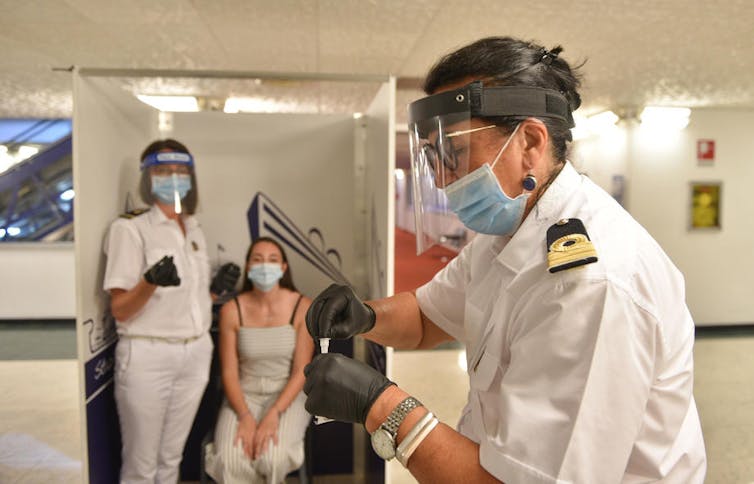
Swab test before boarding.

Rapid COVID-19 testing is emerging as a likely strategy, as lines look to tweak health and safety protocols in order to resume sailings.
Speaking to investors on its second-quarter earnings call, Royal Caribbean president and CEO Michael Bayley stated that rapid testing for COVID-19 is something the line is seriously considering for its brands, which include Azamara, Celebrity, Royal Caribbean, and ultra-luxury line Silversea.
"Particularly as it relates to the Caribbean…testing is very much at the front of how people are thinking of protocols for returning," Bayley said.
A number of Caribbean nations already require travellers to obtain COVID-19 negative testing -- either rapid, molecular or PCR -- prior to arrival; measures that will make rapid testing almost a necessity for cruising to resume in the region. This includes countries like Barbados, Turks & Caicos, and Dominica.
Also included are overseas territories like the U.S. Virgin Islands, which  of a COVID-negative test for visitors residing in states that have higher than 10 per cent positivity rate 
according to data supplied
 by Johns Hopkins University. As of this writing, that includes the states of Alabama, Arizona, Arkansas, Florida, Georgia, Idaho, Kansas, Mississippi, Missouri, Nevada, South Carolina Texas, and Washington.

Rapid Testing " Would Make a Huge Difference"
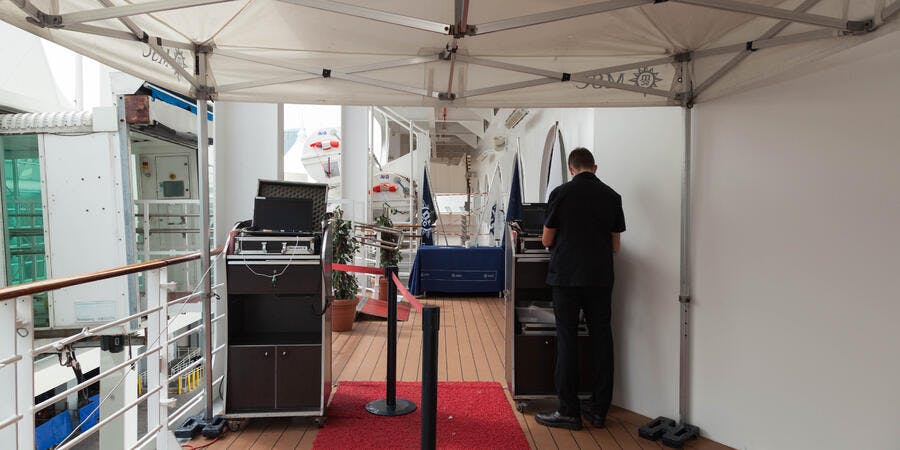
Boarding Area on MSC (Photo: Cruise Critic)

Other cruise lines also see rapid COVID testing as a way for the cruise industry to move forward.
In announcing its recent limited restart of cruising in the Mediterranean for Schengen Zone (European Union) residents, MSC Cruises stated that COVID-19 testing will be a mandatory part of the embarkation process. Under the new protocols, passengers will be given a temperature check, a health questionnaire and a COVID-19 swab test at embarkation.
Passengers who test positive from either the swab test or who or display symptoms will be denied boarding.
Rapid testing could have prevented the situation that UnCruise Adventures found itself in, as the small ship line attempted to restart cruising in Alaska.
In that instance, a passenger who initially tested negative for COVID-19 72 hours prior ended up testing positive when tested at Juneau Airport. Those results took two days to come back, by which time the passenger was already on board and at sea. The ship was forced to turn around, with other passengers quarantined.
On August 13, UnCruise revealed that there was no spread of COVID-19 aboard Wilderness Adventurer, with the passenger in question subsequently testing negative for the virus.
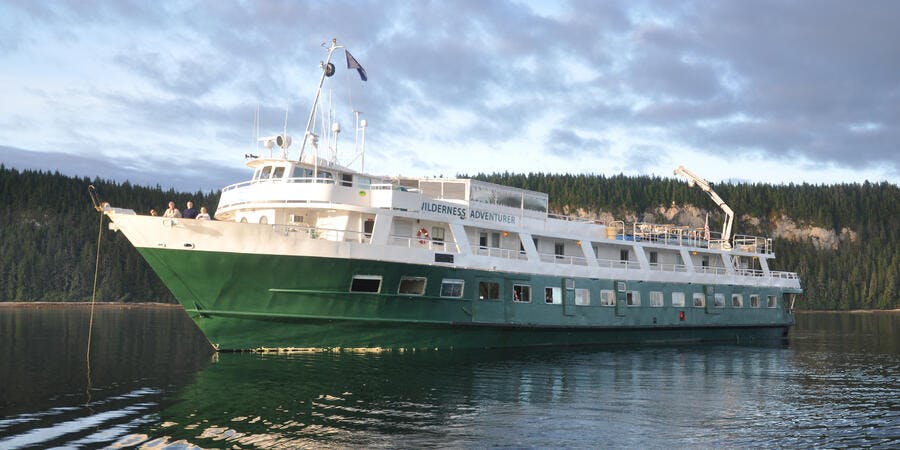
Wilderness Adventurer

"We know that rapid testing is out there but it's not typically available for companies of our size," UnCruise president and CEO Dan Blanchard media on a call during the afternoon of August 13. "I'm told the test kits are available, but the analyzers are not. It's probably not too long before rapid testing is widely available, but of course, it has to be effective rapid testing."
While noting that no test for COVID-19 is currently one hundred per cent accurate, Blanchard says the high degree of reliability of most rapid tests, combined with the relatively low wait time is crucial to restarting tourism and the economy and helping to slow the spread of the virus.
"Rapid testing, in my mind, would make a huge difference," he added. "If we'd had a rapid tester at the Juneau airport and it had a four-hour return on it, that would make the difference between boarding that guest and not boarding that guest."
For his part, Blanchard is adamant that the positive diagnosis obtained in Juneau for the passenger in question has to be taken seriously, regardless of the subsequent negative test.
"What we're going forward with, as far as the rumour mill goes, we are letting that false-positive sit to the side because we believe we have to follow science and not public opinion," he said. Blanchard noted that once news of the infection broke, "It just killed us."
Earlier at the start of the global health crisis, Blanchard's UnCruise and a handful of other local U.S. operators formed a coalition to advocate for the cruise industry within the United States. Blanchard says that focus is now directed at pressing government officials for better access to rapid testing equipment.

"We are in constant contact with our Senators in Alaska and congresspeople with Alaska and Washington, so they are aware of the situation," said Blanchard.  "They are aware of the need for a nationwide rapid-testing program."

What Is Rapid COVID-19 Testing?
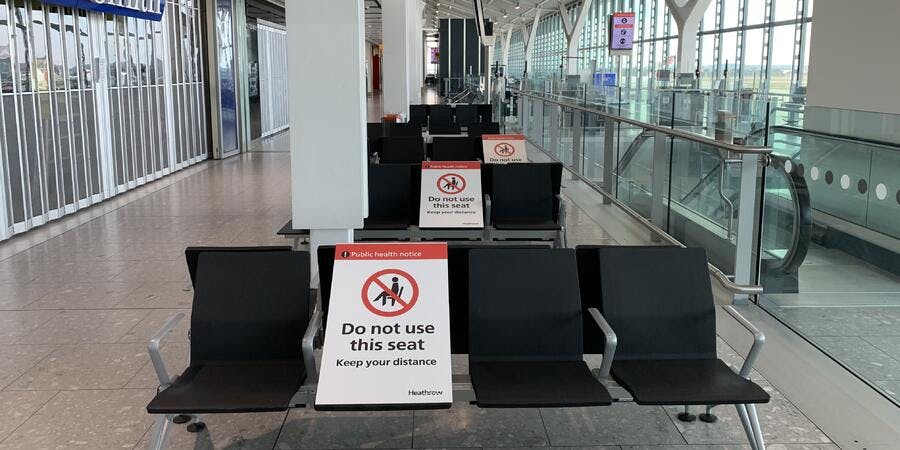
Public Health Notice in London's Heathrow Airport (Photo: Adam Coulter/Cruise Critic)

While rare at first (and still hard to get in some areas), COVID-19 testing is slowly becoming a fact of life in specific instances in the United States and around the world.
In the United States, some medical procedures require a COVID-19 test, while students returning to college are often being required to submit to frequent tests as a pre-requisite before living in dorms. Some essential workers, too, have taken regular COVID-19 tests throughout the pandemic, while some states with low virus rates, such as Massachusetts and Maine, require negative tests for entry.
But many of those tests still have lagging return times.
"There's clearly a need for more good-quality molecular testing, especially rapid handheld diagnostics," Sergio Carmona, chief access officer with Geneva's Foundation for Innovative New Diagnostics (FIND), 
told Chemical and Engineering News
 this month.
The definition of a rapid point-of-care test, according to World Health Organization (WHO) guidelines issued on August 5, mandates that results should be delivered in under 40 minutes and must have a true negative rate of at least 97 per cent. A test should cost less than $20, and machines should be priced at under $3,000.
Several companies have already developed rapid testing machines with these exact specifications. San Diego-based Mesa Biotech's Accula system provides test results in roughly half an hour, and the device only costs a few hundred dollars, with cartridges priced around $20. Nearly 2,000 of the devices are currently in use, with more on the way.
Because these are point-of-care tests, results are delivered on-location, with no need to send testing away to local laboratories.
There are numerous other manufacturers around the world that have either developed or are developing rapid testing devices. The implications of these reach far beyond cruising's sphere; a mining company in Canada recently announced it would begin utilizing the devices to test workers, while the 
UK government has revealed
 it will roll out rapid COVID-19 testing throughout hospitals, care homes and labs beginning this month.  

The devices selected by the UK can also detect other winter viruses like the flu and respiratory syncytial virus (RSV), and do not require a trained health professional to operate them.
As these rapid point-of-care tests increase in availability, the likelihood of them being used in airports, cruise ports, and other travel-related industries increases dramatically.

Cruise Critic Members Supportive
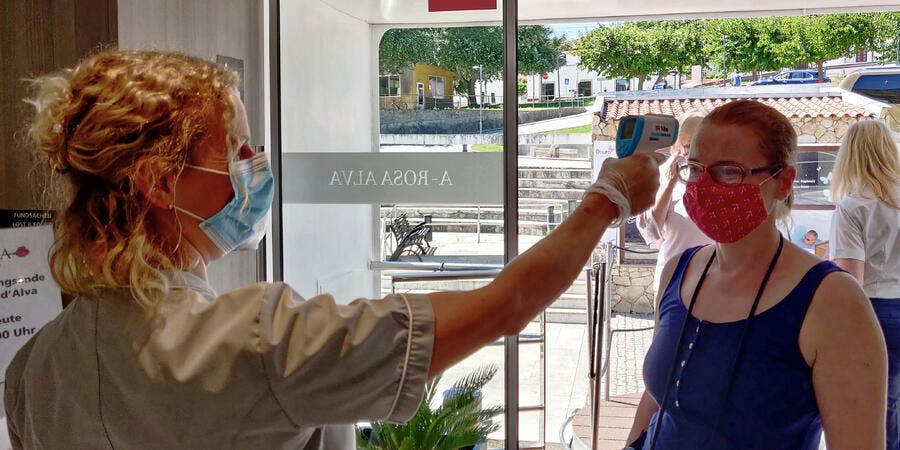
Temperature check on A-ROSA Alva (Photo: Franz Neumeier)

Cruise Critic members are overwhelmingly supportive of rapid-COVID 19 testings as a condition of embarkation.
In an informal poll started by member molly361 on the Royal Caribbean board, 84.4 per cent of the 141 respondents stated they would support taking a rapid COVID-19 test in order to cruise. A total of 10.64 per cent of respondents said they would not concede to a test, while 4.96 per cent were undecided.
"I really had not thought about COVID testing," writes molly361. " I was hung up on not wanting to wear a mask on vacation."
"Why would anyone object to a COVID test," writes compman9. "What possible harm can a check if you have a deadly disease be objectionable?"
"No problem taking a test, but I think other steps would also be necessary since the test is only one part of the story," writes yogimax.

Rapid Testing Not Set In Stone
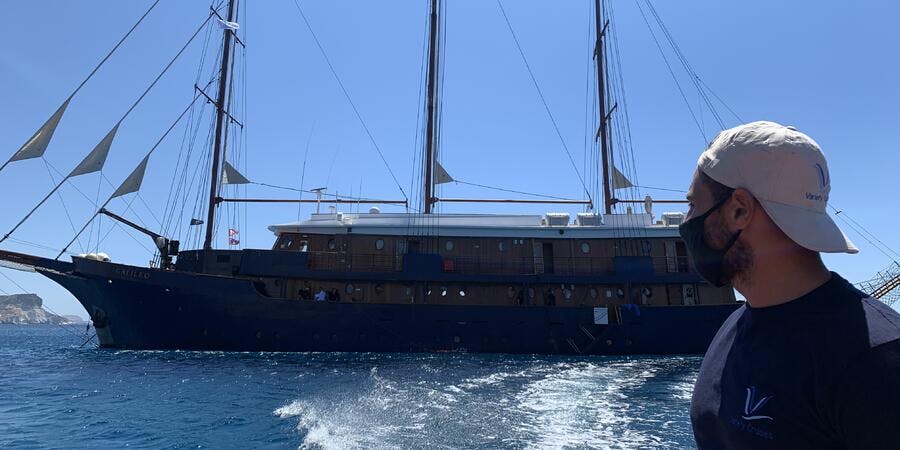
Variety Cruises' Galileo in Greece (Photo: Adam Coulter/Cruise Critic)

Royal Caribbean's Bayley was quick to note that firm health and safety protocols requiring the use of rapid COVID-19 testing as a condition of sailing have not yet been set in stone but again reiterated that for certain destinations its usage would make sense.
"Testing is part of the thinking, but we have not yet reached a point in our protocols where we're ready to publish and release for discussion," concluded Bayley. "Discussions are underway. We have a degree of confidence in the Healthy Sail panel that we've formed and all of our protocols are under review with the panel."
If implemented, rapid COVID-19 tests would still be used in conjunction with other health and safety measures, like masks and social distancing. Royal Caribbean Chairman and CEO Richard Fain have previously stated that masks will most likely play a role in cruising's immediate return to service.
"One of the things the CDC (U.S. Centers for Disease Control and Prevention) has emphasized is the simple solution of people wearing masks would make a huge difference," Fain said during a coffee chat for travel advisors with Vicki Freed, senior vice president of Sales, Trade Support and Service, on July 15. " It's remarkable how effective it (masks) can be. And it's very simple. I now have to add, 'Wear the Mask.'"


Saturday, 1 August 2020

Royal Caribbean Drops ‘Cruise Line’ from Group Name

Royal Caribbean Drops ‘Cruise Line’ from Group Name

Independence of the Seas in Southampton photo credit Dave Jones.

Royal Caribbean Cruises Ltd, the world’s second-largest cruise line operator, will now go by the new moniker: Royal Caribbean Group.

With the new name comes a new identity, as well. The company’s logo has also been updated with the iconic crown and anchor emblem being sharpened and made more symmetrical. The crown will officially now reside inside a circle at all times.
Royal Caribbean Group sets sail with updated corporate identity
“The name is simpler, fresher and more modern. It’s also more descriptive—Royal Caribbean Group sounds like a parent company name, reflective of our growth and evolution since we last updated our identity more than 20 years ago,” said Royal Caribbean Group chairman and CEO Richard Fain.

Royal Caribbean Group’s flagship cruise line brands still include Royal Caribbean International, Celebrity Cruises, Silversea, Azamara, TUI Cruises and Hapag-Lloyd Cruises. Together, the brands operate 63 ships with an additional 16 on order as of July 10, 2020.
The new branding comes as the Royal Caribbean Group (NYSE: RCL) has suspended all sailings through September due to the COVID-19 pandemic. The voluntary suspension is in-line with the U.S. CDC required suspension for cruise lines operating out of the United States.


Friday, 17 July 2020

Royal Caribbean Group extends cruise suspension

Royal Caribbean Group extends cruise suspension

Independence of the Seas in Southampton


Royal Caribbean Group has extended the suspension of its cruise operation in line with the US Centers for Disease Control’s

Cruise lines under the Royal Caribbean Group banner, including Royal Caribbean International, Celerity Cruises, Azamara and Silversea, will not sail before October.

Agents will be contacted about cruises their customers are booked on.

The move follow’s the US Centers for Disease Control’s No Cruise Order, essentially banning cruising up to July 24 to September 30.

Members of Cruise Lines International Association (Clia) had already voluntarily suspended cruises up to September 15.

A Royal Caribbean Group spokesperson said: “The health and safety of our guests, crew and the communities we visit is our top priority. As we work with the CDC and others toward this shared goal, Royal Caribbean Group will be extending the suspension of sailings to include those departing on or before September 30, 2020.

“We will be reaching out to our guests and travel partners to share further details and address any questions or concerns they may have.”