Showing posts with label Titanic. Show all posts

Wednesday, 13 April 2022

P&O and Cunard to Drydock at Harland & Wolff

P&O and Cunard to Drydock at Harland & Wolff


Harland & Wolff has been awarded a drydock contract for two cruise ships from P&O Cruises and Cunard.

The two Carnival Corporation ships will drydock for a total of 33 days as the Aurora and Queen Victoria will both visit the Belfast facility.

They are two of a projected 24 Carnival Corporation ships to drydock in the second quarter.

The work due to being undertaken on both ships are standard drydocking operations that will give Harland & Wolff the opportunity to demonstrate to the wider cruise industry, its skills, capabilities and expertise in these types of projects, the company said, in a press release

Queen Victoria will drydock from May 2 to 19 and will be the largest cruise ship ever to have drydocked in a UK shipyard and the only Cunard ship to have ever drydocked in Belfast.

The Aurora will visit from June 9 to 23.

Harland & Wolff, group CEO John Wood, commented: “When acquiring the assets of Harland and Wolff (Belfast) in December 2019 and in a pre-pandemic period, the cruise industry was one of our key target markets.

“Our facilities are ideally placed to capitalize on these types of large projects whilst we continue servicing our smaller but regular clients. We have now secured contracts in four out of our five markets; commercial, cruise & ferry, renewables and energy – we now look forward to completing the final milestone of securing a defence contract in the near future.”

Carnival UK, vice-president maritime David Varty said: “We are delighted to be able to have these two ships at a UK shipyard with such a long heritage and reputation and we very much look forward to supporting the UK maritime industry and working closely with the Harland & Wolff team on this project.”


Monday, 6 July 2020

Cruise Ship Repairs Start at Harland & Wolff; Yard Eyes New builds

Cruise Ship Repairs Start at Harland & Wolff; Yard Eyes New builds

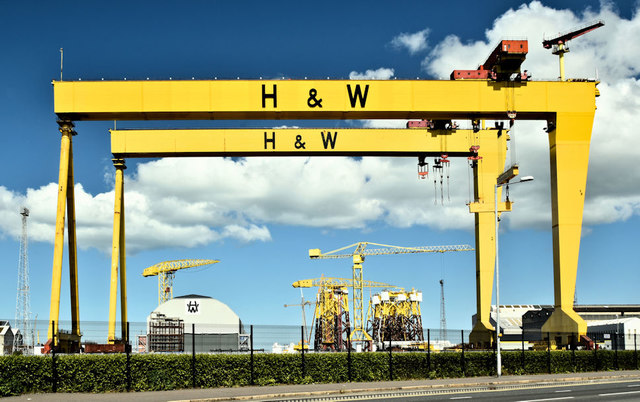
Harland & Wolff cranes, Belfast (May... © Albert Bridge cc-by-sa ...
Two massive cranes at the Harland and Wolff dockyard.
Harland & Wolff is surging back onto the cruise ship repair scene as the ship repair facility is hosting a trio of Viking ships, the Sky, Sun and Sea, in Belfast
Since acquiring Harland and Wolff in December 2019, the new Harland & Wolff team has been quick to realize their strategic ambitions to enter the cruise sector, according to a statement from the shipyard.
Strict protocols were put in place to ensure compliance with all public health guidelines, some of which will be maintained for the foreseeable future as a precautionary measure. While undertaking dockings during the COVID-19 lockdown and with OEM’s unable to travel the yard, teams have made extensive use of video conferencing, enabling OEMs to be virtually involved during maintenance activities onboard the vessels, according to the shipyard.
The yard said the cruise Industry is under financial strain during the pause in operations and has worked with its financial partners to put in place several extended credit term schemes, allowing owners to fully capitalize on periods where vessels are out of service and have works undertaken during this out-of-service period.
Viking Ships at Harland & Wolff
Viking Sky and Viking Sea docking in Belfast.
In addition, yard executives said they not only want to target drydock and repair projects but return to building ships, most likely starting with small expedition-type vessels. 
John Wood Group CEO of Harland & Wolff said: “We are delighted to welcome Viking Sky, Sun and Sea to our facilities in Belfast, this is the first time we have had three cruise vessels docked in Harland & Wolff for many decades. Harland & Wolff was once a market leader in this sector and this is a title we are keen to hold again. On the doorstep of the Mediterranean, the UK is in a prime location for refits, conversions and revitalizations. With our vast facilities set in 85 acres, we can handle several large cruise ships concurrently, as demonstrated by the arrival of three vessels from Viking for minor repairs and upgrade works. With two of the largest docks in Europe and the only yard in the UK that can accept the majority of the works cruise ships demand, we look forward to increasing our presence within the cruise sector as we move forward.
"In order to future-proof our yard we are currently scenario-planning to ensure we can welcome all future cruise vessels as they continue the trend of increasing in size," Wood said ."The cruise sector will be a key cornerstone of our business going forward. With 70% of shipyards closed during the global pandemic, we are now seeing the implications of this as we start to emerge from the crisis, we have witnessed a substantial increase in inquires from the cruise sector with numerous live inquires at this time. It is possible that owners will face delays as they try to get vessels back into service as the industry ramps up again, global availability of drydocks essential to returning vessels into service where they have slipped out of class will be fully occupied not just with cruise vessels but overall sectors that have had dockings cancelled”

Wednesday, 7 September 2016

The Titanic sails again:

The Titanic sails again: Inside the lavish £300million replica of doomed ocean liner, which is due to set sail in 2018

Image result for New Titanic

  • Planned by Blue Star Line, the Titanic II will stick to the incredible detail of the original ship which sank in 1912
  • Titanic II's launch has been pushed back to 2018, with a maiden voyage planned from Jiangsu, China, to Dubai
  • Amenities include a small swimming pool, Turkish baths, a gym with Edwardian equipment and a squash court

If this replica of the RMS Titanic ever sets sail, it will look eerily similar to the ill-fated ocean liner that remains the most famous ship of all time.

These captivating side-by-side images show how the planned Titanic II will stick to the incredible detail of the original ship that sank in the Atlantic Ocean more than 100 years ago.

Even though today’s massive cruise ships have on-board amenities such as robot bartenders and giant slides, the Titanic replica will be toned down in comparison and stay true to its namesake with a small swimming pool, Turkish baths and an Edwardian gym.


The grand staircase, recreated in this rendering, remains one of the most famous features of the original ship, which set sail in April 1912

The grand staircase, recreated in this rendering, remains one of the most famous features of the original ship, which set sail in April 1912

The grand staircase on White Star Line ships, including the Titanic and Olympic, was reserved for first class passengers only

The first class smoking room was a private space for male passengers
This rendering shows the smoking room
The first class smoking room was a private space for male passengers and was meant to resemble gentlemen's clubs in London
Café Parisien, one of the original Titanic's dining options for wealthier passengers, will be recreated on the replica ship 

Café Parisien, one of the original Titanic's dining options for wealthier passengers, will be recreated on the replica ship 

Café Parisien, for first class passengers, was designed to have the appearance and feel of a sidewalk cafe in the French capital

Café Parisien, for first class passengers, was designed to have the appearance and feel of a sidewalk cafe in the French capital

Titanic's 6ft deep pool was filled with salt water
The replica's pool will stay true to that on board the original

Titanic's 6ft deep pool (left) was filled with salt water after the ship had set sail from Southampton en route to New York

The original Titanic was the largest ship in the world when it set sail on its ill-fated maiden voyage from Southampton to New York in 1912


Friday, 19 August 2016

History: SS Eastland, The Ship That SOLAS Sunk

History: SS Eastland, The Ship That SOLAS Sunk

S.S._Eastland_c.1911
The S.S. Eastland, the namesake of the “Eastland phenomena”: when well-intentioned efforts to enhance safety levels have unintentionally reduced safety levels.
What is the “Eastland Phenomena”?
by Dave Lochbaum (AllThingsNuclearThe sinking of the Titanic on her maiden voyage has been immortalized in countless books, articles, movies, and documentaries. Billions of people across the globe know about the luxury liner’s collision with an iceberg in the north Atlantic on April 14, 1912, on her way to New York City with the ensuing loss of 829 passengers and 694 crew members. The ship’s band playing while passengers gathered on deck to board lifeboats and the radio operator staying on duty tapping out SOS distress messages are legends. While the Titanic’s tragic encounter with an iceberg is widely known, her second sinking is virtually unknown.
A Man and His Ship: America's Greatest Naval Architect and His Quest to Build the S.S. United States
Related BookA Man and His Ship: America’s Greatest Naval Architect and His Quest to Build the S.S. United States
Shortly after 7:00 am on the morning of Saturday, July 24, 1915, the gang planks on the steamship Eastland (Figure 2) were taken in after 2,501 passengers had boarded in Chicago for a day’s excursion across Lake Michgan to St. Joseph. With the Eastland still tied to the wharf on the south side of the Chicago River between LaSalle and Clark streets, she capsized. A total of 841 passengers—more than died when the Titanic sank in mid-ocean—and 3 crew members perished. Twenty-two entire families perished.

The Eastland can be considered the Titanic’s second sinking because had the Titanic not sunk, the Eastland very likely would not have capsized. Additional lifeboats, rafts, and davits installed to comply with the new Safety Of Life At Sea (SOLAS) laws in response to the Titanic disaster caused the Eastland to become more susceptible to capsizing. The added weight to the steamship’s upper decks reduced her ability to right herself in response to a list, or lean, to one side or the other.
On the morning of the disaster, the Eastland listed about 10 degrees towards the wharf as boarding passengers collected on that side of the steamship to communicate with friends yet to board. The crew corrected the list by admitting water to the ballast tanks on the steamship’s other side. As more passengers boarded, their more uniform distribution on the steamship caused her to list about ten degrees away from the wharf. The crew attempted to correct this list by reallocating water among the ballast tanks, but small-diameter piping limited how fast water could be transferred between tanks. The list increased until the Eastland rolled over onto her side. Figure 3 captured rescuers assisting survivors off the capsized vessel.
There are important lessons to be learned from both tragedies. The Titanic put to sea with more persons on board than could be accommodated in her lifeboats. If the ship sank, this shortfall meant that some would have to go down with her. To rectify that safety problem, the Eastland was retrofitted with lifeboat capacity for all persons on board. But fixing safety in one area made Eastland less safe in another.
The “Eastland phenomena” has also occurred at nuclear power plants. Well-intentioned efforts to enhance safety levels have unintentionally reduced safety levels. Two examples illustrate such outcomes. One involves the emergency core cooling systems (ECCS) for boiling water reactors (BWRs) and the other involves the ECCS for pressurized water reactors (PWRs)

Monday, 25 February 2013

Titanic II's shipyard prepares for construction


Titanic II's shipyard prepares for construction

Titanic II's shipyard prepares for construction
A life-size replica of the Titanic has moved a step closer to construction after the Chinese shipyard chosen to build the vessel revealed it has begun upgrading its facilities to prepare for the work.
Titanic II is due to be built at CSC Jinling Shipyard Company in Nanjing, China, using the same dimensions as the doomed Belfast-built original vessel, and is being funded by Australian mining magnate Clive Palmer.
The 2,400-passengers vessel will take three years to build, measuring 270 metres long, weighing 40,000 tonnes, and will have 840 cabins, as well as Turkish baths and a swimming pool.
The outside of the vessel will be an exact replica of the original, and passengers will be able to buy first, second and third class tickets, in keeping with the system at the time.
However, not everything will be built to match the original, as engineers will use the latest technology in parts of the ship such as the engine.
Titanic II is expected to make its maiden voyage from Southampton to New York in 2016 along the same route that the original ship sailed.
A spokesman for the shipyard, Li Wenbao, told the Sunday Times: “The liner will be equipped with advanced technologies including the latest life-saving and communications systems, to meet the requirements of modern navigation.”