Showing posts with label electric motors. Show all posts

Thursday, 7 May 2020

‘Future-proofed’ ferries ready to go electric

‘Future-proofed’ ferries ready to go electric

The hybrid-electric, Island-class ferries will be converted to full electric once shore power is available
BC Ferries’ new hybrid-electric class is ready to be converted to fully electric propulsion

Damen Shipyards Group is building all six of BC Ferries’ new Island-class vessels at its Galati shipyard in Romania. The vessels are designed to carry 47 vehicles and up to 450 passengers and crew and will be capable of full-electric propulsion from new.
Two of the ferries were delivered in February 2020: Island Discovery and Island Aurora and are part of BC Ferries’ fleet renewal programme. These will replace 62-year-old North Island Princess and 51-year-old Quadra Queen II. In November, Damen announced it had secured a repeat order from BC Ferries for four additional Island-class ferries.
Discussing the transition from hybrid electric to full electric and the impact of this on the design and construction of the ferries, Damen product director ferries Henk Grunstra says: “When BC Ferries first started looking at using LNG for fuel, it was looking at adding the new Island-class ships to its fleet. It thought LNG for smaller ships was not the most attractive solution, so investigated using hybrid electric or full electric just as the Island-class was to be built.”
He explains the Canadian ferry operator needed a long-term solution, as the vessel will be deployed for the next 40-50 years. Therefore, BC Ferries decided it wanted to run the vessels as fully electric, but needed to start with hybrid-electric power as shore charging facilities are not currently available in the areas the vessels sail.
Mr Grunstra adds: “By starting with hybrid electric, BC Ferries can make the move later relatively easily. The hybrid technology is not a goal, but the first step to making vessels full electric.
“Electric sailing in British Columbia is very attractive as it has a lot of green energy. Therefore, BC Ferries kicked off with the battery pack and hybrid and we have made them ready for future developments so they can be converted to fully electric.”
Mr Grunstra says using hybrid technology makes the design of the vessels “a little more complicated” than full electric, as it requires building an energy power system that makes decisions about when to use batteries, when to use ultra-low sulphur fuel and when to use both. “That was a challenge,” he says “and we had to look at how BC Ferries would use the vessels in different locations. Since this is a class of vessels, the ships will sail in different locations and on different routes and one of the challenges was how to cater to different locations. The software and hardware have been arranged so they can be retuned for a specific operation.”
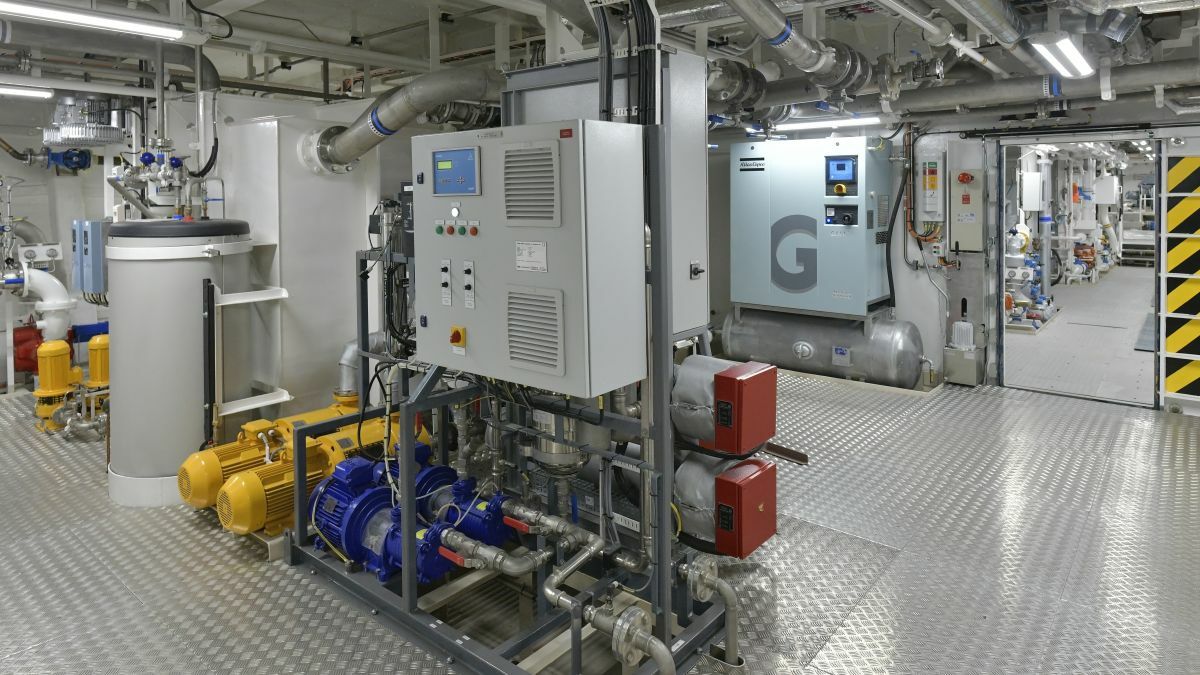
Island-class ferries have two battery rooms, each with 400 kW of batteries
Peak shaving
The hybrid-electric system will be used, among other ways, for peak shaving, to give the engines the most efficient load possible. Mr Grunstra says checking data from AIS and filtering out the way existing vessels operate was key to ensuring the engines were optimised. “These details determine the way the ship is operated. We had to start with the existing situation and see how the vessels were operating. Then we designed the hybrid solution for optimised operation.”
Over the next several months, the crew will be trained to sail the optimised system and the system may require fine-tuning.
The Island-class ferries have two battery rooms, each with 400 kW of batteries. There is room for these locations to be extended to each house 1,000 kW of batteries once the vessels are converted to fully electric.
Mr Grunstra says: “The electric systems in the ferries can cope with bigger batteries and they have been sized to do this; this means there is space in the switchboards. The only uncertainty is how the vessels will be charged – how the vessel connects to the existing infrastructure needs to be decided. But there are so many options this is not seen as an issue.”
Currently, within the hybrid-electric system, the engines charge the batteries. “We aimed for the engines to run at their most optimised setting,” he says. “The goal to make them fully electric means the energy savings will be much bigger than now.”
The Orca Energy batteries have been provided by Corvus, whose chief commercial officer Halvard Hauso explains: “These batteries are 800 kW which means they are not big enough for zero-emissions operations, but they are prepared for it. We sized the battery to the operational profile before shore power was installed. Once shore power is available, they will have room to expand the battery installation, by adding more to the same system. A hybrid ferry reduces costs and emissions by reducing fuel and at the same time reduces the need for maintenance as the engines are running fewer hours and at optimal loads. When they go full electric, they will save even more maintenance and emissions.”
Another strength of the Island-class ferries is the greatly reduced noise and vibration levels they offer.
Mr Grunstra says: “They are diesel-electric, which reduces noise and vibration and ensures the vessels are very quiet. The propellers are sized generously, so there is not a lot of load on the propulsion system, resulting in a very quiet ship. You can isolate the sources of noise easily on these ships and the electric-driven thrusters also reduce load noise. The propellers have a moderate load, which makes it easier to reduce vibration.”
Damen is also building two road ferries for Ontario that have a similar platform to the BC Ferries’ Island-class, but which will have shore charging included from the start. “They have bigger batteries and are charged at the shore after each run,” Mr Grunstra says. “They will run as full-electric all the time unless there are exceptional conditions.”

Henk Grunstra (Damen):“The hybrid technology is not a goal, but the first step to make vessels fully electric"
Henk Grunstra (Damen): “The hybrid technology is not a goal, but the first step to make vessels fully electric"
Snapshot CV
Damen Shipyards product director ferries Henk Grunstra has a long track record at Damen, starting in 1985 in the engineering department, later being responsible for high-speed and naval craft, luxury yachts and currently ferries

Wednesday, 11 May 2016

The Cruise Ship Engine

The Cruise Ship Engine

Without a source of power, these huge cruise vessels would be nothing more than drifting aimlessly hotels. A large number of older ships use diesel reciprocating engines for generating power for propulsion. Cruise ship engine power is supplied through transmission to the propeller shafts. These transmissions determine the revolutions of propellers. Modern ships use either diesel electric engines or gas turbines as a source of power for propulsion, and for ship's systems. Some of the larger ships depend on two power sources - one for electrical power and one for propulsion.
Gas turbine engines, as being aeroderivative, generate heat which is transformed from mechanical energy in electrical power. Compressed air is fired in combustion chamber, to achieve this. Hot exhaust is made over a turbine which spins to drive mechanically a shaft. The power can be used to spin the electrical generators. The same way do diesel-electric engines work, yet they use not a turbine. The output shafts, to produce electrical power, are connected to the electrical generators.
Both engine types need a lot of fuel. Cunard QE2, for example, consumes daily 380 tons of fuel when she's traveling at 28.5 knots speed and carries fuel enough to sail for 12 days. Usually ships fill up at various ports, and use fueling barges as floating gas stations. Vessels use lower-grade diesel which tends not to burn as purely as diesel-powered road-going vehicles.
All ships rely on the propellers to be pushed through water. These, referred to commonly as screws, provide forward and reverse motion. Airplanes, for example, require tremendous speeds of propellers to provide forward motion for flight, but ship propellers don't need to turn so fast and rely on torque power. Therefore, they travel slowly, and rarely top 30 knots (for more info follow our speed-link above).

Cruise ship engine room

The basic detail about the cruise ship engine room is its location. Ships' heaviest weights have to be situated at the lowest possible place because of stability, and usually engines are mounted above the keel. Ship's lowest decks are almost entirely full of machinery. An area creating enough power for driving such an enormous vessel through water needs to be really big - very often engine rooms occupy at least three decks. But rather than long halls stretching length of hulls, machinery is almost always divided into smaller compartments - one might house main engines, and another might contain air-conditioning system. This compartmentalization is for safety reasons. If a penetration to the hull or fire happens, multiple compartments help contain the damage. See at the right the Allure of the Seas cruise ship engine room:
Rarely, engines are not placed at the bottom of ship - four main diesel engines on RMS Queen Mary 2, are placed above the keel, and two smaller gas turbines are on top, aft of funnel.
An interesting fact is that it was not unusual for older liners to feature two engine rooms. Gradually, technology allowed consolidation of engine spaces. However, legislation today requires vessels to have equipment duplication and two engine rooms.

Conventional diesel cruise ship engine

Today's direct-drive diesels feature one main advantage - the option to use shaft generator, which is a device using the circular motion of propeller shaft in order to generate electricity needed for hotel services, like cooking and lighting. Shaft generators can be used only while the ship is moving with fairly constant cruising speed. This is what the NCL Epic cruise ship engine looks like:

Diesel electric cruise ship engine

Almost all new ships feature a diesel-electric propulsion form. On these ships, main engines are not connected to propeller shafts, and instead of it they are directly connected to big generators in order to produce electricity, which is sent in turn to electric motors, that then power and help turn the propellers. Main advantage of the diesel-electric cruise ship engine systems is efficiency as they allow main engines to operate near the most efficient speed, no matter if the ship is moving at 5 or 25 knots.
Losing electrical power is devastating to ships. Main engines and generators require electricity and it's needed to keep them going. Pumps that are driven electrically take in cold water from ocean to cool the engines, and electrical pumps get fuel from fuel tanks and supply it to the engine. Electrical power is vital for many operational functions - without it, ships come to a halt.
Large equipment (propulsion motor, bow thrusters) requires electricity of high voltage. As for smaller machinery (cabin lights, galley equipment), the electricity goes through transformer and is thus stepped down into lower voltage. Large cables snake through all the ship to distribute electrical power. They carry power from generators to switchboards, through passageways, public rooms, crew and passenger cabins. Cabling can be the weak point in the distribution system. If the electrical cables aren't truly redundant, even ships that feature two engine rooms suffer power failure.
While ships are docked, generators and main engines produce more power than needed. They are turned off in port, and smaller generators supply "hotel" load (lights, air-conditioning, galley, etc.). Moving through water takes up vast majority of ship's power needs - about 85% of diesel-electric plant produced power goes to propeller, and the rest towards keeping lights on and crew and passengers comfortable. At the right is the Royal Caribbean's major rival's latest cruise ship power technology: the new Vista Carnival cruise ship engine room (engine type is "MAN 2 × 14V48/60CR", common-rail diesel injection system):